
10 Creative Custom T-Shirt Ideas for Events and Teams
Most custom t-shirt orders fail before they even reach the printer. The design is generic, the message is forgettable, and three weeks after the event, every shirt ends up at the bottom of a drawer. Custom t-shirt ideas that actually work share one thing in common: they are built around a specific audience, a specific moment, and a specific purpose. Whether you are running a team of ten tradespeople or organising a charity 5K with 300 participants, the decisions you make before placing the order determine whether your apparel builds brand recognition or becomes landfill. This guide covers ten proven ideas, grounded in what works in practice.
Table of Contents
- Quick Takeaways
- Idea 1: Colour-Coded Team Roles
- Idea 2: Event Milestone Shirts
- Idea 3: Branded Workwear Bundles
- Idea 4: Limited-Edition Promotional Drops
- Idea 5: Charity and Fundraising Apparel
- Idea 6: Sports Team and Tournament Shirts
- Idea 7: Corporate Away Day and Team-Building Shirts
- Idea 8: Hen and Stag Do Custom Apparel
- Idea 9: School and University Leavers Shirts
- Idea 10: Customer-Facing Promotional Merchandise
- Comparing Printing Approaches for Custom T-Shirts
- Frequently Asked Questions
- References
Quick Takeaways
| Key Insight | Explanation |
|---|---|
| Design for longevity, not just the occasion | Shirts worn after the event extend your brand reach for months. Avoid date-heavy graphics that make the garment feel expired. |
| DTF printing handles complex artwork far better than vinyl | Direct to Film technology reproduces photographic detail, gradients, and fine lines without cracking or peeling over time. |
| Colour-coding by role is practical, not just decorative | At large events, staff wearing distinct colours are easier for attendees to locate. This is a functional design decision with real operational value. |
| Bundle pricing cuts cost per unit significantly | Ordering t-shirts alongside hoodies or polos in a workwear bundle reduces unit cost and ensures consistent branding across garments. |
| Premium fabric quality directly affects perceived brand value | A thin 150gsm shirt undercuts even the best design. Garments in the 200-220gsm range hold shape and communicate professionalism. |
| Free shipping thresholds change order economics | With free shipping on orders over £45 at Psyque, adding one or two extra units to hit that threshold is almost always worth it. |
| Short turnaround is only reliable if artwork is submitted correctly | Fast UK dispatch means nothing if your file is low-resolution. Prepare print-ready files at 300 DPI minimum before contacting any printer. |
Idea 1: Colour-Coded Team Roles
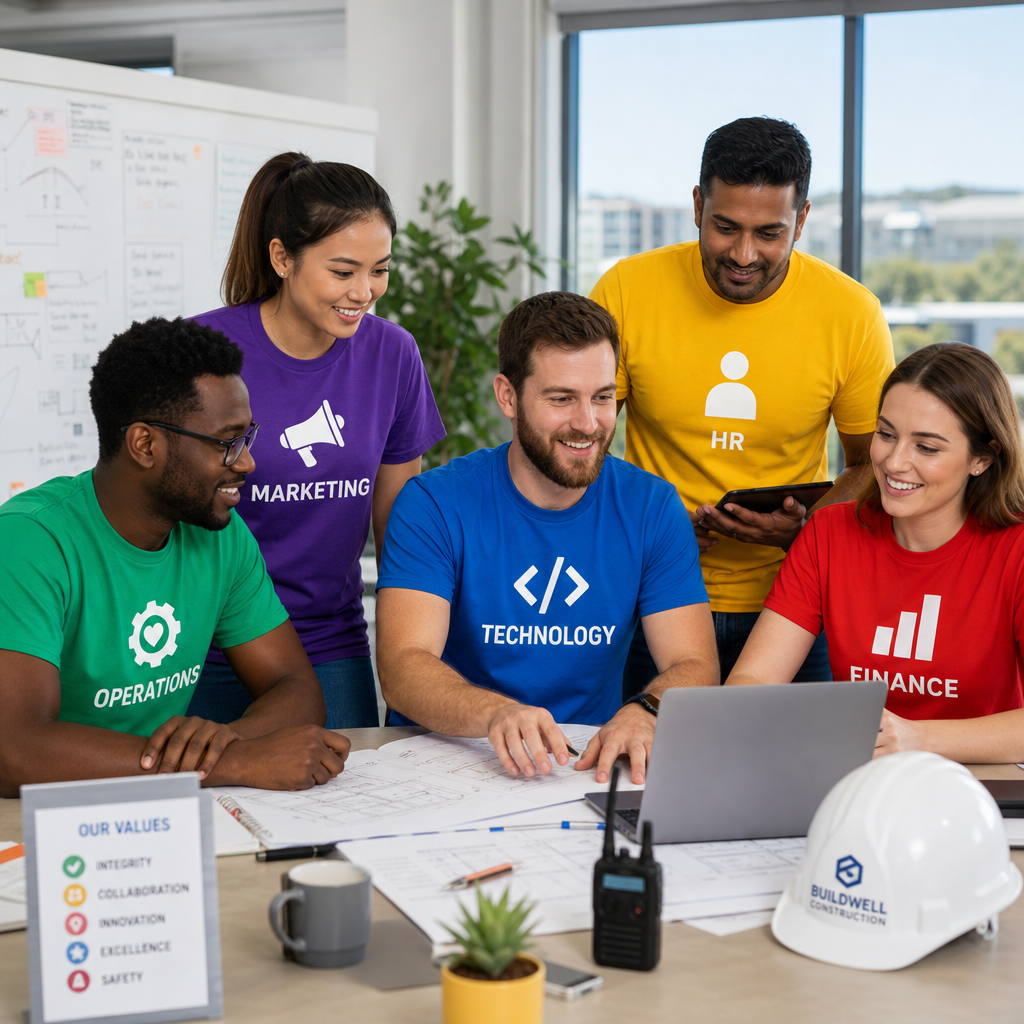
The simplest and most underused custom t-shirt idea for large events is colour-coding by function. Give your security team black shirts, your volunteers green, and your first-aid staff red. This is not about aesthetics. It is about operational clarity at scale.
In practice, event organisers who implement role-based colour schemes report significantly fewer "who do I ask about X" bottlenecks during busy periods. The shirt does the job of a lanyard, a badge, and a staff directory simultaneously.
The design itself can be identical across all colours. Same logo placement, same font, same layout. Only the fabric colour changes. This keeps printing costs predictable and reorder processes simple for future events.
Pro tip: When ordering colour-coded shirts for event teams, keep one or two spares of each colour in a staff kit bag. Replacements for spillages or last-minute team additions save significant stress on the day.
Idea 2: Event Milestone Shirts
Milestone shirts mark a specific moment in time: a company's 10th anniversary, a festival's 25th year, a charity run's 500th participant. These are not promotional merchandise in the traditional sense. They are commemorative items people actively want to keep.
The data consistently shows that people retain branded merchandise significantly longer when it carries an emotional or commemorative element. According to the Advertising Specialty Institute, wearable promotional items generate more impressions per unit than almost any other marketing medium, with the average branded shirt being kept for 14 months.
"Promotional products outperform digital advertising in recall rates. When someone wears a shirt from a meaningful event, they become a walking endorsement." - Advertising Specialty Institute, 2023 Global Ad Impressions Study
A common mistake is printing the specific event date so prominently that it dominates the design. After the date passes, the shirt feels outdated. Instead, use the milestone number or a thematic graphic as the focal point, and position the date as a secondary detail.
Idea 3: Branded Workwear Bundles
Small business owners consistently underestimate the brand impact of consistent staff clothing. If your team turns up to jobs in a mix of personal clothing, you are communicating inconsistency before you have said a single word to the client.
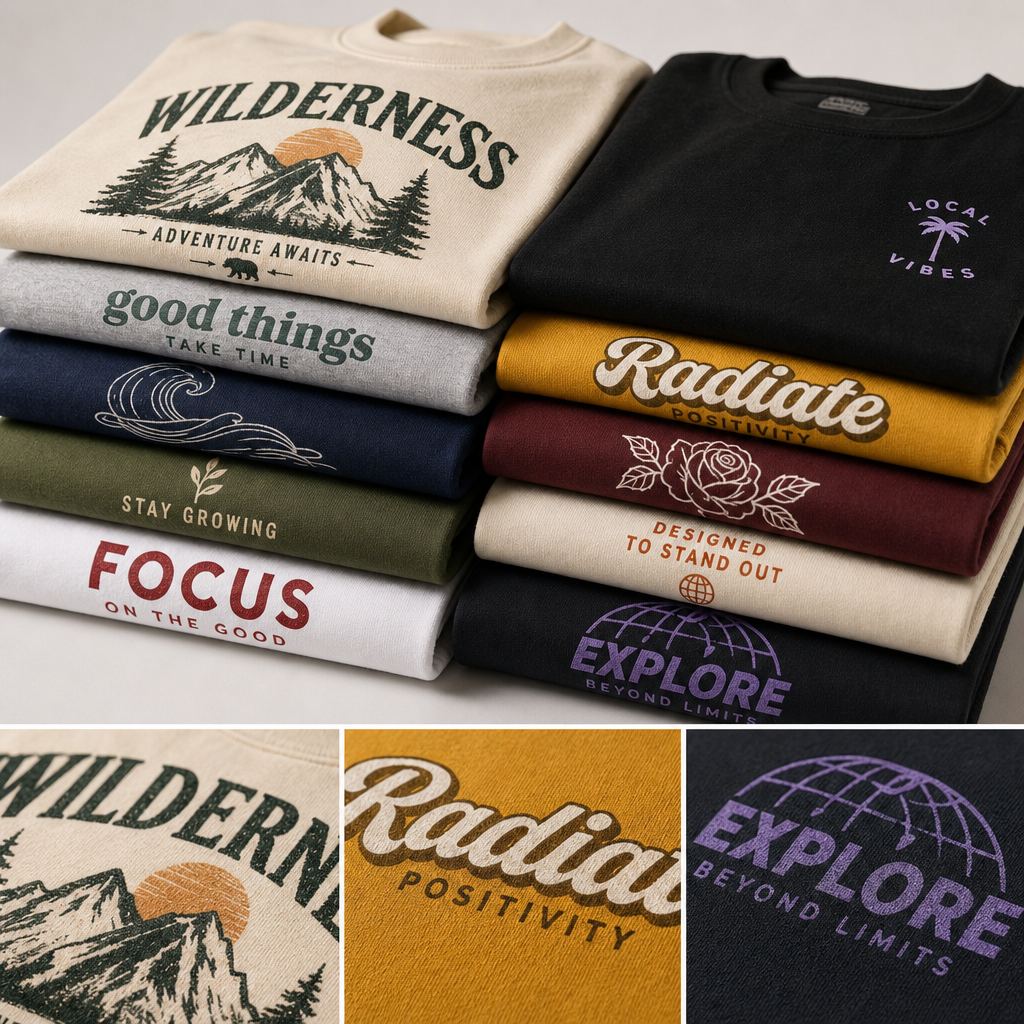
Branded workwear bundles that combine custom t-shirts with matching polos, hoodies, or sweatshirts give your business a professional appearance across all weather conditions and work environments. Psyque's workwear bundle options are built exactly for this, letting you mix garment types while keeping your branding consistent across the range.
For trades businesses specifically, the garment choice matters as much as the print. A plumber in a well-printed branded polo shirt reads as established and trustworthy. The same plumber in a plain white tee does not, regardless of the quality of their work.
Pro tip: Order workwear bundles in advance of busy season, not during it. Supply pressure on garment blanks increases significantly from October through December. Placing your order in August or September guarantees availability and faster turnaround.
Idea 4: Limited-Edition Promotional Drops
Scarcity is a more effective promotional tool than discounts for physical merchandise. A limited-edition branded t-shirt, available only during a product launch period or to the first 100 customers, creates genuine demand where a 10% off voucher does not.
This approach works particularly well for independent retailers, food businesses, and service brands building a local following. The shirt becomes a status item within your customer community. People who own it have a visible signal of their early or loyal customer status.
The key requirement is print quality. A limited-edition item with faded or cracked print after two washes destroys the perceived value immediately. DTF printing, as used by Psyque in their in-house production process, is the right choice here because the ink bonds directly to the fabric fibres rather than sitting on top of them, producing prints that maintain vibrancy through repeated washes.
Idea 5: Charity and Fundraising Apparel
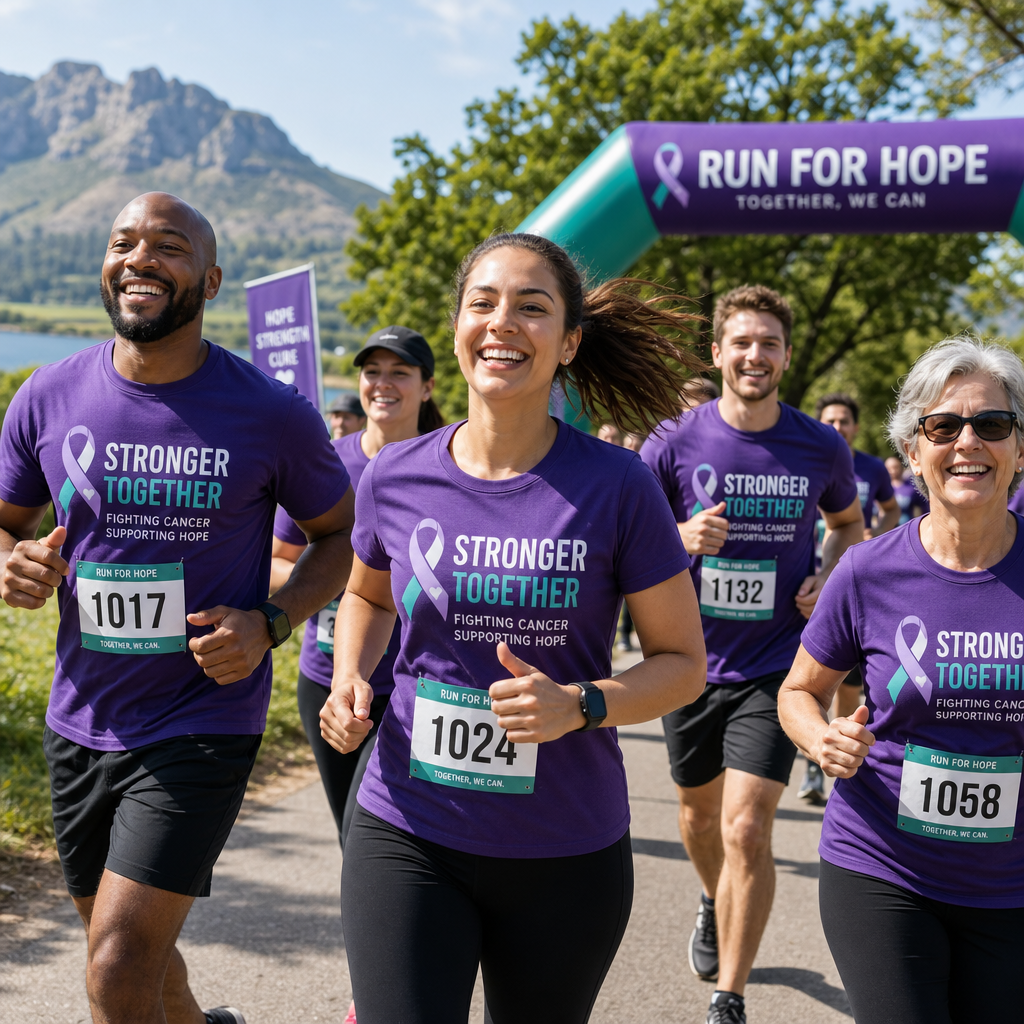
Charity event t-shirts serve a dual function: they identify participants during the event and they act as ongoing awareness tools for the cause long after the event ends. Getting the design right therefore matters more than most organisers realise at the brief stage.
The most effective charity event shirts use the cause name and a strong visual as the primary design element, with the event name and date as secondary information. This approach means the shirt remains wearable and meaningful even six months after the run, walk, or fundraiser has ended.
For fundraising scenarios, the shirt itself can be a revenue stream. Ordering at bulk pricing and selling individual shirts at a margin above unit cost is a straightforward way to add hundreds of pounds to your total fundraising target. Psyque's pricing structure at volume makes this model viable even for smaller charities ordering 50 to 100 units.
Idea 6: Sports Team and Tournament Shirts
Custom team clothing for sport is one of the highest-volume use cases for printed t-shirts in the UK. Five-a-side leagues, amateur football clubs, running clubs, CrossFit teams, and cycling groups all need consistent, durable apparel on a regular basis.
The practical requirements here differ from general event shirts. Sports garments need to survive repeated washing at higher temperatures, and the print must not crack or fade under the physical stress of regular training. This rules out low-quality vinyl transfers immediately.
Tournament shirts often include player names and numbers, which historically made custom printing expensive and slow. DTF printing handles individual name printing efficiently, making it feasible for smaller teams to get personalised tournament shirts without the cost premium that screen printing name and number combinations typically carries.
If your team competes regularly, consider ordering a small inventory buffer rather than ordering exactly the number you need. Teams change size. New members join mid-season. Having three or four extra units in the most common sizes is always worthwhile.
Idea 7: Corporate Away Day and Team-Building Shirts
Away day apparel has a specific job: it signals that everyone present is part of the same team, regardless of seniority or department. This is more psychologically significant than it sounds. Research in organisational behaviour consistently shows that shared visual identity during collaborative tasks increases participation and reduces hierarchical friction.
A common mistake is ordering away day shirts that are too obviously corporate. If the shirt looks like it belongs to the staff uniform rather than a specific shared experience, it loses its psychological function. The design should reference the event itself, not just the company brand.
Practical options include: adding the away day location or theme to the print, using a more casual garment style than standard workwear, and choosing a colour palette distinct from the everyday branded clothing. This creates a sense of occasion that purely logo-printed shirts cannot achieve.
Idea 8: Hen and Stag Do Custom Apparel
Hen and stag do custom t-shirts are one of the most consistent private group orders in the UK custom apparel market. The requirements are straightforward: fast turnaround, matching shirts for a group of 8 to 20 people, and a design that is funny or personalised to the group dynamic.
Where most orders go wrong is on sizing. Groups of friends span a wide range of preferred fits, and ordering a uniform size chart without consulting everyone first reliably results in at least two people wearing something ill-fitting. Build a simple size spreadsheet before placing the order.
Psyque's fast UK dispatch is particularly relevant for these orders, since hen and stag events are often planned weeks rather than months in advance. Knowing your printer can turn around an order quickly removes one of the most common logistical stresses in event planning. You can explore custom t-shirt options at Psyque to see design capabilities and turnaround estimates before committing.
Idea 9: School and University Leavers Shirts
Leavers shirts are a UK tradition with specific design conventions that have evolved significantly in the last decade. The standard approach now includes a large back print featuring every leaver's name, a front logo or year group identity, and often a group-specific slogan or graphic.
The logistical challenge is collecting names and signatures from a large, dispersed group with a hard deadline. Start the collection process at least six weeks before your required delivery date. Late submissions are the single biggest cause of delayed leavers shirt orders.
Print quality is non-negotiable for leavers shirts because they are kept for years, often decades. Parents photograph them. They end up in memory boxes. A shirt that cracks after one wash becomes a source of lasting disappointment rather than pride. Investing in quality DTF or heat-press printing from an established supplier like Psyque is not a premium option. It is the minimum viable standard for this use case.
Idea 10: Customer-Facing Promotional Merchandise
Giving branded t-shirts to customers as part of a loyalty programme, a purchase incentive, or a competition prize is one of the most cost-effective brand awareness strategies available to small businesses. The cost per impression on a quality branded shirt is consistently lower than equivalent digital advertising spend across most industries.
According to HubSpot's marketing research, branded merchandise ranks among the highest-recall promotional formats, with recipients remembering the brand name at rates significantly above display advertising benchmarks.
The critical variable is garment quality. A shirt that a customer chooses to wear repeatedly generates thousands of brand impressions over its lifetime. A shirt that a customer considers low quality gets donated or discarded, and the brand association that accompanies it is negative. Spending slightly more on a 220gsm garment with a premium DTF print is not a luxury. It is the decision that determines whether your merchandise investment actually generates returns.
For businesses ordering promotional merchandise at volume, Psyque's homepage provides a clear starting point to explore garment options and bundle pricing, particularly if you are combining t-shirts with hoodies or polos as part of a broader promotional package.
Comparing Printing Approaches for Custom T-Shirts
Choosing the right printing method affects durability, design complexity, and unit cost. The three methods most commonly used for UK custom apparel orders are DTF (Direct to Film), screen printing, and standard heat-transfer vinyl. Each suits different order profiles.
| Printing Method | Best For | Key Limitation |
|---|---|---|
| DTF (Direct to Film) | Complex designs, photographic detail, small to medium runs (1 to 500 units), full-colour gradients, personalised names | Higher per-unit cost than screen printing at very large volumes (1,000+ units) |
| Screen Printing | Large volume runs (500+ units) with a limited colour palette (1 to 4 colours), simple bold graphics | Setup costs make small orders uneconomical. Colour gradients are difficult or impossible to reproduce accurately. |
| Heat-Transfer Vinyl (HTV) | Single-colour or two-colour text designs, very small runs (1 to 10 units), simple logo transfers | Prone to cracking and peeling over time, especially at print edges. Not suitable for high-detail or photographic designs. |
For the majority of event t-shirts, team clothing, and promotional apparel orders in the 10 to 300 unit range, DTF printing delivers the best combination of design flexibility and durability. It is the method Psyque uses in-house, which is one of the reasons their prints handle complex branding elements without quality compromise.
Frequently Asked Questions
What is the minimum order quantity for custom event t-shirts?
This varies by supplier and printing method. With DTF printing, as used by Psyque, single-unit orders are technically feasible, making it practical for small teams or groups. Screen printing typically requires a minimum of 50 to 100 units to justify setup costs. For most event organisers, ordering between 20 and 50 shirts is the sweet spot where unit pricing becomes competitive without overcommitting to stock you may not need.
How far in advance should I order custom t-shirts for an event?
Order at least three weeks before your event date, and four to six weeks if your design involves complex personalisation such as individual names or a large back-print name list. This buffer accounts for artwork revisions, any stock issues on specific garment sizes, and shipping. Psyque offers fast UK dispatch, but that only helps if your artwork is approved and your order is confirmed in time. Last-minute orders from any supplier carry risk.
What file format do I need to submit for a DTF print?
Submit your artwork as a PNG with a transparent background at 300 DPI minimum, sized to the actual print dimensions. Vector formats (AI, EPS, SVG) are even better because they scale without quality loss. Avoid submitting JPEG files, which introduce compression artefacts that become visible in the printed output. If your designer only provides web-resolution files (72 DPI), ask them to reexport at print resolution before you submit.
Can I mix garment types in a single order?
Yes, and in many cases this is the smarter approach. Ordering a mix of t-shirts, polos, and hoodies with the same printed design gives your team or event staff flexibility across different weather conditions while maintaining visual consistency. Psyque's workwear bundle structure is built for exactly this kind of mixed-garment order, and it often reduces overall cost per unit compared to ordering garment types separately.
What is the best colour for promotional t-shirts?
There is no universal best colour, but there are practical principles. Dark garments (navy, black, charcoal) work well for trade and corporate workwear because they disguise wear and staining. Light garments (white, light grey, natural) show colour in the print more vividly and work better for high-energy events and promotional merchandise where visual impact matters. Avoid mid-range colours like medium grey or brown if your logo contains fine lines, as contrast suffers. Always check how your specific artwork renders on your chosen garment colour before approving a bulk order.
Is DTF printing as durable as screen printing?
For orders under 300 units with multi-colour or detailed designs, DTF printing matches or exceeds screen print durability in real-world use. The key factor is washing temperature. Turn garments inside out and wash at 30 to 40 degrees Celsius to maximise print longevity regardless of the print method used. Screen printing on very simple designs at high volume has a slight edge in raw durability at the extreme end, but for event and team apparel in typical UK use conditions, DTF is entirely sufficient and technically more capable for complex artwork.
If you have used custom printed apparel for an event, a team, or a promotional campaign, share what worked for you and what you would do differently next time.
References
- Statista market data on the global promotional products and branded merchandise industry
- HubSpot marketing statistics and consumer recall data for branded promotional items
- Forbes business coverage of small business branding strategies and merchandise marketing
- Ahrefs blog covering content marketing and audience engagement for small business owners
- UK Government guidance relevant to small business operations and trading standards