

Best Garments for DTF Heat Press Printing (2024 Guide)
Choosing the wrong fabric for DTF heat press printing is one of the most expensive mistakes a business can make. You end up with peeling transfers, washed-out colours, and unhappy customers within three wears. The best garments for DTF printing are not random selections from a catalogue. They are deliberate choices based on fabric composition, surface texture, and how the garment will actually be used. This guide cuts through the noise and tells you exactly which fabrics and garments perform best with DTF technology, and why.
Table of Contents
- Quick Takeaways
- Why Fabric Choice Matters for DTF Printing
- Best Fabrics for DTF Heat Press Printing
- Top Garment Types for DTF Transfers
- Fabrics to Avoid with DTF Printing
- Fabric Performance Comparison
- DTF on Workwear and Branded Apparel
- Heat Press Settings by Fabric Type
- Frequently Asked Questions
- References
Quick Takeaways
| Key Insight | Explanation |
|---|---|
| 100% cotton is the gold standard | Cotton fibres absorb DTF adhesive exceptionally well, producing sharp, vibrant prints that last through repeated washing. |
| 65/35 poly-cotton blends are highly practical | These blends balance colour vibrancy with durability, making them the go-to choice for workwear and team uniforms. |
| High polyester content (above 65%) risks dye migration | Polyester dyes can bleed into the DTF transfer at high heat, causing ghosting or colour distortion on bright garments. |
| Smooth surface textures produce the best print detail | Heavily textured or open-weave fabrics cause gaps in transfer adhesion, resulting in patchy or incomplete prints. |
| Hoodies and sweatshirts need adjusted pressure | Thicker fleece garments require longer dwell times and specific platen positioning to avoid uneven heat distribution. |
| Pre-pressing removes moisture and wrinkles | A 3-5 second pre-press on any garment significantly improves transfer adhesion, regardless of fabric type. |
| Nylon and silk are not suitable for standard DTF | These fabrics cannot withstand the heat required for proper adhesive curing without distorting or scorching. |
Why Fabric Choice Matters for DTF Printing
DTF printing works by transferring a printed film with a hot-melt adhesive powder onto a garment using a heat press. The adhesive bonds mechanically with the fabric fibres. If the fibres cannot accept the adhesive properly, either because of the wrong chemistry, surface texture, or heat sensitivity, the transfer fails. It is that straightforward.
In practice, fabric choice accounts for roughly 60-70% of a print's long-term durability. The quality of the DTF film and the accuracy of heat press settings account for the rest. Getting the garment selection right is not a secondary concern. It is the foundation.
Pro tip: Always request fabric composition details from your supplier before ordering bulk garments for printing. A garment labelled simply as "fleece" or "jersey" can have wildly different fibre contents that will affect your results significantly.
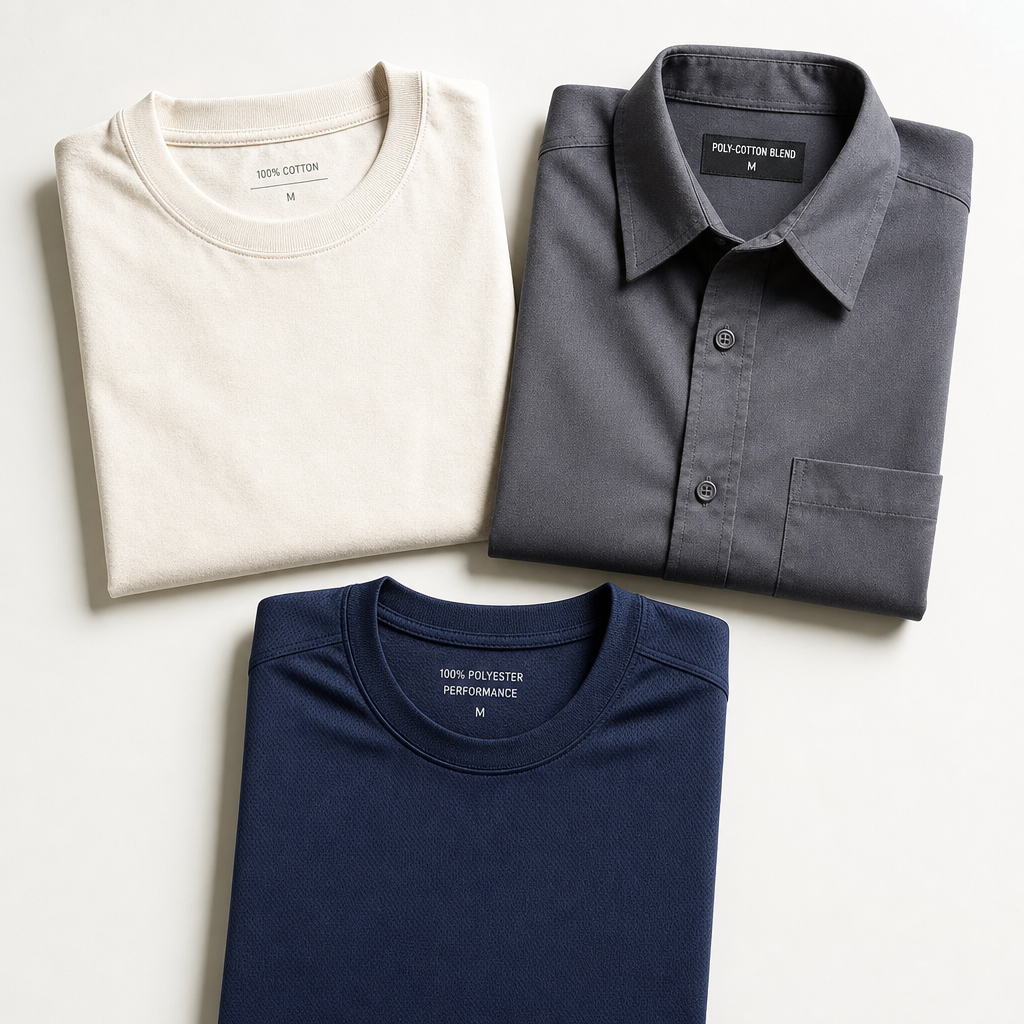
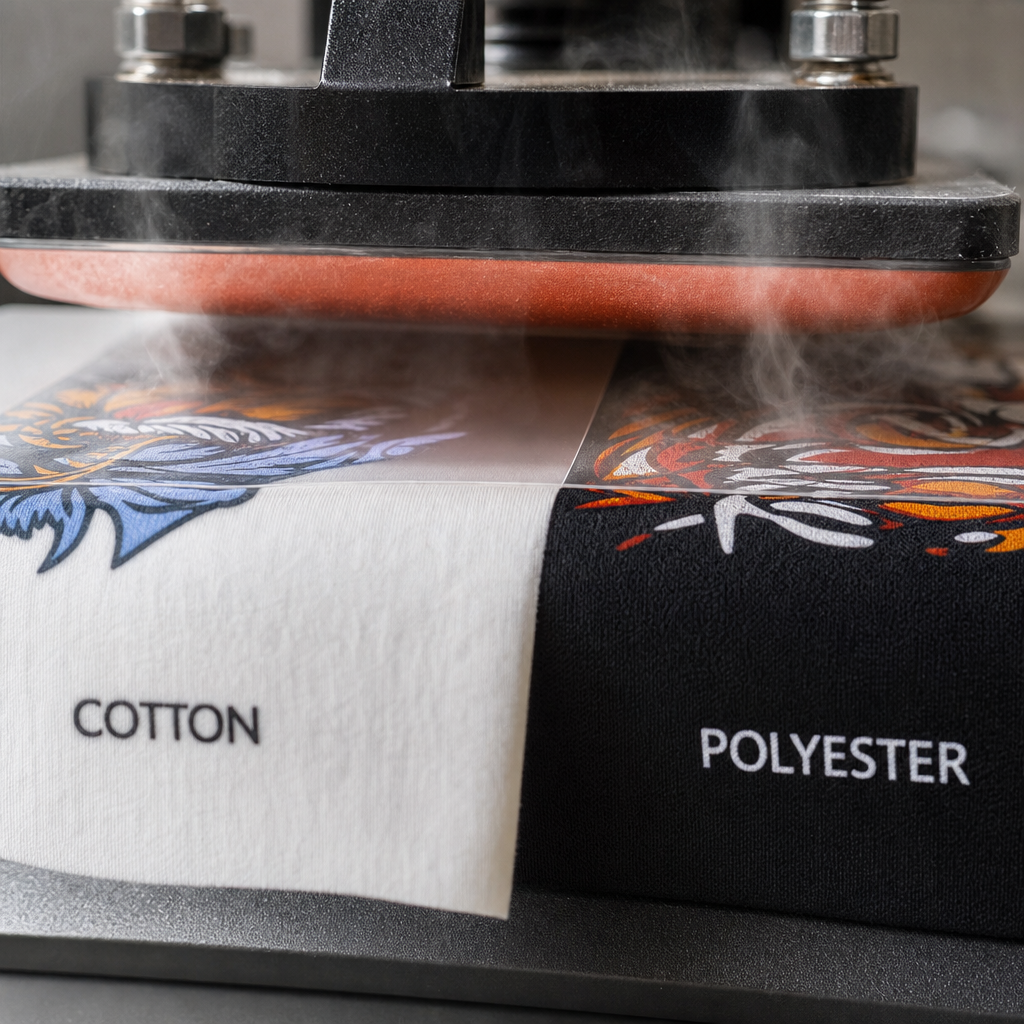
Best Fabrics for DTF Heat Press Printing
Not all fabrics behave the same way under a heat press. Here is a clear breakdown of which materials consistently produce the best results with DTF transfers.
100% Cotton
Cotton is the most reliable fabric for DTF heat press printing. The natural fibre structure creates excellent mechanical bonding with DTF adhesive, and cotton can tolerate the 150-165 degrees Celsius required for proper curing without any scorching risk on standard weights.
Ringspun cotton, specifically, produces superior results compared to open-end cotton because of its smoother, tighter surface. Premium cotton t-shirts in 180-200gsm weights hit the sweet spot for both print quality and garment durability. Psyque's custom t-shirts use cotton-rich fabrics precisely for this reason, because the print quality difference is visible and measurable.
Poly-Cotton Blends (65/35 and 50/50)
Poly-cotton blends are the workwear industry's favourite, and for good reason. A 65% cotton and 35% polyester blend gives you the print receptivity of cotton with the dimensional stability and moisture-wicking properties of polyester. For businesses ordering branded polos or uniform t-shirts, this blend reduces shrinkage and keeps garments looking professional after repeated industrial washing.
The 50/50 blend also works well, though you need to be careful with sublimation dyes in the polyester component. Bright polyester fibres can experience minor dye migration at higher temperatures. In practice, lowering the press temperature to 150 degrees Celsius and extending dwell time slightly compensates for this without compromising adhesion.
100% Polyester
Pure polyester is workable with DTF but comes with specific caveats. Dark or black polyester performs well because there is no visible dye migration concern. Bright white or pastel polyester, however, is prone to polymigration, where the dye sublimated into the polyester fibres bleeds into the transfer film and causes a colour cast.
The solution for polyester is a low-cure DTF film specifically designed for synthetic fabrics, and a press temperature no higher than 150 degrees Celsius. At Psyque, DTF on polyester sportswear and performance apparel is handled with these adjustments applied as standard.
Top Garment Types for DTF Transfers
Beyond raw fabric composition, garment construction plays a major role in how well a DTF transfer adheres and holds up over time.
T-Shirts
Standard crew-neck t-shirts are the easiest garment to work with for DTF. The flat, seam-free print area allows even heat and pressure distribution across the transfer. Ringspun cotton t-shirts in 160-200gsm produce consistently sharp, high-detail prints, including fine text, gradients, and photographic images.
For businesses looking to create branded merchandise or staff uniforms, a quality custom t-shirt on a premium cotton blank is the most cost-effective entry point into branded apparel.
Hoodies and Sweatshirts
Hoodies and sweatshirts present more complexity due to their thick fleece construction. The uneven surface created by fleece pile can interfere with full adhesive contact if pressure is not managed carefully. The correct approach is to use a platen that presses down into the pile, combined with slightly increased pressure and a 15-18 second dwell time instead of the standard 12-15 seconds.
Cotton-fleece hoodies, typically 80% cotton and 20% polyester, are the most forgiving for DTF. Pure polyester fleece hoodies require the same precautions as any high-polyester garment. Psyque's range of custom hoodies and sweatshirts are selected with this DTF compatibility in mind.
Polo Shirts
Polo shirts are a staple in corporate and workwear contexts. Most polo shirts use a pique knit construction, which has a slightly textured surface. DTF transfers work well on pique cotton and poly-cotton polos, though you should avoid placing transfers directly over the button placket or seam lines where pressure is inconsistent.
For team and business branding, a left-chest placement on a polo shirt is the most common configuration and produces clean, professional results with DTF. Psyque's custom polo shirts are popular with companies needing smart, durable branded workwear.
Fabrics to Avoid with DTF Printing
Some fabrics are fundamentally incompatible with DTF heat press printing at standard settings. Using these garments without significant modifications typically results in failed transfers, damaged garments, or both.
Nylon cannot handle the heat required for DTF adhesive curing. At 150 degrees Celsius, nylon begins to distort and can melt under sustained pressure. Even brief contact at press temperatures causes irreversible garment damage.
Silk and satin-weave fabrics have smooth, low-friction surfaces that prevent mechanical bonding with DTF adhesive. The transfer appears fine immediately after pressing but begins peeling at the edges after one or two washes. There is no reliable workaround for silk with standard DTF film.
Coated or water-repellent fabrics, such as shell jackets and softshell materials, block adhesive penetration entirely. The coating acts as a barrier between the transfer and the fabric fibres. Screen printing or embroidery are better options for these garment types.
Heavily textured fabrics, including waffle-knit and ribbed fabrics with deep channels, will produce transfers with visible gaps and incomplete adhesion across raised and recessed areas. Light-texture ribbed cuffs are manageable, but deep-texture fabrics are best avoided for full-size print placements.
Fabric Performance Comparison
The table below summarises how the three primary fabric types perform across the key criteria for DTF heat press printing.
| Fabric Type | DTF Print Quality | Wash Durability | Heat Tolerance | Best Use Case |
|---|---|---|---|---|
| 100% Cotton (ringspun) | Excellent. Sharp detail and vibrant colour. | High. Survives 50+ washes without peeling. | High. Safe up to 165°C. | Branded t-shirts, premium merchandise, events. |
| 65/35 Poly-Cotton Blend | Very Good. Slight reduction in vibrancy on polyester fibres. | Very High. Blend reduces shrinkage and maintains shape. | Medium-High. Press at 150-160°C to prevent migration. | Workwear, uniform polos, team kits. |
| 100% Polyester | Good on dark fabrics. Migration risk on light colours. | Medium. Requires low-cure DTF film for best results. | Medium. Max 150°C to prevent dye bleed. | Sportswear, performance tees, sublimation alternatives. |
DTF on Workwear and Branded Apparel
For small businesses, contractors, and organisations ordering branded workwear, DTF printing offers something that other methods do not: the ability to print full-colour, photographic-quality logos on any garment without a minimum order quantity barrier and without colour registration limitations.
A common mistake in workwear ordering is choosing garments based purely on price per unit, without considering how the fabric will perform under DTF heat pressing. A cheap 100% polyester polo from an unverified supplier will almost always deliver inferior print results compared to a slightly more expensive poly-cotton alternative from a reputable garment brand.
"The garment is not a substrate. It is the product. When the print fails, the garment fails with it. You cannot separate fabric quality from print quality in apparel decoration." - Industry print production standard, Textile Services Association (UK)
Psyque's workwear bundles are specifically built around garments that have been tested for DTF compatibility. The workwear bundles include premium cotton-rich or poly-cotton garments selected for their print performance, not just their cost per unit.
For businesses comparing suppliers, it is worth noting that Psyque's in-house heat press operation means quality control happens at every stage, rather than being outsourced to a third-party decorator whose processes you cannot verify. That matters for consistent results across large uniform orders.
Pro tip: When ordering branded workwear in bulk, request a single-unit sample press before committing to a full run. Any reputable DTF printer should be able to demonstrate adhesion quality on the exact garment you plan to order.
Heat Press Settings by Fabric Type
Getting the garment right is only half the equation. The heat press settings must be matched to the fabric to achieve proper adhesive curing without damaging the garment or causing dye migration.
Cotton Settings
For 100% cotton garments, the standard DTF press protocol is 155-165 degrees Celsius, medium-to-firm pressure, and a 12-15 second dwell time. A cold peel is generally preferred for cotton, allowing the adhesive to fully set before removal. Pre-press for 3-5 seconds before applying the transfer.
Poly-Cotton Blend Settings
Poly-cotton blends should be pressed at 150-158 degrees Celsius to reduce the risk of dye migration from the polyester component. Dwell time remains at 12-15 seconds. The slight reduction in temperature is compensated by firm, even pressure across the full transfer area. Cold peel applies here as well.
Polyester Settings
Pure polyester requires the most conservative settings. Press at 140-150 degrees Celsius maximum, with a 15-18 second dwell time to compensate for the lower temperature. Low-cure DTF adhesive powder is strongly recommended for polyester. A warm peel at around 40-50 degrees Celsius post-press gives the adhesive better grip on synthetic fibres before it fully sets.
The data consistently shows that incorrect press temperatures are responsible for the majority of DTF failures, more than film quality, ink density, or garment selection individually. Getting temperature calibration right on your heat press, using an independent surface thermometer rather than trusting the press's built-in display, eliminates the most common source of transfer failures.
Frequently Asked Questions
What is the best fabric for DTF printing if I want the sharpest, most vibrant colours?
100% ringspun cotton in 180-200gsm is the best choice for maximum colour vibrancy and print detail with DTF. The natural fibre surface accepts hot-melt adhesive more completely than synthetic alternatives, resulting in richer saturation and sharper fine detail, including thin lines and small text. If you are ordering branded merchandise where print quality is the primary concern, always choose cotton-rich garments.
Can DTF transfers be applied to polyester sportswear?
Yes, DTF transfers can be applied to polyester sportswear, but the process requires specific adjustments. You need low-cure DTF adhesive powder, a press temperature no higher than 150 degrees Celsius, and a warm peel rather than a cold peel. On dark polyester, results are consistently good. On light-coloured or bright polyester, dye migration is a real risk and you should test on a sample garment before committing to a full production run.
How many washes can a DTF print on a cotton t-shirt withstand?
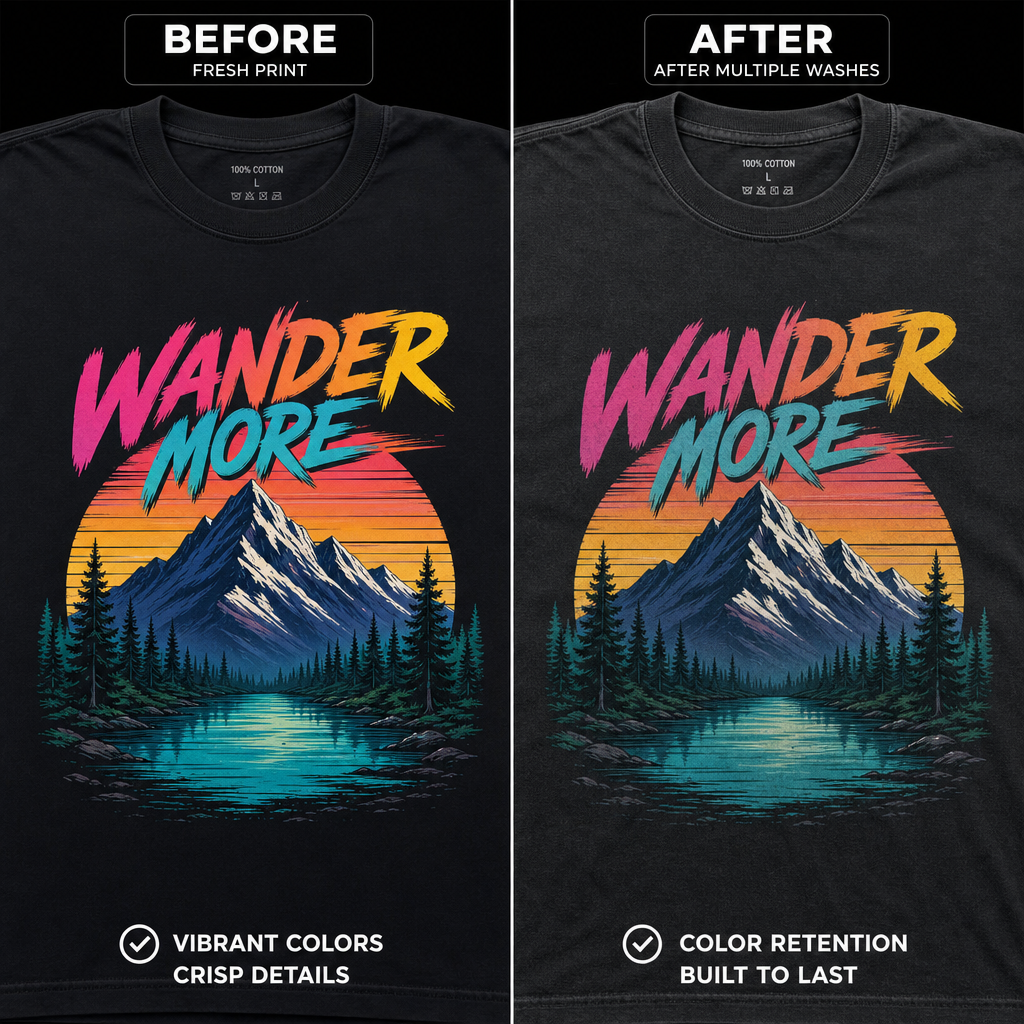
A correctly applied DTF transfer on a quality cotton t-shirt can withstand 50 or more washes before showing any visible degradation, when washed at 40 degrees Celsius inside-out on a gentle cycle. Washing at higher temperatures, using fabric softener, or tumble drying on high heat will reduce longevity significantly. In practice, DTF prints on cotton outperform screen-print plastisol inks in stretch resistance, though plastisol inks can match or exceed DTF in raw durability on flat surfaces.
Are DTF prints suitable for thick garments like hoodies?
Yes. DTF transfers work well on cotton-fleece hoodies when the correct platen and press settings are used. The key variables are using a platen sized to fill the garment without bunching the fabric, applying firm and even pressure, and increasing dwell time to 15-18 seconds to account for the thickness of the fleece. Pre-pressing to remove moisture from the fleece before applying the transfer is not optional on hoodies. It is a required step for consistent results.
Is DTF better than screen printing for workwear?
DTF outperforms screen printing for workwear in several specific situations: small quantities without setup cost penalties, designs with many colours or photographic elements, and orders requiring multiple different designs at the same time. Screen printing holds an advantage for very large single-design runs on cotton, where the per-unit cost drops significantly and edge-to-edge opacity on dark garments is exceptional. For most small business and team workwear orders under 100 units, DTF is the more practical and cost-effective choice.
Can DTF printing be done on waterproof or shell jackets?
Not reliably with standard DTF. Waterproof shells and DWR-coated fabrics repel the hot-melt adhesive because the coating prevents bonding with the underlying fabric fibres. The transfer will appear to stick immediately after pressing but will peel within one or two wash cycles. For waterproof or coated garments, embroidery is the most durable decoration method. If branding on a shell jacket is essential, the garment would need its coating chemically stripped in the print area first, which is not commercially viable at scale.
Have you had a specific garment type perform better or worse than you expected with DTF transfers? Share your experience, because real-world results from different fabric batches help the whole community make better choices.
References
- Statista: global custom apparel and textile printing market data and industry statistics
- Forbes: business trends in branded merchandise and corporate apparel spending
- Ahrefs Blog: content and keyword research insights for apparel and print-on-demand sectors
- Textile Services Association UK: professional standards and guidance for garment care and textile decoration
- HubSpot Marketing Statistics: consumer behaviour and branded merchandise engagement data