

Branded Polo Shirts vs T-Shirts: Which Fits Your Team?
Most business owners choose between polo shirts and t-shirts for their team based on gut feel or price alone. That is a mistake that costs them either credibility with clients or comfort for their staff. When you are ordering branded polo shirts UK-wide for a trade team, retail crew, or event staff, the wrong choice affects how customers perceive your business every single day. This article gives you a direct, experience-based breakdown of polo vs t-shirt workwear so you can make the right call for your team, your industry, and your budget.
Table of Contents
- Quick Takeaways
- What Makes a Workwear Garment Look Professional
- Polo Shirts for Branded Workwear: Where They Win
- T-Shirts for Branded Workwear: Where They Win
- Polo vs T-Shirt: Side-by-Side Comparison
- Industry-Specific Guidance: Who Should Wear What
- Print Quality and DTF Considerations for Both Garments
- Cost and Ordering Considerations for UK Businesses
- Frequently Asked Questions
- References
Quick Takeaways
| Key Insight | Explanation |
|---|---|
| Polos signal authority without formality | A branded polo sits between a uniform shirt and a casual tee, making it the default choice for customer-facing roles in trade, retail, and hospitality. |
| T-shirts outperform polos in physical roles | For warehouse, construction, or event setup crews, t-shirts allow greater freedom of movement and are easier to replace at scale. |
| DTF printing works equally well on both | Direct to Film transfers produce bold, durable prints on both polo pique fabric and jersey cotton, so print quality is not the deciding factor. |
| Polo collars increase perceived brand value | Research on consumer perception consistently shows that collared garments are rated as more trustworthy and professional by customers. |
| T-shirts win on bulk order economics | Unit cost for custom printed t-shirts is typically lower than polos at the same quantity, making them better for large one-off events or seasonal promotions. |
| Blended fabrics affect print longevity | Polyester-cotton blends common in performance polos require DTF over screen printing to maintain colour vibrancy after repeated washing. |
| Mixing both styles on the same team creates hierarchy | Some businesses intentionally give polos to supervisors and t-shirts to general staff. This is a deliberate branding tactic, not a budget compromise. |
What Makes a Workwear Garment Look Professional
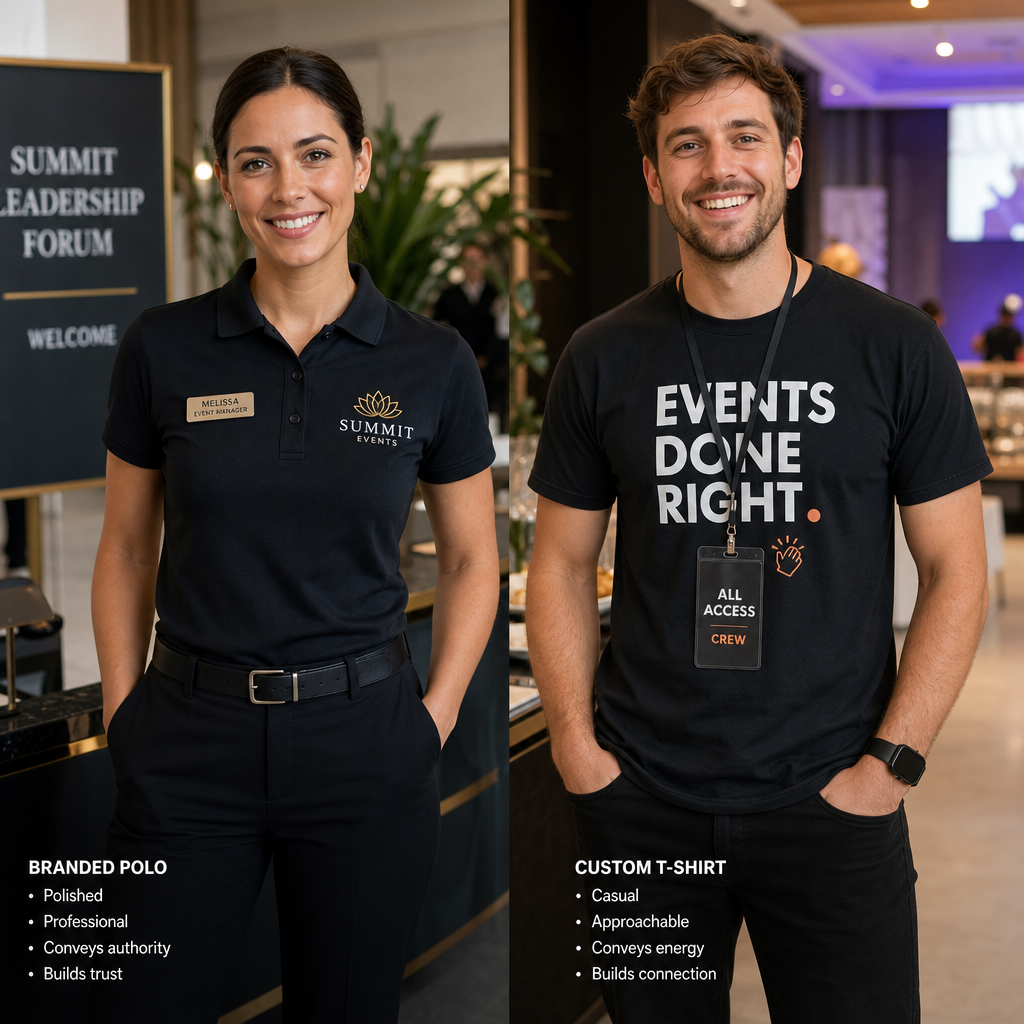
Professionalism in workwear is not about spending more. It is about fit, consistency, and print quality. A team wearing identical, well-printed t-shirts looks more professional than a team wearing mismatched polos with faded logos. That said, the garment style does carry social signals that customers pick up on, often without consciously noticing.
The collar is the single biggest visual cue. Studies in consumer behaviour, including research cited by Forbes on workplace dress and brand perception, confirm that collared garments trigger higher trust ratings from customers in service environments. This is not an opinion. It is a documented pattern in how people read social cues from clothing.
In practice, the question is not just "which looks better" but "which fits the job your team is doing." A plumber in a polo who has been crawling under floorboards does not look more professional than a plumber in a clean, branded t-shirt. Context matters enormously.

Polo Shirts for Branded Workwear: Where They Win
Custom polo shirts for business are the default choice for customer-facing teams, and for good reason. The collar and placket structure gives the garment an inherent formality that a t-shirt cannot replicate, regardless of how premium the t-shirt fabric is.
Customer-Facing Roles Where Polos Are the Clear Winner
Retail staff, hospitality teams, tradespeople who work inside client properties, and service engineers all benefit from the authority a polo shirt communicates. When a customer opens their front door to an engineer wearing a clean branded polo, they immediately read that person as more professional than if the same engineer were in a t-shirt. That perception influences reviews, repeat business, and referrals.
Estate agencies, IT support companies, cleaning firms, and automotive businesses consistently choose polos for field teams precisely because of this effect. The polo does part of the credibility work before the employee says a word.
Polo Fabric and Durability for Daily Wear
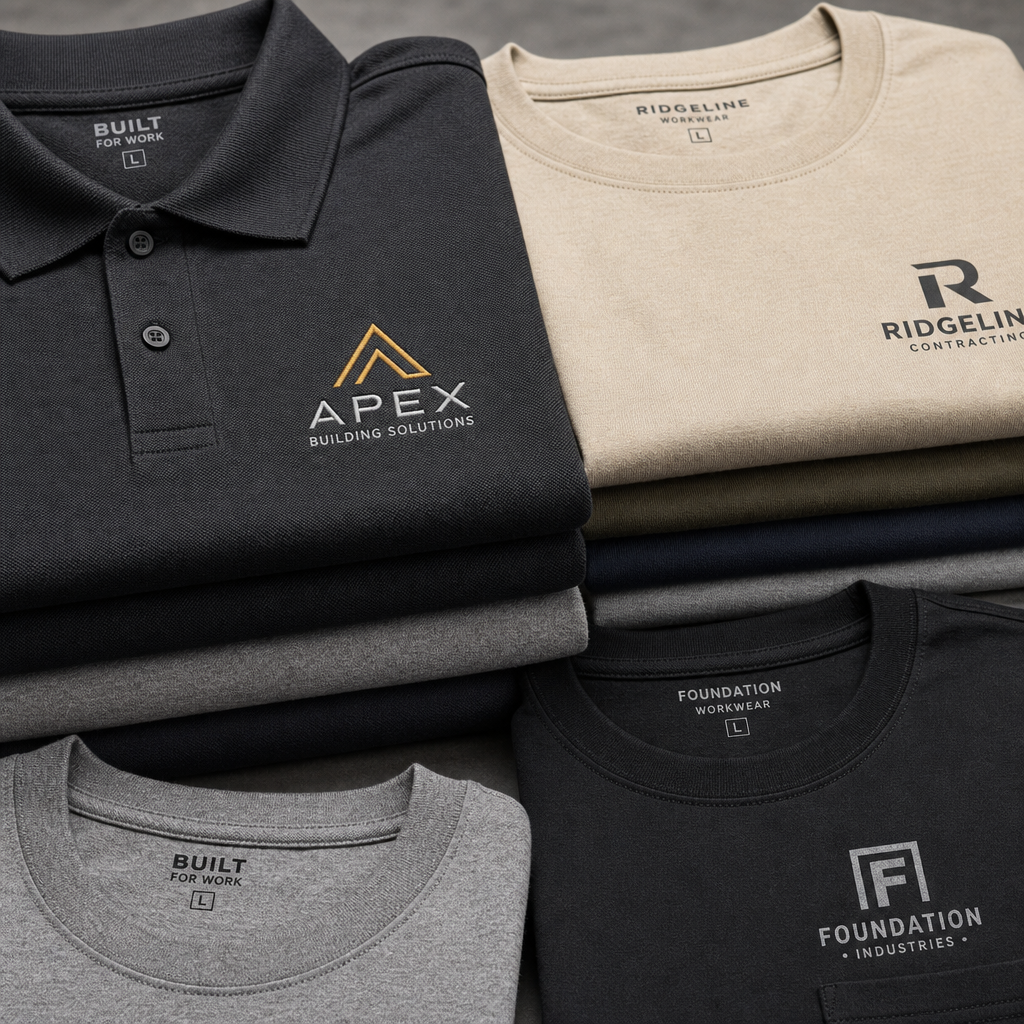
Standard pique polo fabric, the textured knit used in most workwear polos, is genuinely more durable than single-jersey t-shirt fabric at the same weight. The pique weave resists pilling and holds its shape through repeated washing better than cheaper t-shirt cotton. For a team wearing their workwear five days a week, this matters. A polo ordered from Psyque's custom polo shirts range will last longer in daily rotation than a lightweight promotional tee.
"Clothing is the most immediate signal of professional identity. Before a word is spoken, a customer has already formed an impression based on what your staff are wearing." - Dr. Karen Pine, Professor of Psychology, University of Hertfordshire, commenting on workplace dress research.
Pro tip: If your team works in warm conditions, choose a moisture-wicking performance polo rather than a standard cotton pique. DTF printing handles polyester blends well, and your staff will actually wear the garment rather than rolling up their sleeves or removing it entirely.
T-Shirts for Branded Workwear: Where They Win
T-shirts are not the lesser option. They are the right option for specific contexts, and forcing a polo onto every team member is as much a mistake as assuming a t-shirt is always good enough.
Physical and Outdoor Roles Where T-Shirts Work Better
Construction crews, warehouse teams, festival and event staff, sports coaches, and personal trainers all operate in environments where freedom of movement and ventilation matter more than collar structure. A t-shirt allows full arm movement, breathes better under physical exertion, and is far easier to source in large quantities at short notice.
For event organisers running a one-day festival with 30 volunteer staff, custom printed t-shirts are the practical answer. They are quick to produce, cost-effective at volume, and easy to size across a diverse group.
Brand Visibility and Print Area Advantages
T-shirts offer a larger, flatter print surface than polos. The chest area of a standard t-shirt gives a clean canvas without the button placket interrupting the centre of the design. For bold graphic branding, a large logo, or a design that relies on visual impact, custom printed t-shirts often deliver a stronger result than the same design on a polo.
Psyque's custom t-shirt printing uses DTF technology that produces rich, full-colour prints on 100% cotton and blended fabrics without the cracking or fading that older heat-press methods caused. If your brand relies on colour accuracy, that matters.
Pro tip: For event staff t-shirts, use the back as well as the front. A large back print turns every staff member into a walking directional sign at a crowded venue, which has genuine operational value beyond branding.
Polo vs T-Shirt: Side-by-Side Comparison
The table below covers the most important decision factors directly. No garment wins on every dimension. The right answer depends on your industry, your team's role, and your brand positioning.
| Factor | Branded Polo Shirts | Custom Printed T-Shirts |
|---|---|---|
| Professional perception | High. Collar signals authority and trustworthiness in customer-facing settings. | Moderate to high depending on print quality and garment weight. No collar cue. |
| Comfort in physical roles | Good, but collar and placket can restrict movement or feel formal in hot conditions. | Excellent. Full range of movement, better ventilation, no structural constraints. |
| Print surface quality | Good. Pique texture creates slight print texture. Placket limits centred chest designs. | Excellent. Flat, smooth surface ideal for large graphics and complex designs. |
| Durability in daily use | High. Pique fabric resists pilling and retains shape longer under frequent washing. | Moderate to high. Depends heavily on fabric weight. 180gsm+ cotton performs well. |
| Unit cost at typical order volumes | Higher. Expect to pay 15-30% more per unit than an equivalent t-shirt at the same quantity. | Lower. More economical at scale, particularly for orders of 50 units or more. |
| Best use case | Customer-facing roles: retail, trades, hospitality, field service, corporate events. | Physical roles, events, promotions, volunteer crews, gyms, outdoor teams. |
Industry-Specific Guidance: Who Should Wear What
The polo vs t-shirt workwear debate plays out differently depending on the industry. Here is a direct breakdown based on common team types that order custom branded workwear in the UK.
Trades and Construction
Sole traders and small trade businesses, such as electricians, plumbers, and decorators, nearly always benefit from branded polos. When you arrive at a client's home, the polo communicates competence and care before you have touched a single tool. For site labourers and ground workers doing heavy physical work, t-shirts are the better fit. A tiered approach, polo for the business owner and senior tradespeople, t-shirt for labour crews, is entirely sensible.
Retail and Hospitality
Polos are the standard in retail environments because they photograph well on social media, look clean on CCTV, and communicate a brand identity that a t-shirt struggles to match without very high print quality. In hospitality, particularly café and restaurant front-of-house roles, polos strike the balance between approachable and professional that a formal shirt and a casual tee both fail to achieve.
Events and Festivals
This is the clearest case for t-shirts. Event staff need to be visually identifiable at a distance, which is where a bold back print on a brightly coloured t-shirt outperforms a subtly branded polo every time. Speed of identification matters more than formality. Event organisers ordering team apparel through Psyque's workwear bundles typically find that t-shirt bundles give them the best volume-to-cost ratio for short-duration events.
Gyms, Personal Trainers, and Fitness Businesses
Performance t-shirts win here with almost no debate. Coaches and PTs need full movement, breathability, and the ability to demonstrate exercises. A quality polyester-blend performance tee with a sharp DTF print looks professional in a gym setting without restricting the physical work.
Print Quality and DTF Considerations for Both Garments
One question that comes up repeatedly when businesses are comparing garment options is whether print quality differs between polos and t-shirts. The short answer is: DTF printing handles both exceptionally well, but there are practical differences worth knowing.
How DTF Printing Behaves on Polo Fabric
The pique knit texture of a polo shirt means the DTF transfer sits on a slightly textured surface. For simple logos, text, and solid colour designs, this makes no visible difference. For very fine detail or photographic imagery, a flat jersey t-shirt fabric will always produce a sharper result. If your logo has thin lines or small text, test on the actual polo fabric before committing to a large order.
The button placket running down the centre chest of a polo is also a practical constraint. Designs that need to be centred on the chest must be offset to one side, or placed on the left chest in a smaller format. Psyque's design team can advise on this during the artwork setup process.
Wash Durability of DTF Prints on Both Garments
DTF transfers bond to the fabric fibres directly and outperform screen printing in wash durability on polyester blends, which are common in performance polos. On 100% cotton t-shirts, both DTF and screen printing perform comparably over time, provided garments are washed inside-out at 40 degrees or below. The data consistently shows that DTF prints on correctly prepared fabric maintain colour vibrancy for 50-plus washes without significant fading, which matters for workwear used daily.
Cost and Ordering Considerations for UK Businesses
Budget is a real factor, and dismissing it is not useful. Branded polo shirts UK-wide cost more per unit than equivalent custom t-shirts, and that difference compounds at volume. A business ordering 50 garments will typically spend 15 to 30 percent more per unit on polos than on t-shirts from the same supplier.
When to Spend More on Polos
If your team is customer-facing and your brand positions itself as premium or trustworthy, the extra cost per unit on polos is genuinely justified. The perception value a polo delivers in customer interactions is not easily quantifiable, but businesses in trades, retail, and professional services consistently report better client first impressions when staff are in branded polos rather than t-shirts.
When to Keep Costs Down with T-Shirts
For internal teams, physical roles, promotional giveaways, or event staffing where garments will only be worn once or twice, t-shirts are the economically sensible choice. Psyque offers workwear bundle pricing that brings the per-unit cost down significantly at volume, and free UK shipping applies to orders over £45, which most team orders easily exceed.
A common mistake is ordering polos for an event because they feel more professional, only to find the cost eats into the event budget and the garments are too formal for the outdoor physical context. Match the garment to the job, not to an abstract idea of what looks good.
Frequently Asked Questions
Are branded polo shirts better than t-shirts for small business workwear?
For most customer-facing small businesses, yes. Branded polo shirts UK businesses order most frequently for retail, trade, and service roles because the collar adds a professional signal that t-shirts cannot replicate. However, if your team does physical or outdoor work where comfort and movement matter more than formality, a quality custom t-shirt is the better choice.
Can DTF printing be used on both polo shirts and t-shirts?
Yes. Direct to Film printing works on both garment types and handles polyester blends common in performance polos as well as cotton jersey used in standard t-shirts. The main practical difference is that polo pique fabric has a slight texture that can soften very fine print detail, while flat jersey fabric gives sharper results on intricate designs.
What is the minimum order quantity for custom polo shirts for business use?
This varies by supplier. Psyque accepts small batch orders, which suits start-ups and small businesses that do not need hundreds of units at once. Check the current options directly on the Psyque polo shirts page for up-to-date minimum quantities and bundle pricing.
How do I decide between polos and t-shirts if I have a mixed team doing different jobs?
Use garment type to reflect role. Give polos to customer-facing or supervisory staff and t-shirts to physical or back-of-house teams. This is a deliberate brand hierarchy tactic used by many trades businesses and hospitality groups. It communicates structure without requiring different branded designs, since both garments can carry the same logo.
Which garment holds a printed logo better over time?
DTF prints on either garment hold well when cared for correctly. Wash inside-out at 40 degrees or below and avoid tumble drying on high heat. Polo pique fabric is generally more resistant to fabric wear around the print area because the weave structure is denser, but the print itself behaves the same on both garment types when DTF technology is used.
Do branded polo shirts cost significantly more than custom t-shirts for UK business orders?
Typically yes, by around 15 to 30 percent per unit at comparable order quantities. Whether that premium is worth it depends entirely on your team's role. For a field service engineer visiting client properties daily, the credibility a polo delivers is worth more than the cost difference. For a warehouse packing team, it is not.
If you have ordered both polos and t-shirts for your team, we would like to know which worked better in practice and why.
We would love your feedback and any insights you would share with others. What perspective would you add?
References
- Forbes: Business leadership and workplace culture reporting covering brand identity and employee presentation
- Statista: UK workwear and branded apparel market data and consumer spending statistics
- HubSpot Marketing Statistics: Research on brand perception, visual identity, and customer trust signals
- Business of Fashion: Industry analysis covering garment manufacturing, fabric performance, and apparel trends
- Health and Safety Executive: UK guidance on workwear suitability and protective clothing standards for different job roles