
Branded Workwear UK: Complete Guide for Small Businesses
Most small business owners spend more time worrying about their logo placement than they do understanding why their workwear order falls apart at 50 washes. Branded workwear in the UK is a £500 million-plus market, yet the majority of small businesses still get the basics wrong: wrong fabric weight, wrong print method for their use case, wrong supplier. This guide covers everything you need to order branded workwear UK correctly the first time, from choosing a print method to calculating your cost per garment, with practical guidance built specifically for small business budgets and timelines.
Table of Contents
- Quick Takeaways
- Why Branded Workwear Matters for Small Businesses
- Choosing the Right Print Method
- Garment Types and What They Signal
- How to Calculate Your Real Cost Per Unit
- Print Method Comparison
- How to Brief Your Supplier Correctly
- Ordering Workwear Online: What to Check Before You Buy
- Common Mistakes Small Businesses Make
- Frequently Asked Questions
- References
Quick Takeaways
| Key Insight | Explanation |
|---|---|
| DTF printing outperforms screen print for small orders | Direct to Film has no minimum quantity and handles full-colour artwork without setup fees, making it the right choice for orders under 50 units. |
| Fabric weight determines print quality and durability | Garments under 180gsm distort under heat press and wear poorly. Go 200gsm minimum for workwear that needs to survive daily use. |
| Free shipping thresholds change your unit economics | Suppliers offering free delivery above a certain threshold (such as £45 at Psyque) make small reorders significantly cheaper. Factor this into your planning. |
| A single artwork file in the wrong format costs you money | Supplying artwork as a low-resolution JPEG instead of a vector file forces the printer to redraw your logo, adding time and potentially a fee. |
| Bundled workwear packs reduce your cost per garment | Ordering t-shirts, polos, and hoodies in a bundle from one supplier cuts per-unit price and ensures colour consistency across your team's uniform. |
| Wash durability is determined by print method, not garment price | A £10 DTF print on a mid-weight hoodie will outlast an embroidered logo on a cheap polyester blend. Material and method together define longevity. |
| UK-based dispatch protects your event or launch deadline | Offshore suppliers may offer lower unit prices but routinely add 10 to 21 days to delivery. For time-sensitive orders, UK printing is non-negotiable. |
Why Branded Workwear Matters for Small Businesses
There is a persistent myth that branded workwear is a luxury reserved for franchises and large companies with dedicated uniform budgets. In practice, a tradesperson in a printed polo shirt closes more quotes than one in a plain sweatshirt. A study published by the Advertising Specialty Institute found that branded apparel generates more impressions per item than nearly any other form of advertising, with a single garment averaging over 3,400 impressions throughout its lifespan. For a small business spending under £200 on a team uniform, that return is exceptional.
Custom workwear for small businesses serves three functions simultaneously: it builds brand recognition, it signals professionalism to customers, and it creates team cohesion. These are not abstract benefits. A builder's company van wrap costs thousands. A set of 10 printed polo shirts with the same logo costs a fraction of that and goes everywhere the van cannot.
The real question is not whether to invest in branded workwear but how to order it without wasting money on poor print quality, incorrect sizing, or garments that fade within three months.
"Uniforms give employees a sense of belonging and signal to customers that they are dealing with a professional organisation, regardless of company size." - Federation of Small Businesses, UK Business Insight Reports
Choosing the Right Print Method
The print method is the single most important decision in your workwear order. Get this wrong and you will have peeling logos after 15 washes, cracked graphics on cold days, or a print that looks nothing like your brand colours. There are four methods you will encounter when you order workwear online in the UK: screen printing, embroidery, DTG (Direct to Garment), and DTF (Direct to Film).
DTF Printing: The Best Option for Most Small Business Orders
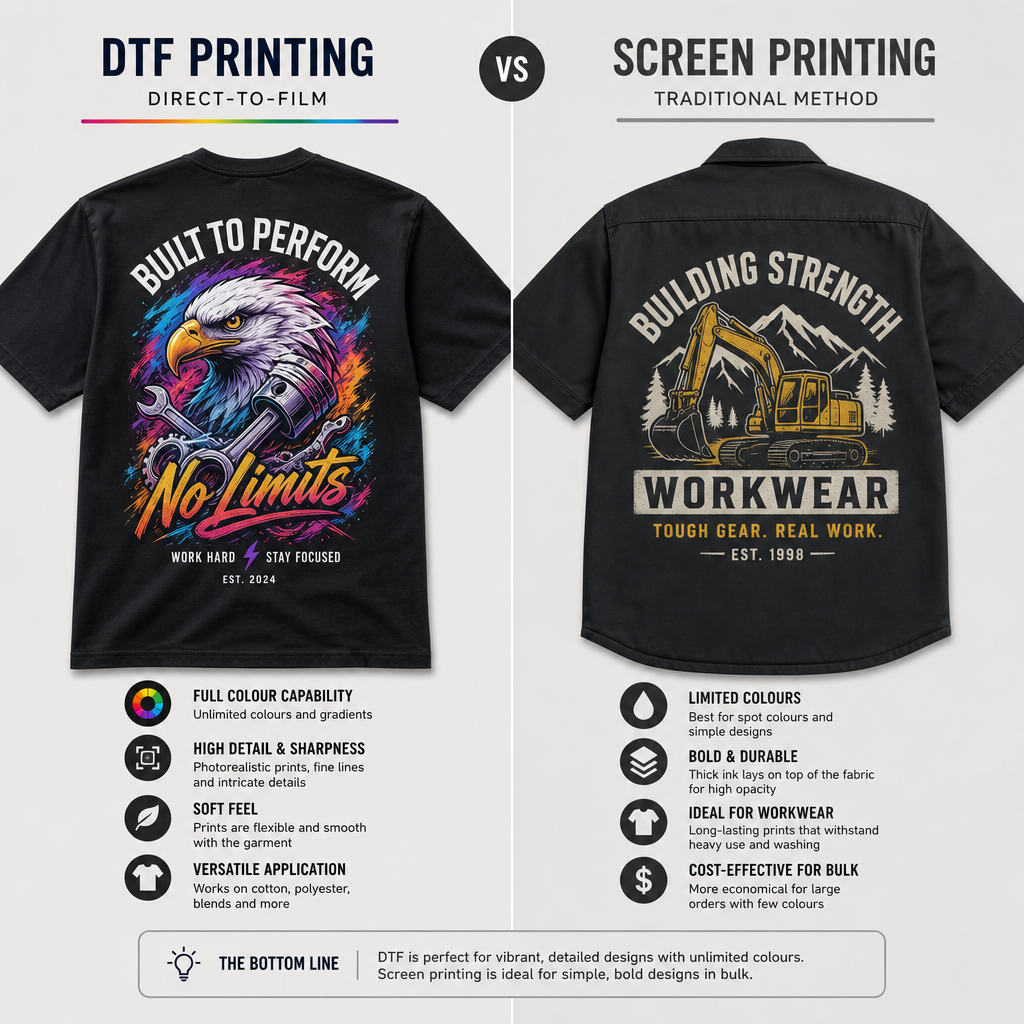
DTF printing transfers a printed film directly onto the garment using a heat press. It supports full-colour artwork, photographic detail, gradients, and fine lines without any setup fees or minimum quantities. For a small business ordering 10 to 100 units with a complex logo or multiple colours, DTF consistently delivers the best combination of quality, cost, and turnaround.
In practice, the durability concern around DTF has largely been solved by improved adhesive powders. A properly applied DTF transfer on a 200gsm cotton garment will maintain print integrity beyond 50 washes when the care instructions are followed. Psyque's in-house heat-press process uses commercial-grade equipment, which eliminates the inconsistency you get from consumer-level machines used by some resellers.
Screen Printing: When Volume Justifies the Setup Cost
Screen printing requires a separate screen for each colour in your design, which means setup costs. For a two-colour logo on 100 identical garments, screen printing becomes cost-competitive. Below that volume, the setup cost per unit makes it uneconomical for most small businesses. It also handles photographic or gradient artwork poorly.
Embroidery: Right for Premium Branded Garments, Wrong for Complex Logos
Embroidery works well for simple, bold logos on polo shirts, fleeces, and jackets where a tactile, premium finish is important. It is the wrong choice for logos with fine detail, small text, or more than three or four colours, because thread cannot replicate that level of detail without the design looking muddled. Embroidery also adds weight to the garment and can cause puckering on lightweight fabrics.
Pro tip: If your logo contains fine lines or text smaller than 6mm in height, request a digital print method rather than embroidery. At that scale, embroidery will distort the lettering beyond recognition.
Garment Types and What They Signal
Every garment type sends a signal to the customer before a word is spoken. Choosing the wrong garment for your industry is a subtle but real credibility problem. A tradesperson in a heavyweight hoodie with a chest logo reads as competent and established. The same tradesperson in a thin promotional t-shirt reads as an afterthought.
T-Shirts: High Volume, Low Cost, High Visibility
Custom printed t-shirts are the most ordered branded workwear item in the UK. They are appropriate for hospitality, events, retail, and any customer-facing role in warmer months. For workwear purposes, do not go below 180gsm. Stanley/Stella and Gildan 65000 range fabrics at 200gsm to 220gsm hold prints well and do not become see-through under bright lighting.
Polo Shirts: The Default Uniform for Trade and Service Businesses
Polo shirts strike the right balance between professional appearance and practical comfort. They are the go-to choice for plumbers, electricians, landscapers, estate agents, and any service business where the team member interacts directly with customers in a home or business setting. A pique cotton polo at 220gsm with a chest-print logo is the most cost-effective branded workwear investment a small business can make.
Hoodies and Sweatshirts: Layering and Long-Season Workwear
For UK businesses operating outdoors or in warehouses, a printed hoodie or sweatshirt is a practical necessity, not a luxury. A 280gsm fleece-back sweatshear carries a large back print well and provides warmth without restricting movement. Ordered as part of a bundle with matching t-shirts and polos, they create a consistent branded look across seasons.
How to Calculate Your Real Cost Per Unit
The sticker price per garment is not your real cost. Your real cost includes delivery, any artwork or setup fees, the cost of reprinting if quality is poor, and the time cost of managing an overseas supplier with slow communication. Small businesses routinely underestimate this by 20 to 40 percent when they chase the cheapest per-unit price without reading the full terms.
Here is a simple framework for calculating your true cost per unit on a printed workwear order:
Take the total garment cost, add any setup or artwork fees, add delivery (or subtract the saving if you are above a free shipping threshold), then divide by the number of units. If a supplier charges a £25 screen setup fee on an order of 10 shirts at £8 each, your real cost is not £8 per shirt. It is £10.50 per shirt before delivery.
Suppliers like Psyque, which use DTF printing with no per-colour setup fees and free shipping on orders over £45, make the cost calculation much cleaner for small business buyers. There are no hidden fees in the artwork preparation stage, which is where many competitors add charges that do not appear in the initial quote.
Pro tip: Always ask your supplier for a fully itemised quote before placing an order. If they cannot break down garment cost, print cost, setup fees, and delivery as separate line items, that is a red flag.
Print Method Comparison
| Print Method | Best For | Key Limitation |
|---|---|---|
| DTF (Direct to Film) | Small orders (1 to 100 units), full-colour logos, photographic detail, fast turnaround | Requires correct heat press application; quality varies by supplier equipment |
| Screen Printing | Large orders (100+ units), single or two-colour designs, flat-rate colour artwork | High setup cost per colour; unsuitable for gradients or photographic artwork |
| Embroidery | Premium polo shirts, jackets, and fleeces; simple bold logos; corporate uniform programmes | Cannot reproduce fine detail or text below 6mm; adds weight; higher cost per unit |
How to Brief Your Supplier Correctly
A common mistake is submitting a brief that leaves too much to the supplier's interpretation. When you order printed workwear, ambiguity in the brief translates directly into a print that misses your brand standards. A proper brief prevents this and speeds up production.
Artwork Requirements
Supply your logo as a vector file (AI, EPS, or SVG). If you only have a PNG or JPEG, it must be at a minimum of 300dpi at the intended print size. Anything below this will be scaled up by the printer, and the pixelation will be visible in the final print. If your designer supplied you with a low-resolution file, ask them for the original vector before you approach any workwear supplier.
Colour Specification
Specify your brand colours using Pantone (PMS) codes, not RGB or hex values. RGB values are screen colours and do not translate accurately to physical print. If your brand guidelines only list hex values, ask your printer to match to the nearest Pantone equivalent, and approve a digital proof before production begins.
Placement and Size
State the exact print position (left chest, centre chest, full back, sleeve) and the intended print dimensions in centimetres. A chest logo that looks right at 8cm wide can look undersized on a 2XL or oversized on an XS. If you are ordering multiple sizes, ask your supplier whether they adjust print size proportionally or use a single size across the range.
Ordering Workwear Online: What to Check Before You Buy
The UK market for online workwear ordering has grown substantially, but the quality and reliability gap between suppliers is significant. Not every company offering printed workwear online has in-house printing capability. Many are resellers passing orders to third-party printers, which adds lead time, reduces quality control, and makes it harder to resolve problems when something goes wrong.
Before placing an order, ask three direct questions: Where is the printing done? What is the expected dispatch time from artwork approval? What is the returns and reprint policy if the quality does not match the proof? A legitimate in-house printer will answer all three quickly and specifically. A reseller will hedge or redirect you to terms and conditions.
Psyque operates with in-house DTF printing and heat-press capability, which means quality control happens at the same site as production. This matters when you are ordering 50 branded polo shirts for a team launch and do not have time to manage a dispute with an overseas fulfilment centre.
Also check for:
- UK-based customer support that responds within one business day
- Clear artwork approval process before printing begins
- Stated dispatch timeframes, not just estimated delivery windows
- Free shipping thresholds that make reorders cost-effective
Common Mistakes Small Businesses Make
After seeing hundreds of workwear orders go wrong for the same predictable reasons, it is worth stating these explicitly rather than burying them in caveats.
Ordering only one size of each garment to test the supplier. This almost never produces a useful result. Print quality on a test order of three shirts will be inconsistent with what you receive on a 50-piece production run, because the heat press settings and batch processes differ. Request a printed sample at your intended quantity, or review the supplier's published sample policy.
Choosing the cheapest per-unit price without checking fabric weight or garment brand. A 150gsm t-shirt from an unknown blank brand will look and feel cheap on your team regardless of print quality. The garment is part of the brand presentation. The data consistently shows that customers associate garment quality with service quality, even when they cannot articulate why.
Failing to order enough stock to cover staff turnover or sizing exchanges. Order 10 to 15 percent above your current headcount. Workwear is not like marketing collateral. When a new team member starts, you need their uniform available immediately, not after a two-week reorder cycle.
Leaving the order too late before an event or launch date. Even with fast UK dispatch, factor in artwork approval time, production time, and a buffer for courier delays. For an event on a Friday, your artwork should be approved by the previous Monday at the latest. Earlier if the order is large or involves multiple garment types.
Frequently Asked Questions
What is the minimum order quantity for branded workwear in the UK?
This depends entirely on the print method. DTF printing has no practical minimum, meaning you can order a single custom garment if needed. Screen printing typically requires 25 to 50 units to make the setup cost worthwhile. Suppliers like Psyque using DTF are the right choice for small businesses that need flexibility on quantity without sacrificing print quality.
How long does it take to receive printed workwear after ordering?
With a UK-based printer using in-house production, you should expect 3 to 7 business days from artwork approval to dispatch. Offshore suppliers or those using third-party printers can add 10 to 21 days. Always confirm the dispatch timeline before paying, not after. If a supplier cannot give you a specific timeframe, that is a meaningful warning sign.
What file format should I use when submitting my logo for printing?
Vector formats are the correct choice: AI (Adobe Illustrator), EPS, or SVG. These scale to any print size without quality loss. If you only have a raster file (JPEG or PNG), it must be at least 300dpi at the final print size. Submitting a low-resolution PNG from a website or social media profile will result in a blurry or pixelated print, and most reputable printers will flag this before production rather than print a poor result.
Is DTF printing durable enough for daily workwear use?
Yes, when applied correctly to the right fabric. A DTF transfer applied to a 200gsm or heavier cotton or cotton-poly blend garment using a commercial heat press will maintain print integrity through 50-plus washes when washed inside out at 30 to 40 degrees. The durability failures people associate with DTF are almost always the result of incorrect application temperature, wrong adhesive powder, or washing the garment on a high heat cycle.
Can I order different garment types with the same logo in one order?
Yes, and this is strongly recommended. Ordering t-shirts, polo shirts, and hoodies in a single order from the same supplier ensures colour consistency across your team uniform. It also typically qualifies you for bulk pricing thresholds and free delivery minimums. Be specific in your brief about whether you want the logo placed identically on each garment type or adjusted for each style.
How do I choose between DTF printing and embroidery for my workwear?
Choose DTF if your logo has multiple colours, fine detail, gradients, or small text. Choose embroidery if you have a simple, bold logo with no more than three or four colours and you want a premium tactile finish on polo shirts or outerwear. If your logo contains both detailed and bold elements, a printed DTF version will almost always reproduce more accurately than an embroidered version at standard workwear scale.
What should I check when comparing UK workwear suppliers?
Check whether printing is done in-house or outsourced, what the stated dispatch time is from artwork approval, whether there are setup or artwork fees on top of the per-unit price, what the reprint or returns policy is, and what fabric weights and garment brands are used. A supplier that ticks all five of these clearly in their product listings and terms is operating with transparency. One that is vague on any of these points warrants more scrutiny before you commit budget.
If you have recently ordered custom workwear for your business, share what went right or wrong in the process as your experience will help other small business owners make a better decision the first time.
References
- Statista: UK and global branded apparel and workwear market size statistics
- Forbes: Small business branding and the commercial value of branded uniforms
- Federation of Small Businesses: Research and insight reports on UK small business operations and brand investment
- Ahrefs Blog: Data on branded search and consumer trust signals for small business websites
- UK Government Business Hub: Guidance on business branding, trading standards, and consumer regulations for UK businesses