
Budget Branded Workwear UK Startup Guide (2024)
Most UK startups waste their first workwear budget on one of two mistakes: ordering too few garments to qualify for bulk pricing, or paying premium rates for a print quality that fades after ten washes. A 2023 survey by the British Promotional Merchandise Association found that 72% of consumers remember a brand better after receiving branded apparel, yet small business owners consistently underspend on workwear because they assume quality branding is out of reach without a big budget. It is not. This guide covers exactly how to get budget branded workwear UK startup teams will actually wear, with strategies built around real print methods, smart ordering decisions, and supplier choices that hold up under scrutiny.
Table of Contents
- Quick Takeaways
- Why Branded Workwear Matters for UK Startups
- Choosing the Right Print Method for Your Budget
- How to Order Smart and Reduce Cost Per Unit
- Picking the Right Garments Without Overspending
- Designing for Durability and Brand Impact
- Comparing Your Workwear Printing Options
- Common Budget Workwear Mistakes UK Startups Make
- Frequently Asked Questions
- References
Quick Takeaways
| Key Insight | Explanation |
|---|---|
| DTF printing suits startups better than screen printing at low quantities | Screen printing requires setup fees per colour that make small runs expensive. DTF has no screen setup cost, making it cost-effective from as few as 5 units. |
| Order a mixed bundle, not individual items | Bundling t-shirts, hoodies, and polos in one order with a single supplier reduces shipping costs and often qualifies you for bulk pricing sooner. |
| Free shipping thresholds can cut your effective cost per item | Suppliers like Psyque offer free UK shipping on orders over £45. Structuring your order to hit that threshold reduces the true per-unit cost noticeably. |
| Two-colour logo designs print cheaper and last longer | Simpler artwork uses less ink and creates a crisper result on fabric. Overly complex gradients often look muddy on garments at real-world viewing distances. |
| Branded workwear doubles as free advertising | Staff wearing branded clothing in public, at events, or on job sites generates passive impressions with no additional spend. This is the most undervalued ROI in startup marketing budgets. |
| Fabric weight directly affects perceived brand quality | A 180gsm t-shirt feels noticeably cheaper than a 220gsm option. Spending 50p more per unit on fabric weight significantly upgrades how the brand is perceived. |
| Heat-press applied DTF transfers outperform iron-on vinyl for business use | Professionally heat-pressed DTF transfers bond at higher temperatures and pressure than consumer iron-on products, producing a wash-resistant result that holds up through regular commercial laundering. |
Why Branded Workwear Matters for UK Startups
A startup with five employees all wearing the same branded polo at a trade show looks like a ten-person business. That perception gap is real and it costs nothing extra once the garments are printed. In practice, branded clothing is one of the lowest-cost, highest-visibility marketing tools available to a small UK business, and it scales naturally as your team grows.
According to research published by Statista on UK promotional product spending, branded wearables consistently rank as the top recalled promotional item category, outperforming pens, mugs, and tote bags for unaided brand recall. The reason is simple: clothing gets worn repeatedly in public, each occasion generating additional impressions for zero marginal cost.
For startups specifically, workwear also builds internal culture. Teams that wear the same branded kit report stronger group identity, which matters when you are trying to retain talent in a competitive hiring environment. This is not motivational fluff. It is a documented effect in organisational psychology research on group cohesion and uniform use in workplace settings.
"Branded apparel is the only marketing asset that your customer or employee actively chooses to wear in public. Nothing else in the promotional mix does that." - British Promotional Merchandise Association, Industry Insight Report 2023
The barrier for most startups is not desire, it is knowing how to get quality results without overspending. That is exactly what the rest of this guide addresses.
Choosing the Right Print Method for Your Budget
The print method you choose has the single biggest impact on your cost per item at low quantities. Most startups do not need 500 units to start, so optimising for methods that work well at 10 to 50 units is essential.
DTF Printing: The Best Option for Small UK Startup Orders
DTF (Direct to Film) printing is currently the most cost-effective method for startup workwear budgets in the UK. Unlike screen printing, which requires a screen to be burned for each colour in your design, DTF prints a full-colour transfer film that is then heat-pressed onto the garment. There are no setup fees, no minimum colour charges, and no wasted screens.
In practice, this means a ten-unit order of branded t-shirts with a four-colour logo costs roughly the same per unit as a fifty-unit order, minus volume discounts. For startups still testing their brand identity or ordering for a small team, this flexibility is critical. Psyque operates with in-house DTF printing and heat-press capability, which removes the middleman markup that online-only print platforms typically add.
Screen Printing: When It Makes Sense
Screen printing becomes cost-competitive at quantities above 100 units, particularly for single or two-colour designs. Below that threshold, the per-unit setup cost makes it significantly more expensive than DTF. A common mistake is assuming screen printing is the professional standard and paying setup fees for a 20-unit order that could have cost 40% less with DTF.
Embroidery: Reserved for Premium Pieces
Embroidery creates a premium look and is extremely durable, but it costs more per unit than either DTF or screen printing for logos with more than three colours. It works well for caps, polos, and corporate outerwear where the tactile quality justifies the price. For general team workwear across t-shirts and hoodies, DTF delivers comparable durability at a lower price point.
Pro tip: If you want the look of embroidery on a budget, ask your supplier about puff DTF transfers. They create a raised, textured effect that reads as premium from a distance without the embroidery surcharge.
How to Order Smart and Reduce Cost Per Unit
Ordering strategy matters as much as choosing the right supplier. The same print quality from the same supplier can cost you significantly more or less depending on how you structure your order.
Bundle Your Garment Types Into One Order
Instead of ordering 10 t-shirts in January and 10 hoodies in March, place one order covering both garment types. Most UK workwear suppliers, including Psyque, apply their shipping threshold to the total order value. Splitting orders into smaller batches means you pay shipping multiple times and may miss bulk pricing brackets.
Use Free Shipping Thresholds Strategically
Psyque offers free UK shipping on orders over £45. On a 10-unit order of branded t-shirts priced at £12 each, your subtotal is already £120, which clears the threshold comfortably. However, on very small orders, adding one or two extra units to cross a free-shipping threshold reduces your effective cost per item more than any other single action you can take.
Coordinate With Partner Businesses
A common tactic among UK startup founders is splitting a bulk order with a complementary business. If you run a cleaning company and a colleague runs a landscaping firm, you each need branded workwear. A joint order of 30 units each reaches 60 total, which qualifies for better pricing even though your designs are completely separate. The supplier ships to one address and you divide accordingly.
Pro tip: Order five extra units of each garment type above your current headcount. Onboarding new staff without a branded kit ready creates a bad first impression, and reordering in tiny quantities is expensive. The marginal cost of five extra shirts is almost always worth it.
Picking the Right Garments Without Overspending
Not every branded garment delivers the same ROI. Choosing the right mix for your startup depends on where your team works, what they do, and how public-facing their roles are.
T-Shirts: The Highest-Volume Workhorse
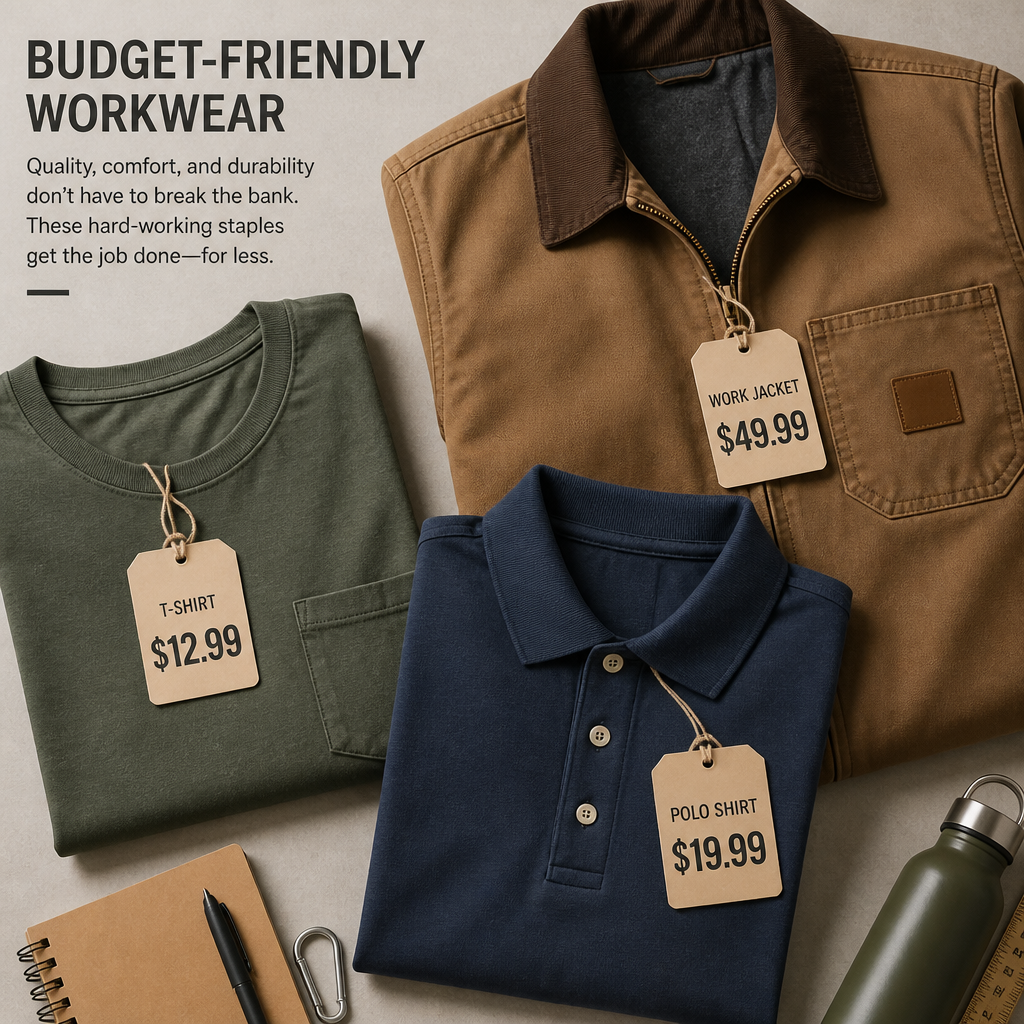
Custom t-shirts are the most cost-effective branded garment for most startups. They suit every body type, they are easy to size inclusively, and they get worn outside work hours, which extends your brand's public exposure beyond working time. Go for at least 180gsm fabric. Anything lighter starts to feel disposable and reflects poorly on the brand regardless of how good the print is.
Hoodies and Sweatshirts: High Perceived Value, Higher Cost
Branded hoodies cost more per unit than t-shirts but have a higher perceived value, which makes them useful for client-facing roles, event staff, and senior team members. A branded hoodie also gets worn for years, meaning the cost-per-impression figure drops significantly over its lifespan. Psyque offers custom hoodies and sweatshirts as part of their workwear bundles, making it straightforward to mix garment types in a single order.
Polos: The Right Choice for Customer-Facing Roles
Branded polos sit between t-shirts and formal shirts in terms of professionalism. They are the standard choice for tradespeople, retail staff, and hospitality teams. A polo shirt with a left-chest logo print looks professional without requiring the higher cost of an embroidered corporate shirt. For cheap custom workwear UK business owners running trades or service companies, polos are often the single most practical workwear investment.
Designing for Durability and Brand Impact
A well-designed logo for apparel is not the same as a well-designed logo for a website. Fabric introduces constraints that screen design does not have. Getting this right means your prints stay sharp through 50 washes instead of fading after 10.
File Format and Resolution Requirements
Always supply your artwork as a vector file (AI, EPS, or high-resolution PDF) or at minimum a PNG with a transparent background at 300dpi. Low-resolution JPEGs taken from a website look pixelated when printed at full garment size. This is one of the most common and easily avoidable reasons a startup ends up with poor-quality branded clothing.
Colour Choices That Hold Up on Fabric
Dark garments require white underbase layers in DTF printing to make colours pop. If your brand uses pastel or light tones, printing on a white or light grey garment eliminates the underbase requirement and reduces ink cost slightly. High-contrast designs, typically a bold primary colour on white or black, produce the cleanest, most durable results on DTF-printed workwear.
Placement That Works Across Garment Types
Left-chest placement is the professional standard for business workwear. Full back prints work well for event staff or teams where visibility from behind matters. Avoid sleeve-only prints on hoodies as a standalone branding choice, since sleeves distort with movement and the logo becomes difficult to read. For affordable custom clothing UK startups, sticking to left-chest or centre-chest placement on every garment type keeps your print costs consistent and your brand readable.
Comparing Your Workwear Printing Options
The table below compares the three main printing approaches UK startups use for branded workwear. The cost ranges are approximate and based on typical UK market rates for small to medium order quantities in 2024.
| Printing Method | Best For | Cost Per Unit (10-50 units) |
|---|---|---|
| DTF (Direct to Film) | Full-colour logos, small runs, mixed garment types, startups with evolving brand identity | £8 to £18 per garment including print (varies by garment type) |
| Screen Printing | Single or two-colour designs, large runs (100+ units), established brand with fixed logo | £15 to £30 per garment at low quantities due to setup fees; drops sharply above 100 units |
| Embroidery | Caps, polos, corporate outerwear, premium client-facing pieces | £12 to £25 per garment depending on stitch count and garment type |
For the majority of UK startups ordering between 10 and 50 units across multiple garment types, DTF printing consistently delivers the best combination of print quality, colour accuracy, durability, and cost per unit. This is why suppliers like Psyque have invested in in-house DTF and heat-press capabilities rather than outsourcing to third-party print houses.
Common Budget Workwear Mistakes UK Startups Make
Knowing what to avoid is as valuable as knowing what to do. These are the patterns that come up repeatedly when startups end up disappointed with their first workwear order.
Ordering Too Small to Hit Volume Pricing
A startup with 8 employees orders 8 shirts. They pay close to the highest per-unit price available, ship 8 times in the coming year as staff turnover happens, and end up spending more per shirt than a team of 20 would. Order at least 15 to 20 units from the start, even if some go into storage. The cost difference more than offsets the upfront outlay within two reorders.
Choosing the Cheapest Garment Available
The data consistently shows that the cheapest blank garment from the cheapest supplier produces workwear that staff do not want to wear. A garment that sits unworn in a drawer generates zero brand impressions. Spending 20% more on a higher-quality blank produces workwear that gets worn voluntarily, multiplying your return on the print cost significantly.
Ignoring Size Range Inclusivity
Ordering a size range that stops at XL excludes staff and creates an immediate morale issue. Most UK workwear suppliers carry sizes up to 3XL or 4XL as standard. Confirm size availability before committing to a garment style to avoid situations where part of your team cannot be uniformly branded.
Using a Low-Resolution Logo File
As noted above, a logo pulled from your website at 72dpi will not print cleanly. If you do not have a vector file, ask your designer or branding agency to supply one. If you used a free logo tool online, export the highest resolution PNG available with a transparent background before submitting to your printer.
Psyque handles the print and heat-press process in-house, which means their team can flag file quality issues before production rather than printing a poor result and shipping it anyway. That kind of quality control at the supplier level is worth factoring into your supplier choice, especially for first orders where the stakes of getting it wrong are higher.
Frequently Asked Questions
What is the minimum order quantity for budget branded workwear in the UK?
Most UK DTF printing suppliers, including Psyque, have no strict minimum order quantity, meaning you can technically order as few as one or two items. However, the most cost-effective starting point is around 10 to 15 units, where per-unit costs become reasonable and shipping becomes proportional. Below 10 units, the cost per garment is often high enough that you would be better off waiting until you can place a slightly larger order.
How long does branded workwear printing take in the UK?
Turnaround times vary by supplier, but most UK-based in-house printers can complete orders within 3 to 7 business days. Suppliers using overseas print partners often quote longer lead times. Psyque offers fast UK dispatch, which makes them a practical choice for event-deadline orders or new hire onboarding needs. Always confirm turnaround time before placing an order if you have a specific deadline.
Is DTF printing durable enough for workwear used in trades or outdoor roles?
Yes, professionally heat-pressed DTF transfers are highly durable and suitable for workwear used in physically demanding environments. The key variable is the quality of the heat-press application. Consumer-grade iron-on transfers fail quickly because they are applied at lower temperatures and inconsistent pressure. Industrial heat-press machines used by suppliers like Psyque bond the transfer at precise temperatures and pressure settings, producing a result that withstands repeated commercial washing without peeling or fading.
Can I mix different garment types in one branded workwear order?
Yes, and you should. Ordering t-shirts, polos, and hoodies in a single order from one supplier allows you to use a consistent logo file across all garment types, qualify for shipping thresholds on the combined order value, and present a cohesive brand identity across different team roles. Most suppliers apply the same print file to different garment types without additional artwork fees.
How do I keep my branded workwear costs low as my team grows?
The most effective approach is to standardise your garment range early and stick to it. Changing your workwear style or colour scheme with each new hire order means you restart the cost-per-unit curve every time. Establishing a consistent kit of two or three garment types in fixed brand colours allows you to consolidate reorders, reduce decision time, and build toward volume pricing brackets over time. Using a supplier with no minimum order quantity also means you can top up in small batches without penalty.
What is the difference between cheap custom workwear and budget branded workwear for UK businesses?
The distinction matters more than most startups realise. Cheap custom workwear prioritises the lowest possible unit price, often at the expense of garment quality, print durability, and size range. Budget branded workwear means getting the best possible quality and brand impact within a defined budget. The goal is to minimise waste, not to minimise spend. A garment that lasts three years and gets worn five days a week costs far less per impression than a cheap garment that fades and gets discarded after six months.
If you have experience ordering branded workwear for your UK startup, whether it went brilliantly or was a complete disaster, share what you learned in the comments below so other small business owners can benefit from your experience.
We would love your feedback and any insights you would share with others. What perspective would you add?
References
- Statista: UK promotional products and branded merchandise market data and consumer recall statistics
- Forbes: Small business branding strategy insights and ROI analysis for branded merchandise
- HubSpot: Marketing statistics on brand recall, promotional products, and visual brand identity
- UK Government business support resources for startups and small businesses on marketing budgets
- McKinsey: Research on employee engagement, workplace identity, and the role of shared visual branding in team cohesion