
Custom Printed Hoodies for Teams: UK Buying Guide
Ordering custom printed hoodies UK teams actually wear, rather than stuff in a drawer, comes down to decisions most buyers get wrong the first time. Fabric weight, print method, minimum order quantities, and artwork setup all interact in ways that are not obvious until you have a failed order sitting on your desk. This guide covers every decision point, in the order you will face it, based on real production experience rather than generalised advice. Whether you are kitting out a five-person trade crew or ordering branded hoodies for a 200-person corporate event, the principles are the same.
Table of Contents
- Why Hoodies Work for Team Apparel Better Than Other Garments
- Quick Takeaways
- Choosing the Right Hoodie Style for Your Group
- Print Methods Compared: DTF, Screen Print, and Embroidery
- Artwork Setup: What You Need Before You Order
- Sizing for Groups: How to Get It Right First Time
- Fabric Weight and Garment Quality: What the Numbers Mean
- Minimum Orders, Pricing Tiers, and What Drives Unit Cost
- Turnaround Times and UK Delivery: Planning Your Timeline
- Comparison: DTF, Screen Print, and Embroidery Side by Side
- Frequently Asked Questions
- References
Why Hoodies Work for Team Apparel Better Than Other Garments
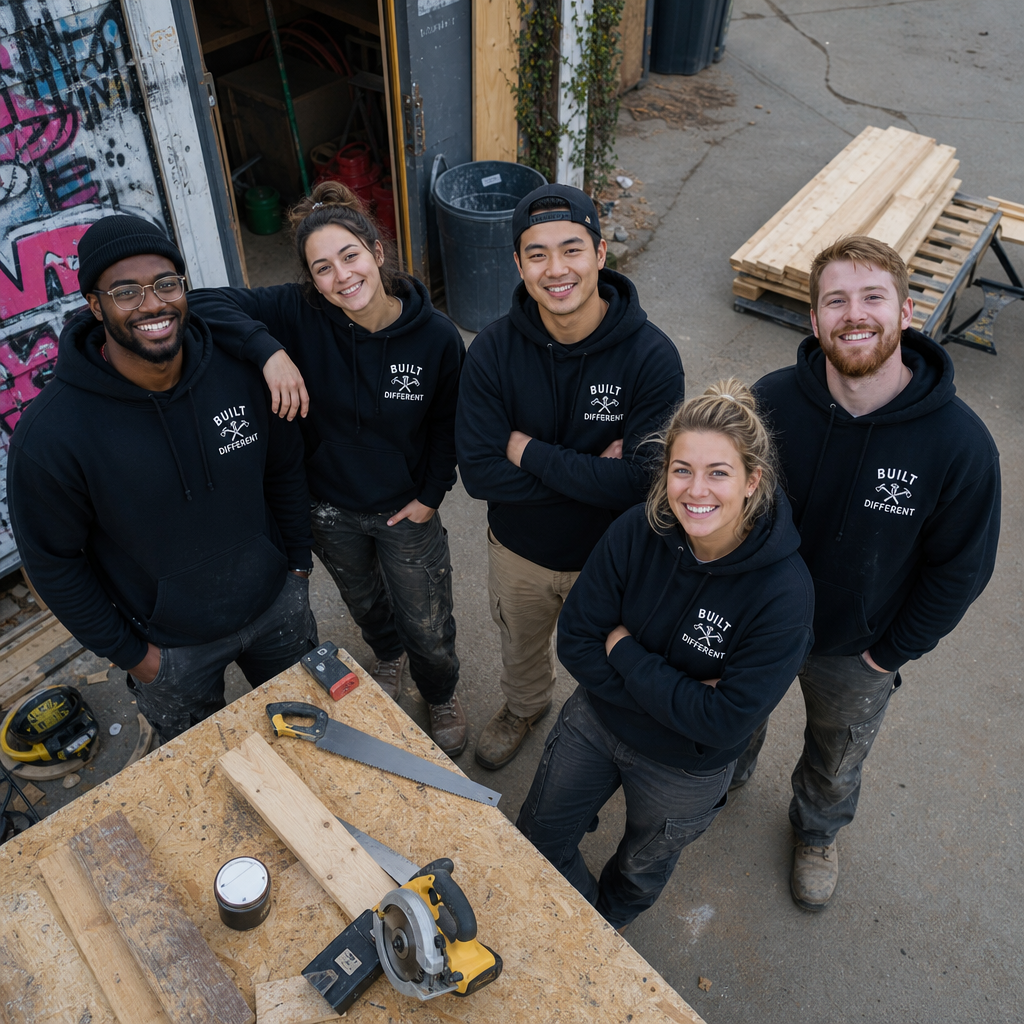
Hoodies outperform polo shirts and standard t-shirts for team visibility in the UK climate for one straightforward reason: they get worn outside the work context. A branded hoodie worn on a commute or at a weekend market extends your brand exposure without any additional effort or cost. That passive exposure is something a polo shirt locked in a work locker never achieves.
For small business owners and workwear buyers specifically, hoodies also solve a practical problem. They layer over uniform pieces in cold weather, eliminating the need for separate branded outerwear. One well-chosen hoodie replaces two or three separate garment decisions.
Quick Takeaways
| Key Insight | Explanation |
|---|---|
| DTF printing handles complex artwork without setup fees | Direct to Film transfers reproduce photographic detail and gradients that screen printing cannot match at low quantities, making it the best choice for most small team orders under 50 units. |
| 300gsm fabric is the minimum for a premium feel | Anything below 280gsm will look thin and feel cheap after washing. For workwear that needs to survive daily use, 300gsm to 350gsm is the practical target range. |
| Artwork must be supplied at 300dpi or vector format | Low-resolution logos are the single most common cause of print quality problems. A JPEG screenshot of a logo will not reproduce cleanly. Always supply an SVG or AI file if you have one. |
| Size splits matter more than total quantity | A group order of 30 hoodies split across 8 sizes causes fulfilment complexity. Collect sizes from every team member before you order, not after. Errors here cannot be corrected after printing. |
| Free shipping thresholds reduce per-unit cost significantly | Psyque offers free UK shipping on orders over £45, which at typical hoodie prices means even small group orders qualify. Factor this into your budget comparison with other suppliers. |
| Print placement affects durability | Chest prints on the left breast pocket area experience less cracking and peeling than full-front prints because the surface curves less during wear. For workwear, left chest placement is more durable long-term. |
| Turnaround time is not the same as delivery time | Production time and shipping time are two separate figures. Always ask for both. A supplier quoting 3-day dispatch may still need 5 working days in production before that clock starts. |
Choosing the Right Hoodie Style for Your Group
The first decision is whether you need a pullover hoodie or a zip-up. This matters more than most buyers realise. Pullover hoodies give you a larger, uninterrupted print surface across the chest and back. Zip-up hoodies split that surface in half the moment the zip opens, which means chest prints are less visible in use. For brand visibility, pullover wins every time.
Pullover Hoodies for Maximum Print Visibility
A pullover provides a flat, stable canvas for a full-chest or full-back design. For event teams, sports groups, and branded workwear, this is almost always the right call. The print stays visible whether the wearer is moving or stationary. Psyque's custom hoodie range is built around pullover styles precisely because this is what branded orders require.
Zip-Up Hoodies for Versatility
Zip-up styles work better when the hoodie is worn open over another garment, where the full-front print visibility trade-off is acceptable. In practice, zip-ups are most appropriate for corporate casual or hospitality settings where versatility matters more than bold branding. If your team will be standing at a trade stand in January, a zip-up is going to be more comfortable. If they are serving customers at a branded event, a pullover projects better.
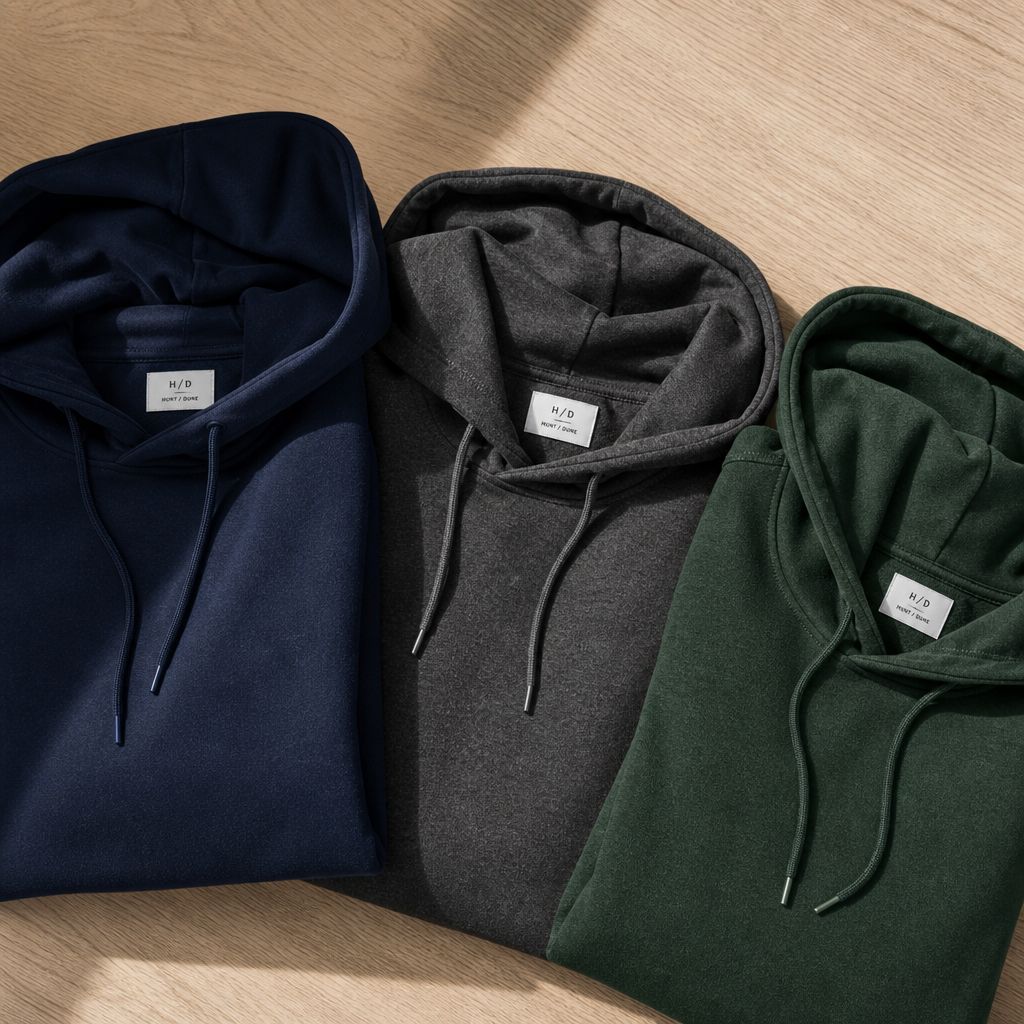
Colour selection follows style. A common mistake is choosing too many colourways to accommodate personal preference. Standardise on one or two colours maximum. Mixed colourways across a team undermine the visual coherence that makes branded apparel worth the investment in the first place.
Print Methods Compared: DTF, Screen Print, and Embroidery
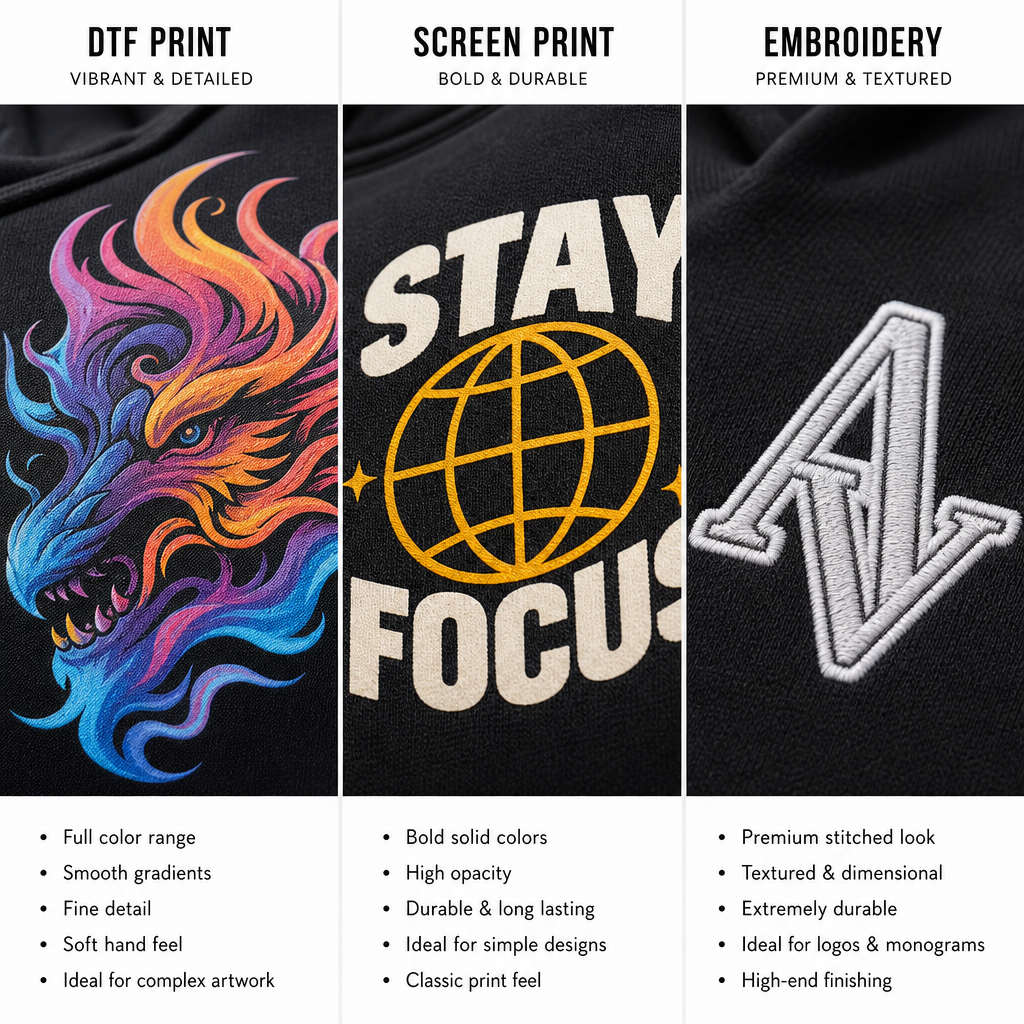
The print method is the single most consequential technical decision in your order. It affects colour reproduction, durability, minimum quantities, cost, and how the finished garment feels. There is no universally best method. The right one depends on your artwork, quantity, and end use.
DTF (Direct to Film) Printing
DTF printing transfers a full-colour design from a film carrier onto the garment using heat and pressure. It handles gradients, photographic images, and fine detail that other methods cannot reproduce at low volumes. There are no colour separation fees or screen setup charges. This makes DTF the practical default for most custom team hoodie orders in the UK, particularly for orders under 100 units. Psyque uses in-house DTF printing and heat-press technology specifically to deliver this without the setup costs that screen printing requires.
Screen Printing
Screen printing uses separate screens for each colour in a design. It produces vivid, opaque colours with excellent washfastness, and the per-unit cost drops significantly at quantities above 50 to 100 units. The limitation is cost at low volumes. Each colour requires a separate screen, and setup fees of £20 to £50 per colour are standard across UK suppliers. A four-colour logo costs £80 to £200 in setup fees before a single hoodie is printed. For large runs with simple artwork, screen printing is highly cost-effective. For small teams with complex logos, it is not.
Embroidery
Embroidery is the most durable decoration method and conveys a premium feel that neither DTF nor screen printing quite matches. The limitation is detail. Fine lines and small text below 6mm height cannot be reproduced accurately in thread. Embroidery also adds physical weight to the garment and can stiffen the fabric around the design area. It works excellently for left-chest logos in one or two colours. It does not work for full-back photographic designs or anything requiring gradient colour.
Pro tip: If your logo has fine detail, gradients, or more than four colours, DTF is the only method that will reproduce it accurately at a practical price point for team quantities under 100 units. Do not let a supplier simplify your artwork to fit a screen printing constraint. Get the print quality your brand deserves.
Artwork Setup: What You Need Before You Order
Artwork problems delay more orders than any other single factor. The requirements are not complicated, but ignoring them creates real problems that cannot be solved after production starts.
File Formats That Actually Work
Vector files (SVG, AI, EPS, PDF) are the correct format for logo-based artwork. They scale to any size without losing quality. If you are ordering hoodies with a large back print and you only have a PNG pulled from your website, your print quality will suffer. Ask your designer or brand agency for the original vector source file before you place any order. Most designers can supply this in minutes if asked correctly.
For photographic or illustrated artwork supplied as raster images (PNG, JPEG, TIFF), the minimum resolution for print is 300 dots per inch at the final print size. A logo that is 72dpi on a screen at 10cm wide is not equivalent to a 300dpi file at 10cm wide. The pixel count is completely different.
Colour Modes and Brand Accuracy
Screen displays use RGB colour. Printing uses CMYK. The same orange that looks vivid on a monitor will print differently if the CMYK values are not correctly specified. For brand colour accuracy, supply Pantone references alongside your artwork file. This is the professional standard and most reputable UK printers, including Psyque, work with Pantone references to match brand colours precisely.
Pro tip: Always request a digital proof before production begins. A digital proof shows your artwork placed on the actual garment at scale. It takes a few minutes to review and eliminates the most common sizing and placement errors before they are permanently heat-pressed onto 30 hoodies.
Sizing for Groups: How to Get It Right First Time
Group sizing is where well-organised orders fall apart. The problem is not that sizing is complicated. The problem is that buyers assume they know their team's sizes and order based on a rough guess, then discover that three people cannot wear their hoodie and two others received the wrong size.
Collect Individual Sizes Before You Order
Send a simple form to every team member with the supplier's specific size guide attached. Do not use a generic size chart. Every garment brand runs differently. A medium in one manufacturer's hoodie is a different fit from a medium in another's. Psyque provides garment-specific size guides for this exact reason. Collect responses, close the form, then place the order. This single step eliminates the most common post-delivery complaint in group apparel orders.
Unisex Fit Versus Gender-Specific Sizing
Most team hoodies are supplied in a unisex fit. Unisex garments run with a slightly boxy cut that works well for workwear but can feel oversized for wearers accustomed to fitted styles. In mixed teams, it is worth noting on your size collection form that the garment is unisex and advising wearers who prefer a fitted look to consider sizing down. This avoids the situation where half the team's hoodies feel wrong on delivery.
Fabric Weight and Garment Quality: What the Numbers Mean
Fabric weight is measured in grams per square metre (GSM). For hoodies specifically, the weight directly determines warmth, durability, and how the garment holds its shape after repeated washing. This is not a subjective quality metric. It is a physical measurement you can use to compare garments objectively.
In practice, hoodies below 280gsm feel noticeably thin and tend to pill quickly with regular washing. The print surface also degrades faster on lightweight fabrics because the garment stretches more during wear. 300gsm to 320gsm is the standard for quality branded workwear, and anything above 350gsm crosses into heavyweight territory suitable for outdoor trades in cold conditions.
Cotton composition also matters. A 100% cotton hoodie breathes better but shrinks more. A 50% cotton, 50% polyester blend resists shrinkage and holds colour better after washing, but breathes less. For printed workwear that needs to maintain its shape and print quality through hundreds of washes, a cotton-polyester blend at 300gsm or above is the correct specification.
"The garment is the canvas. If the canvas is poor quality, the best print technology in the world cannot compensate. Weight, composition, and construction determine whether your branded hoodie still looks professional after 50 washes or looks worn out after 10." -- Industry standard principle repeated by every serious UK garment decorator.
Minimum Orders, Pricing Tiers, and What Drives Unit Cost
Most UK custom hoodie suppliers impose minimum order quantities (MOQs) of between 5 and 25 units depending on the print method. Screen printing MOQs are typically higher because setup costs must be distributed across enough units to be commercially viable. DTF printing has lower or no effective MOQs because there are no per-job setup screens to recover.
Unit cost follows a volume curve. Ordering 10 hoodies costs significantly more per unit than ordering 50, which in turn costs more than ordering 100. The price break points vary by supplier, but as a working rule, you should expect meaningful price reductions at 25 units, 50 units, and 100 units. If your group size sits just below a price break, it is worth calculating whether adding a few extra units brings the total cost down despite the higher quantity.
For event organisers and team managers specifically, the Psyque workwear bundles approach bundles garment cost and printing into straightforward pricing that avoids the surprise setup fees that competitors like JRS Industrial and Order Uniform often apply on top of quoted garment prices. Always ask suppliers whether their quoted price is all-inclusive or whether artwork setup, screen fees, or delivery are additional.
Turnaround Times and UK Delivery: Planning Your Timeline
The most common order mistake is leaving too little time. Buyers see a deadline, divide the time available in half, and assume that is sufficient buffer. It is not. Production time for custom printed hoodies in the UK typically runs 3 to 10 working days depending on order complexity and supplier workload. Add delivery time, and a realistic lead time from order placement to receipt is 5 to 15 working days under normal conditions.
Peak periods, notably October through December and the run-up to major sporting events, extend lead times further. If you are ordering for Christmas, a New Year event, or a summer sports season, add a minimum of 5 additional working days to your estimate and order accordingly. A common mistake is ordering in the second week of December for a Christmas party the following week. No reputable UK supplier can guarantee that turnaround without significant rush fees, and rush fees frequently make the per-unit economics unviable.
Psyque operates with fast UK dispatch, which means production and shipping are handled domestically without the delays that offshore-printed competitors introduce. Orders over £45 qualify for free UK shipping, which for most team hoodie orders of any meaningful size is a given. Factor delivery cost into your total budget comparison with suppliers that do not offer free shipping thresholds.
Comparison: DTF, Screen Print, and Embroidery Side by Side
The table below compares the three main decoration methods across the criteria that matter most for team hoodie orders. Use it as a reference when briefing a supplier or evaluating quotes.
| Criteria | DTF Printing | Screen Printing | Embroidery |
|---|---|---|---|
| Best for order size | 1 to 100 units | 50 to 500+ units | Any quantity, best at 10+ |
| Colour complexity | Unlimited, including gradients and photos | Best at 1 to 4 spot colours | Best at 1 to 6 thread colours, no gradients |
| Setup cost | None or minimal | £20 to £50 per colour screen | £15 to £40 digitising fee per design |
| Wash durability | High, improves with quality fabric | Very high on correct fabric | Highest of all three methods |
| Fine detail reproduction | Excellent, including small text | Good, limited below 2mm stroke | Poor below 6mm text height |
| Feel on garment | Soft, flexible, low profile | Slightly raised, opaque finish | Raised, textured, premium feel |
| Ideal for | Complex logos, full-colour designs, small teams | Simple designs at high volume | Left-chest logos, premium corporate wear |
Frequently Asked Questions
What is the minimum order quantity for custom printed hoodies in the UK?
It depends on the print method. DTF printing suppliers, including Psyque, typically accept orders from as low as 1 unit, though unit economics improve meaningfully from around 10 units upward. Screen printing suppliers generally require a minimum of 25 to 50 units because screen setup costs must be spread across the order. If your team is small, DTF is almost certainly the correct method.
How long does it take to receive custom team hoodies after ordering?
Realistically, allow 7 to 14 working days from order confirmation to delivery for a standard UK order. This includes production time of 3 to 10 working days and delivery of 1 to 3 working days. During peak periods such as November and December, add 5 additional working days minimum. Always confirm both production lead time and shipping time separately when requesting a quote.
What file format should I send for my logo?
Vector format is always preferred: SVG, AI, EPS, or a high-quality PDF. These files scale to any print size without quality loss. If you only have a raster image such as a PNG or JPEG, it must be at least 300 dots per inch at the intended print size. A logo pulled from a website at 72dpi will produce a blurry print and most professional suppliers will flag this before production, but not all do. Source your vector file from your designer before ordering.
Can I order different sizes within a single team hoodie order?
Yes. All reputable custom hoodie suppliers in the UK accept size splits within a single order. The practical limit is that very granular splits, for example one unit in each of eight sizes, may push some suppliers above their minimum quantity threshold per size. Collect individual sizes from your team before ordering and submit a complete size breakdown with your order. Do not guess and adjust later. Once hoodies are printed, size changes are not possible.
What is the difference between branded hoodies for groups and standard hoodies?
The garment itself may be identical. The difference is in print placement, artwork complexity, and the production process. Branded group orders typically require consistent print placement across all units, colour-matched brand colours, and artwork proofing before production. Standard retail hoodies have no custom decoration. When ordering branded hoodies for groups, always request a proof, confirm Pantone colour matching if brand accuracy matters, and verify that all units will be checked for print consistency before dispatch.
Are DTF prints on hoodies washable and durable?
DTF prints are durable when the correct washing instructions are followed. Turn garments inside out, wash at 30 to 40 degrees Celsius, and avoid tumble drying on high heat. Under these conditions, a quality DTF print on a 300gsm or heavier hoodie should maintain its colour and adhesion for well over 50 wash cycles. The garment fabric itself is typically the first thing to show wear, not the print. Cheap, lightweight hoodies degrade faster regardless of print method.
How do I calculate how many hoodies to order for my team or event?
Order exactly the number you need, plus a 5% to 10% buffer for large orders to account for fit issues or last-minute team additions. For events, account for staff, volunteers, and any VIP or speaker allocations separately. Do not over-order assuming you will sell surplus units. Surplus custom-printed garments with a specific team name or event date have essentially zero resale value. Collect confirmed sizes and names before placing your final order.
If you have ordered custom printed hoodies for a team before, share what worked, what did not, and what you wish you had known before placing your first order.
We would love your feedback and any insights you would share with others. What perspective would you add?
References
- Global and UK apparel market data and consumer spending statistics on clothing
- Forbes coverage of branded merchandise, corporate identity, and small business marketing
- HubSpot marketing statistics on brand recognition and promotional product effectiveness
- Ahrefs research on consumer search behaviour for custom printed apparel and workwear
- British Print industry standards and guidance on garment decoration methods and quality benchmarks