
Custom Printed T-Shirts for UK Events: The Full Guide
Roughly 30% of event attendees say branded merchandise is what they remember most about an event, according to the British Promotional Merchandise Association. Yet most UK event organisers and small business owners leave this entirely to chance, ordering the wrong quantities, choosing the wrong print method, or missing their deadline by a week. This guide covers everything you need to know about ordering custom printed t-shirts for UK events, from choosing the right garment and print method to nailing quantities and turnaround times, so your next festival, corporate day, or team event actually looks the part.
Table of Contents
- Why Custom T-Shirts Matter at UK Events
- Choosing the Right Print Method
- Garment Selection for UK Weather and Events
- Design Principles That Work on Fabric
- Print Method Comparison
- Ordering Quantities and Turnaround Times
- Budgeting for Event T-Shirts in the UK
- Workwear and Staff Uniform Use Cases
- Frequently Asked Questions
- References
Why Custom T-Shirts Matter at UK Events
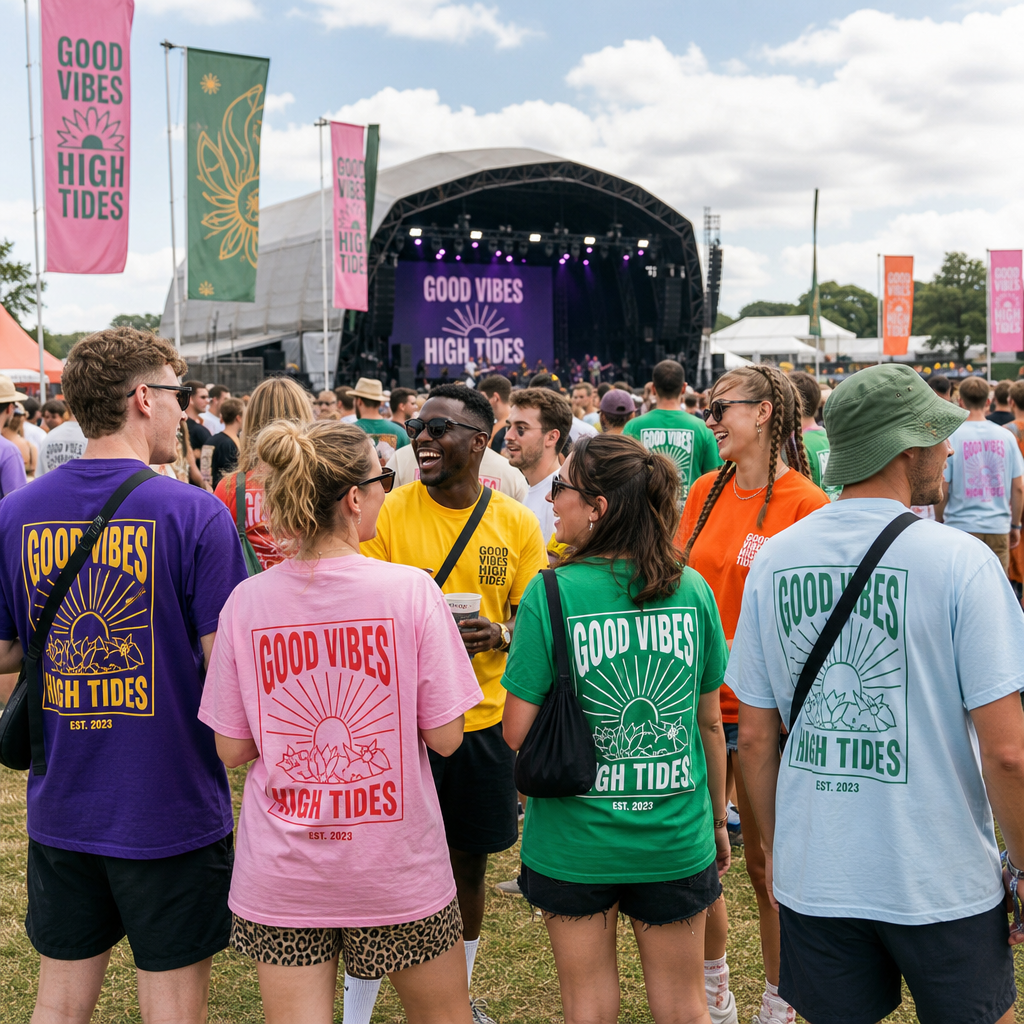
Custom printed t-shirts do two things at once: they give your team or group a clear visual identity, and they act as walking advertisements long after the event is over. At a busy festival or trade show, branded clothing is often the only thing that separates your staff from the crowd. A well-printed t-shirt communicates professionalism and intent without a single word being spoken.
The data consistently shows that branded merchandise outperforms digital advertising for recall. According to the BPMA, a promotional item is kept for an average of 8 months, meaning a well-made event t-shirt continues marketing your brand or cause well past the event date. Cheap, poorly printed shirts do the opposite: they signal low quality and tend to be discarded immediately.
In practice, event t-shirts in the UK serve three distinct audiences: staff who need to be identifiable, attendees who want a memento, and sponsors or partners who want their branding visible. Each audience has slightly different needs, and the best event orders account for all three.
Choosing the Right Print Method
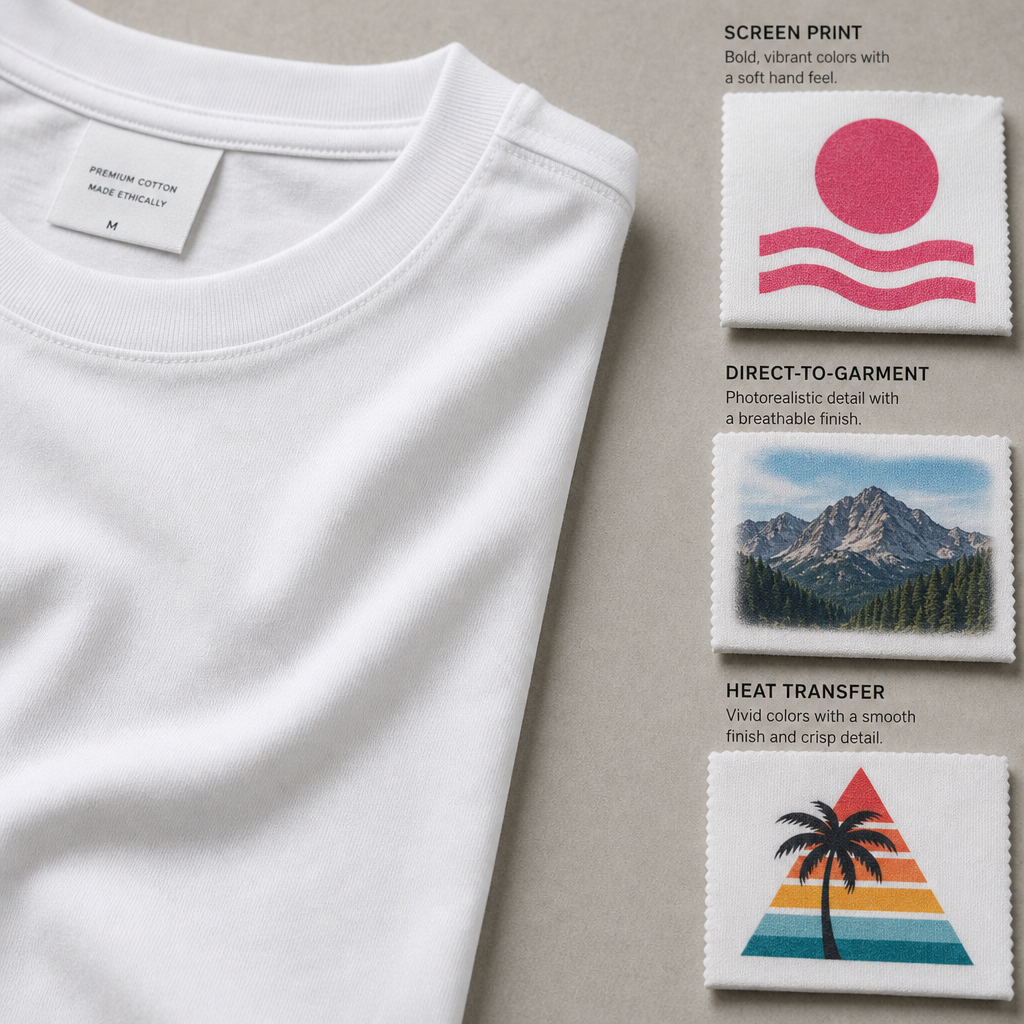
The print method is the single most important technical decision you will make when ordering festival custom clothing in the UK. Each method has a different cost structure, colour range, minimum order quantity, and durability profile. Getting this wrong means either overpaying or receiving prints that crack after two washes.
DTF (Direct to Film) Printing
DTF printing is the method Psyque uses in-house, and for good reason. It produces vibrant, full-colour prints with no minimum order quantity, no colour limitations, and exceptional durability. Unlike screen printing, there are no setup screens to pay for, which makes it genuinely cost-effective for orders ranging from 5 to 500 units. The print is applied via heat press, bonding directly to the fabric rather than sitting on top of it.
A common mistake is assuming DTF is only for small runs. It handles large orders just as efficiently, with consistent colour accuracy across every garment in the batch.
Screen Printing
Screen printing is the traditional choice for large volume single-colour or limited-colour designs. It becomes cost-effective at around 50 units and above, but the per-colour setup cost makes it expensive for photographic or gradient-heavy designs. For a festival where you want a single bold logo on 200 shirts, it can work well. For a design with 6 colours and subtle shading, it is the wrong tool.
Embroidery
Embroidery suits workwear and polo shirts where a premium finish is required, but it is not suited for large printed graphics or festival merchandise. It costs more per unit and has limited detail resolution. Use it for staff uniforms where longevity and a professional appearance matter more than print complexity.
Pro tip: If your design includes more than three colours or any photographic elements, DTF printing will almost always produce a better result than screen printing at a lower setup cost, especially for event orders under 150 units.
Garment Selection for UK Weather and Events
The UK climate means you cannot always rely on a light cotton t-shirt being comfortable for an outdoor event. Choosing the right base garment affects print quality, wearability, and how long the item stays in circulation after the event.
T-Shirts for Summer Festivals and Outdoor Events
For summer festivals, a 180-190gsm cotton or cotton-poly blend is the practical standard. Lighter weights (under 160gsm) tend to feel insubstantial and the print can appear less opaque. Heavier weights (over 220gsm) can feel too warm and add unnecessary cost. Brands like Gildan, AWD, and Stanley/Stella offer reliable mid-weight blanks that hold DTF prints exceptionally well.
Avoid 100% polyester garments for events where attendees will wear the shirt casually after the event. Polyester does not breathe well, and while it works fine for sportswear, it tends to feel cheap as casual wear.
Hoodies and Sweatshirts for UK Autumn and Indoor Events
For events running into the evening or taking place in autumn and winter, custom printed hoodies and sweatshirts are the better choice. They carry larger print areas, offer more surface for branding, and are kept far longer than a t-shirt. The cost per unit is higher, but the retention rate justifies the investment for staff uniforms and premium event merchandise.
Psyque offers custom hoodies and sweatshirts with the same in-house DTF printing, meaning your event branding stays consistent whether it is on a t-shirt or a hoodie.
Pro tip: Order a mix of garment types for large events. Provide staff with hoodies for outdoor visibility and durability, and offer printed t-shirts as lower-cost attendee merchandise. This approach manages budget without compromising on staff presentation.
Design Principles That Work on Fabric
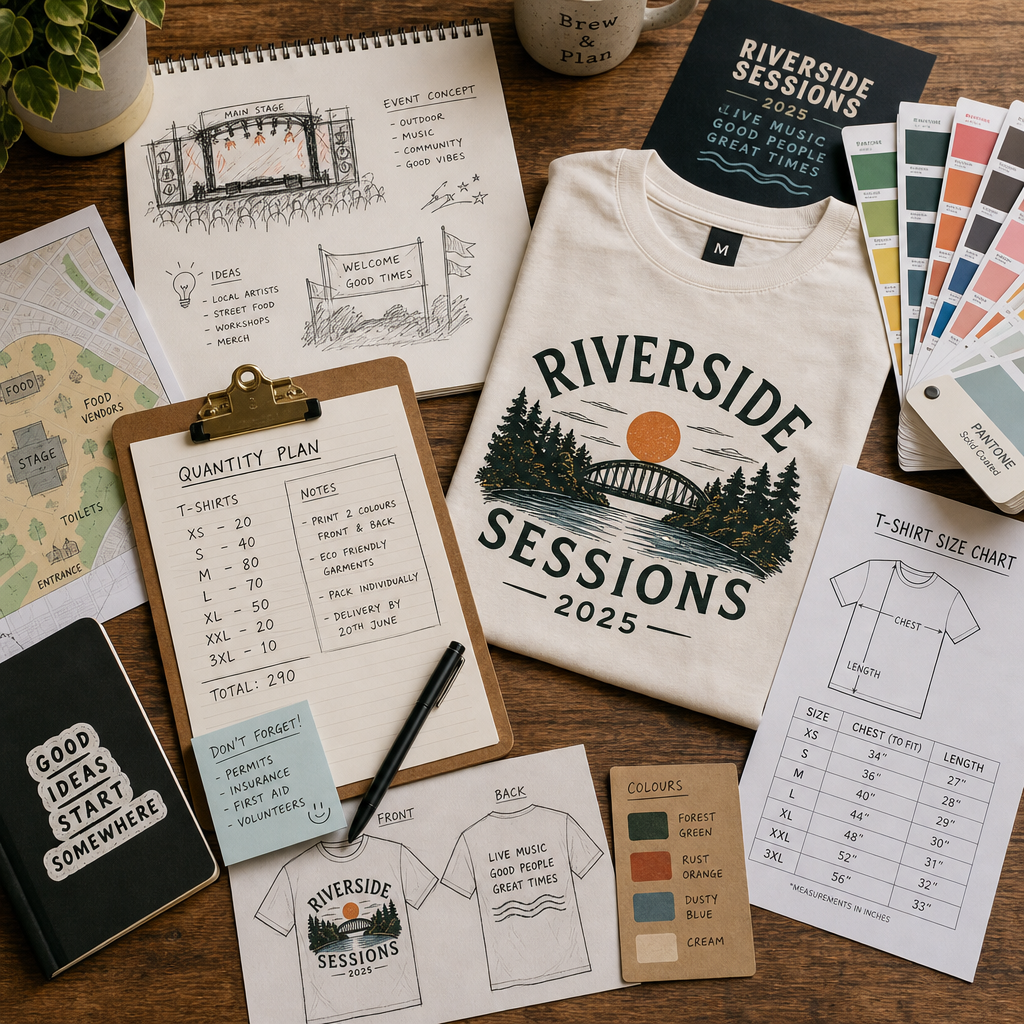
A design that looks excellent on a screen can look poor on fabric if it is not prepared correctly for garment printing. This is one of the most common points where event orders go wrong, particularly for buyers who supply their own artwork.
The first rule is resolution. Artwork intended for print should be at least 300dpi at the intended print size. A logo exported from a website at 72dpi will appear blurry and pixelated when printed at chest size. Always supply vector files (AI, EPS, or SVG) where possible, or high-resolution PNG files with transparent backgrounds.
The second rule is colour contrast. Dark prints on dark garments lose visibility fast. If your brand uses navy blue as its primary colour, a dark navy garment will make that branding nearly invisible. Either choose a garment colour that contrasts with your design, or use a white base layer in your artwork to make the print stand out.
The third rule is print placement. For event t-shirts, the standard left chest placement works well for logos and small branding. For large graphic designs, a full front print between the collar and midriff is the most impactful option. Back prints work well for team names and event details that attendees will read when people walk ahead of them.
"The biggest design mistake we see is event organisers submitting low-resolution files they pulled from their website. Always prepare your artwork at print resolution before you order, and if in doubt, ask your printer to confirm the file is print-ready before production starts." - Psyque Production Team
Print Method Comparison
The table below compares the three main print methods used for event t-shirts UK suppliers commonly offer. Use it to match your order requirements to the most appropriate method.
| Print Method | Best For | Key Limitations |
|---|---|---|
| DTF (Direct to Film) | Full-colour designs, small to large runs (5-500+ units), photographic artwork, no setup cost, works on cotton and blends | Slightly higher per-unit cost than screen printing at very high volumes (1000+ units) |
| Screen Printing | High volume, single or limited colour designs, exact Pantone colour matching required | Per-colour setup cost, minimum quantities apply, poor for gradients or photographic artwork |
| Embroidery | Premium workwear, polo shirts, staff uniforms where durability and texture matter | Limited detail, no gradients, higher cost per unit, not suited for large graphic prints |
Ordering Quantities and Turnaround Times
Getting the quantity wrong is one of the most expensive mistakes in event merchandise. Order too few and you run out before the event ends, leaving staff without uniforms or merchandise sold out before the afternoon session. Order too many and you are left with excess stock that has limited use after the event.
How to Estimate the Right Quantity
For staff uniforms, the formula is simple: one shirt per staff member, plus 10-15% as replacements for sizing errors or last-minute additions. For merchandise, a safe starting point is 40-50% of your expected attendance for paid events, and 20-30% for free events where merchandise is sold rather than given away.
For UK festivals and events where t-shirts are sold as merchandise, the data consistently shows that sizes M and L account for around 55-60% of total sales, with XL at around 20%, S at around 12%, and XXL and XS making up the remainder. Order accordingly, rather than splitting evenly across sizes.
UK Turnaround Times to Plan Around
Most UK DTF printers, including Psyque, can complete standard orders within 5-10 working days from artwork approval. Rush orders are possible but come at a premium. The realistic planning timeline is 3-4 weeks from initial enquiry to delivery, which accounts for back-and-forth on artwork, approval, production, and dispatch.
A common mistake is leaving the t-shirt order until two weeks before the event. If your artwork needs revisions or there is a sizing query, that two-week window disappears fast. Start the process 6-8 weeks out for any order above 50 units.
Budgeting for Event T-Shirts in the UK
Budget is almost always the first question event organisers ask, and it is the right question to ask early. The total cost of an event t-shirt order depends on four variables: garment quality, print complexity, quantity, and any setup or delivery costs.
As a rough guide for DTF printed t-shirts in the UK, expect to pay between £8 and £15 per unit for standard mid-weight garments with a full-colour front print, at quantities between 20 and 100 units. Prices decrease at higher quantities. Hoodies and sweatshirts typically range from £18 to £30 per unit depending on garment quality and print size.
Psyque offers free UK shipping on orders over £45, which makes a meaningful difference for smaller event orders. Always confirm whether your supplier includes delivery in the quoted price or adds it at checkout. Some suppliers quote attractively but add significant delivery costs for bulk orders.
For small business owners ordering branded workwear bundles, combining garment types in a single order (for example, t-shirts and hoodies together) often unlocks better per-unit pricing and reduces shipping costs compared to placing separate orders. Psyque's workwear bundles are structured specifically for this use case.
Workwear and Staff Uniform Use Cases
Event t-shirts and festival merchandise get most of the attention in this space, but custom printed workwear for event staff is just as important. A clearly identified team creates a safer, more professional event environment and reflects directly on the organiser's brand.
The most effective staff uniform combinations for UK events include a printed t-shirt or polo for front-of-house staff, a printed hoodie or sweatshirt for outdoor and evening crew, and a printed cap or additional accessory for team leads or security. This creates a visual hierarchy that attendees can read instantly.
For small business owners who attend trade shows, markets, or networking events, custom printed polo shirts and branded hoodies serve as both uniform and marketing tool. Unlike a business card, a well-printed garment is seen by everyone in the room for the entire duration of the event. Psyque's in-house DTF printing means you can order a small run of branded polos without paying screen printing setup fees, making it viable even for a single market stall or pop-up event.
When ordering workwear bundles for events, include washing instructions in your briefing to staff. DTF prints are durable, but washing inside-out at 30-40 degrees and avoiding tumble drying on high heat significantly extends the life of the print. This matters when staff will wear the same garment across multiple events or market days.
Frequently Asked Questions
What is the minimum order quantity for custom printed event t-shirts in the UK?
With DTF printing, there is no strict minimum order quantity. Psyque can print from a single unit upward, which makes it practical for small teams, pilots, or mixed-size event bundles. Screen printing typically requires a minimum of 25-50 units per design to be cost-effective due to setup costs.
How far in advance should I order custom t-shirts for a UK festival or event?
Order at least 6-8 weeks before your event if you have more than 50 units. For smaller orders, 3-4 weeks is usually sufficient, but this assumes your artwork is print-ready from day one. Last-minute artwork changes are the most common cause of delayed event orders.
Which fabric is best for printed festival t-shirts worn outdoors in the UK?
A 180-200gsm cotton or 60/40 cotton-polyester blend is the practical standard for outdoor festival t-shirts in the UK. It prints well with DTF, breathes in warm weather, and holds its shape after washing. Avoid very lightweight fabrics under 160gsm, as the print can appear translucent on lighter garments.
Can I supply my own artwork for custom event t-shirts?
Yes, and most printers prefer it. Supply your artwork as a high-resolution PNG (minimum 300dpi at print size) with a transparent background, or as a vector file in AI or EPS format. If your logo is only available as a low-resolution JPEG from your website, ask your printer to advise whether it is suitable before placing the order.
What is the difference between DTF printing and screen printing for event t-shirts?
DTF printing applies full-colour artwork through a heat-pressed film with no setup fees and no colour limitations, making it ideal for event orders with detailed logos or photographic designs. Screen printing uses physical screens per colour, making it more cost-effective at very high volumes for simple, single or dual-colour designs, but it becomes expensive and impractical for multicolour or photographic artwork.
Does Psyque offer free delivery on event t-shirt orders?
Yes. Psyque offers free UK shipping on orders over £45, which covers the vast majority of event and workwear bundle orders. For orders below that threshold, standard UK delivery charges apply. All orders are dispatched from the UK, so there are no import delays or international shipping complications.
Are custom printed t-shirts suitable as merchandise to sell at UK events?
Absolutely, and they are often the highest-margin merchandise item at festivals and community events. The key is ordering the right size split (focus on M and L), choosing a garment weight that feels premium enough to justify the sale price, and ensuring your design is bold enough to be visible from across a stall. DTF printing handles the full-colour, detailed designs that sell best as event merchandise.
If you have ordered custom printed t-shirts for a UK event or festival, share what worked well for you and what you would do differently next time.
We would love your feedback and any insights you would share with others. What perspective would you add?
References
- Statista: UK promotional merchandise and branded apparel industry data and market statistics
- Forbes: Business branding and promotional merchandise effectiveness for small businesses and events
- HubSpot Marketing Statistics: Brand recall and promotional item retention research and benchmarks
- Ahrefs Blog: Consumer search behaviour trends for custom merchandise and branded clothing in the UK
- Moz Learn SEO: How branded search and local intent shape purchasing decisions for event merchandise suppliers