
Custom Sports Kit Printing UK: DTF Guide for Teams
Most teams ordering custom sports kit printing UK make the same expensive mistake: they choose a supplier based on price alone, then receive faded prints after three washes and numbers that peel mid-season. DTF (Direct to Film) printing has changed what teams should expect from printed club kits in the UK, delivering full-colour, wash-resistant graphics that traditional screen printing and embroidery simply cannot match on performance fabrics. This guide covers everything, from how DTF works on sports garments to what your club or team actually needs to order, price, and reorder without wasting money.
Table of Contents
- Quick Takeaways
- What Is DTF Printing and Why It Suits Sports Kits
- DTF vs Other Printing Methods for Club Kits
- What You Can Print on Your Team Kit
- Choosing the Right Garments for Your Kit
- Ordering Custom Team Clothing DTF UK: The Process Step by Step
- Minimum Order Quantities and Pricing for Printed Club Kit UK
- Artwork and Design Requirements
- Durability and Care for DTF Printed Kit
- Frequently Asked Questions
- References
Quick Takeaways
| Key Insight | Explanation |
|---|---|
| DTF works on polyester and blended fabrics | Unlike screen printing, DTF transfers bond to synthetic performance fabrics, making it ideal for sports shirts, training tops, and moisture-wicking garments. |
| No minimum order is a real advantage for small clubs | DTF printing does not require screen setup costs, so you can order single pieces or small runs without the per-unit price explosion common with screen printing. |
| Full-colour prints cost the same as single-colour | Because DTF uses a digital process, printing a club crest with six colours costs no more than printing a single-colour number. This changes how teams should design their kit. |
| Artwork file quality determines print quality | Supplying a PNG at 300 DPI or a vector file (.AI, .PDF, .EPS) produces a sharp result. A low-resolution logo stretched to shirt-front size will print soft and pixelated. |
| Wash durability depends on pressing technique, not just ink | A DTF transfer applied at the correct temperature (around 160°C) and pressure will survive 50+ washes. Incorrect heat-pressing is the most common cause of premature peeling. |
| Reordering individual garments is viable with DTF | When a player joins mid-season, you can order one shirt with their name and number without reprinting the whole squad. Screen printing cannot do this economically. |
| DTF can reproduce photographic and gradient artwork | Sponsor logos with gradients, photographic crests, or complex artwork that would require expensive separations in screen printing are straightforward with DTF. |
What Is DTF Printing and Why It Suits Sports Kits
DTF stands for Direct to Film. The process prints your artwork onto a special release film using water-based inks, coats it with a hot-melt adhesive powder, cures it with heat, and then heat-presses the finished transfer onto your garment. The result is a full-colour, flexible print that sits cleanly on the fabric surface without blocking the weave.
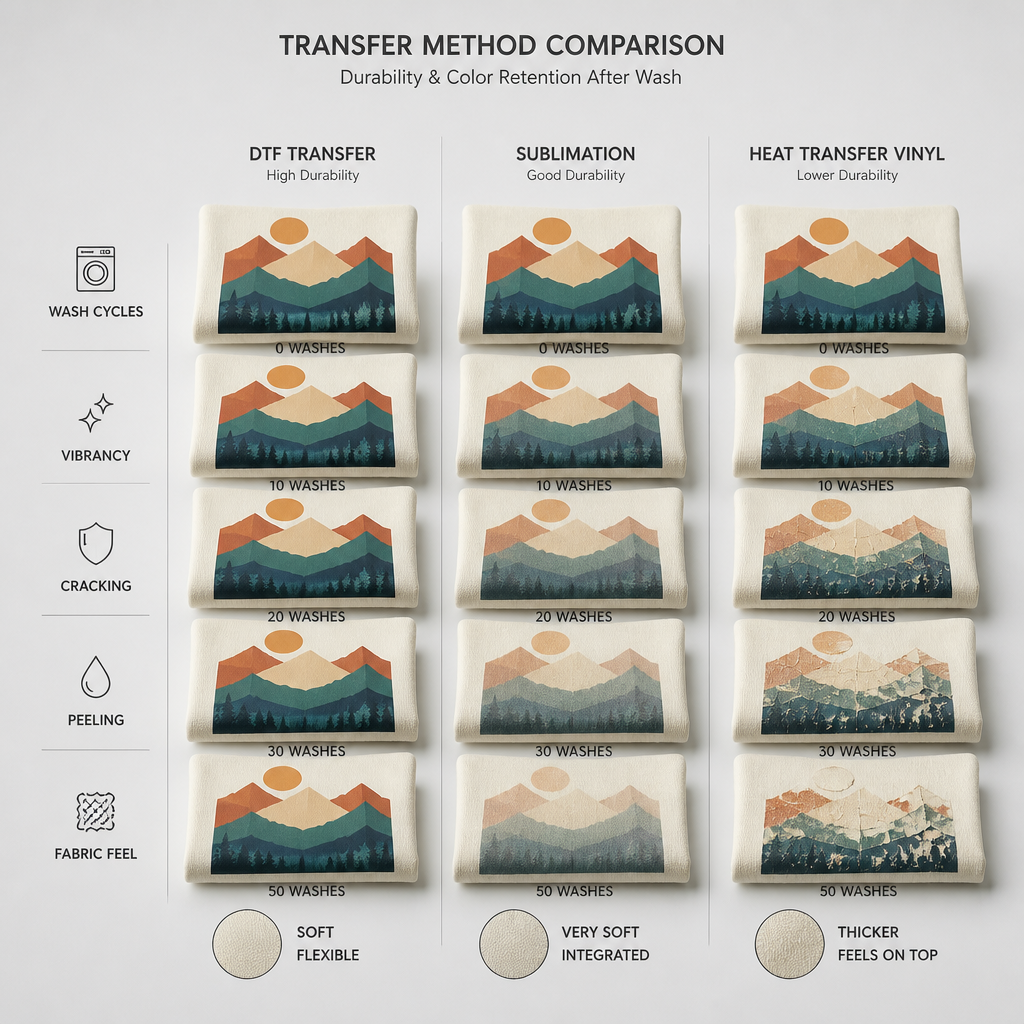
The flexibility of a DTF transfer is the key property for sports apparel. A football shirt stretches when a player moves. A rigid plastisol screen print will crack under repeated stretching and washing. A properly applied DTF transfer stretches with the fabric, which is why it has become the preferred method for printed club kit UK among professional suppliers who understand garment behaviour under match conditions.
In practice, DTF also removes the constraint of fabric content. Cotton kits, polyester training tops, nylon jackets, and cotton-poly blended hoodies all accept DTF transfers well. This matters when your squad needs a consistent look across different garment types, like a matching kit of performance shirts, bench jackets, and team hoodies from a single order.
DTF vs Other Printing Methods for Club Kits
Teams comparing printing options usually weigh up DTF, screen printing, sublimation, and embroidery. Each method has a specific profile of strengths and genuine weaknesses for sports kit applications.
Screen Printing
Screen printing produces excellent, durable results on cotton garments for large orders. The problem for most clubs is the setup cost. Each colour requires a separate screen, so a four-colour crest might carry a setup charge of £50-£100 before you print a single shirt. For runs of fewer than 24 identical garments, screen printing is rarely cost-effective. It also cannot economically handle individualised numbering or naming, which most kits require.
Sublimation
Dye sublimation is popular for all-over printed kits in sports like cycling and swimming. The ink becomes part of the fabric permanently. However, sublimation only works on 100% polyester white or very light-coloured garments. If your team wants to print on a navy cotton hoodie or a dark training top, sublimation is not viable. It also produces a different texture and finish than most teams expect from a traditional kit look.
Embroidery
Embroidery gives a premium, textured finish ideal for club crests on polo shirts or jacket breast pockets. A common mistake is assuming embroidery works well for back numbers and player names. It does not. The raised texture of embroidered lettering on the back of a football shirt is uncomfortable, and large embroidery areas add significant weight to the garment. Embroidery is best used as a complement to DTF printing, not a replacement.
| Printing Method | Best Use Case for Sports Kit | Main Limitation |
|---|---|---|
| DTF Printing | Full-colour crests, numbers, names, sponsor logos on any fabric type or colour | Slightly raised print feel compared to sublimation on all-over designs |
| Screen Printing | Large runs of identical designs, particularly single-colour prints on cotton | High setup costs, no individual personalisation, limited to flat designs |
| Dye Sublimation | All-over printed designs on 100% polyester white garments | Cannot print on dark fabrics or non-polyester materials |
Pro tip: If your club wants a premium crest on the chest and individual player names and numbers on the back, combine embroidery for the crest with DTF for the back print. Psyque's in-house heat-press capabilities make this combination straightforward without using multiple suppliers.
What You Can Print on Your Team Kit
DTF printing is not limited to the front chest. Modern custom team clothing DTF UK includes full placement options that match what you would expect from a professional kit manufacturer.
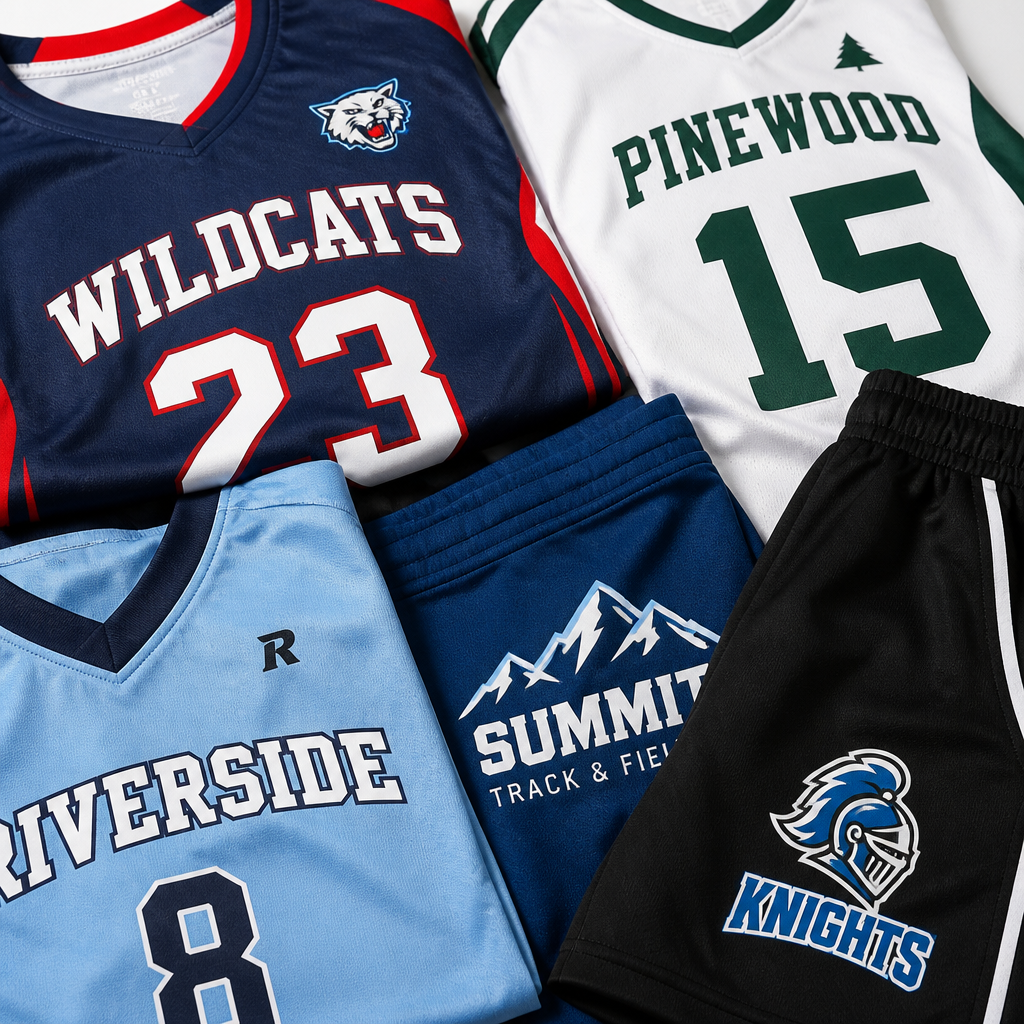
Standard placements for sports kits include the front chest (left breast or full chest), back yoke area for player name, back lower panel for squad number, left and right sleeve bands, and collar or neckline prints for sponsor names. All of these are achievable with DTF in a single garment order.
Sponsor integration is one area where clubs frequently underuse what DTF makes possible. A shirt sponsor logo with gradients, shadows, or photographic elements prints perfectly with DTF, whereas the same logo in screen printing would require expensive colour separations and a large minimum order to justify the cost. For semi-professional clubs with multiple tier sponsors, this means you can accurately reproduce every sponsor's brand assets without simplifying their artwork.
Squad numbers in DTF give you full flexibility on font choice, colour, and outline detail. You are not limited to a standard block number set. Your club can use a custom numbering font that matches your crest typography, with a secondary outline colour that reflects your kit design, and the cost per number does not increase with complexity.
Choosing the Right Garments for Your Kit
The garment you choose matters as much as the print method. DTF transfers are applied with a heat press at approximately 160°C, which means the fabric must be able to withstand that temperature without distortion. Most standard sportswear fabrics, including polyester, nylon, and cotton-poly blends, handle this without issue.
Performance Shirts and Training Tops
For match-day kits and training tops, lightweight polyester or moisture-wicking blends are the standard choice. These fabrics are specifically designed for movement and sweat management. DTF transfers adhere well to these fabrics and maintain their flexibility after multiple washes, which is the primary reason professional clubs have adopted DTF over older transfer methods for training wear.
Hoodies and Sweatshirts for Team Use
Team hoodies and sweatshirts are an important part of a club's overall identity, worn before matches, at social events, and sold as merchandise. Cotton-poly fleece hoodies are the most common substrate for these items, and DTF printing on fleece produces bold, clean results. The texture of the fleece slightly softens the print edge, which some clubs prefer for a more casual, off-pitch aesthetic.
Polos and Workwear Crossover
Many sports clubs, particularly those with a business sponsor or a club shop function, also need polo shirts for officials, coaches, and committee members. This is where the crossover between sports kit and branded workwear becomes practical. A single order through a supplier like Psyque can cover match shirts, training hoodies, and staff polos in one go, all with consistent DTF printing quality across every garment type.
Ordering Custom Team Clothing DTF UK: The Process Step by Step
Understanding the order process removes the most common sources of delay and disappointment. Custom team clothing DTF UK orders typically follow a structured workflow, and knowing what is expected at each stage means your kit arrives on time.
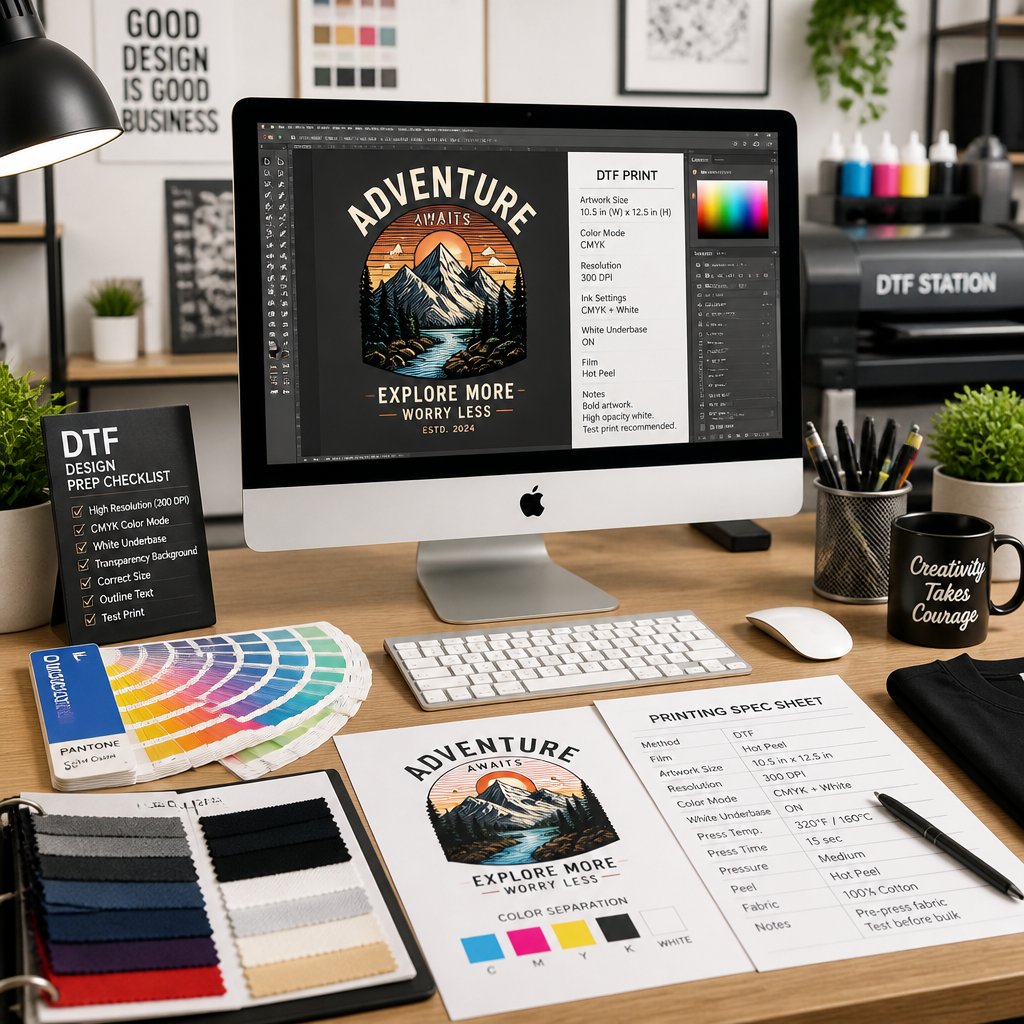
Step 1: Artwork submission. You supply your club crest, sponsor logos, and any text elements (squad numbers, names, club motto) as high-resolution files. Vector formats (.AI, .PDF, .EPS) are ideal. If you only have a JPG or PNG, it needs to be at 300 DPI at the print size, not the size it appears on a website.
Step 2: Garment and size selection. You choose the garment style, colour, and provide a size breakdown for your squad. Most club orders involve a mix of sizes from XS through to 2XL or 3XL. Providing an accurate size run upfront avoids additional postage costs for replacements.
Step 3: Print placement confirmation. Your supplier produces a mock-up showing exactly where each print element sits on the garment. This is your final chance to check that a name and number are not obscured by a seam, that your crest is centred correctly, and that the sponsor logo size is proportionate.
Step 4: Production and dispatch. Once you approve the mock-up, production begins. DTF printing is a faster production process than screen printing because there is no screen setup. For standard club kit orders through Psyque, UK dispatch is fast and free shipping applies on orders over £45, which most squad orders easily meet.
Pro tip: Always order two or three spare shirts in your most common sizes when placing the initial kit order. Having spares on hand for new squad members mid-season costs less than a separate small reorder with its own dispatch overhead.
Minimum Order Quantities and Pricing for Printed Club Kit UK
Pricing for custom sports kit printing UK depends on three variables: garment cost, print complexity (size and number of placements), and order quantity. DTF printing changes the equation compared to screen printing because there is no per-screen setup cost, but the per-unit price for very small quantities is higher than bulk.
A typical grassroots football club ordering a squad of 16 shirts with printed numbers, names, club crest, and one sponsor logo should budget approximately £18-£30 per shirt depending on garment quality and total placements. At 25+ units, the per-shirt cost typically falls to the lower end of that range. For comparison, sublimated all-over print kits from specialist kit manufacturers often start at £35-£50 per shirt with a minimum order of 10 units.
The real financial advantage of DTF for clubs is reordering. When a player leaves and a new one joins, you can order a single shirt with updated name and number. With screen printing, a one-off shirt reorder is economically unfeasible. With DTF, it is a standard transaction with no setup premium.
"The sports apparel market in the UK is driven by grassroots clubs and community sports organisations that need professional-looking kit on a budget that reflects their actual income. DTF has democratised quality printing for those organisations." - Sports Textile Industry Report, UK Active
Artwork and Design Requirements
Poor artwork is the single most common reason a club receives a kit that does not match expectations. This is not the printer's fault when the artwork supplied was never print-ready in the first place. Understanding what makes artwork suitable for DTF printing saves time, money, and frustration.
File formats accepted: Vector files (.AI, .EPS, .PDF with embedded fonts) are always preferred. They are resolution-independent and can be scaled to any print size without quality loss. Raster files (PNG, TIFF, JPG) are acceptable only at 300 DPI at the intended print size. A logo that is 100px wide on your club website is not usable for a 15cm chest print.
Colour accuracy requires attention. DTF printing uses CMYK inks. If your club colours are defined as specific Pantone values, ask your supplier how closely their DTF process can match those values. Most suppliers can produce a very close match, but exact Pantone replication is not guaranteed with digital printing. Approving a colour proof before the full run is printed protects both parties.
Text in artwork files must either be converted to outlines before submission or supplied with all fonts embedded. A supplier who does not have your specific club font installed will either substitute a default font or come back to you asking for the font file. Converting text to outlines in Adobe Illustrator takes 30 seconds and prevents this problem entirely.
Durability and Care for DTF Printed Kit
A DTF print applied correctly will last the life of the garment. The key variables are press temperature, press pressure, and peel timing. These are controlled by your printer, not by you, which is why choosing a supplier with in-house heat-press capabilities (rather than outsourcing the pressing stage) produces more consistent results.
Wash care makes a significant difference to print longevity. The standard guidance for DTF printed garments is to wash inside out at 30-40°C, avoid tumble drying on high heat, and never iron directly on the print. Following these instructions, a properly applied DTF transfer on a club shirt will survive a full season of weekly matches and training sessions without visible degradation.
A common mistake clubs make is purchasing cheap garments from a supermarket or online discount retailer and then taking them to a local printer for DTF pressing. These garments often have fabric treatments that prevent proper transfer adhesion, resulting in prints that peel within weeks. Ordering garments and printing together from a supplier like Psyque, which controls the entire process in-house, eliminates this variable entirely.
Frequently Asked Questions
Can DTF printing be used on dark-coloured sports kits?
Yes, and this is one of DTF's clearest advantages over dye sublimation. DTF transfers include a white underbase layer that is printed first, which means full-colour artwork prints vibrantly on black, navy, red, or any dark fabric. A white crest on a black shirt produces sharp, clean results that sublimation simply cannot achieve on dark fabrics.
What is the minimum order quantity for custom club kit with DTF printing?
DTF printing has no technical minimum order. You can order a single personalised shirt. In practice, most suppliers apply a unit pricing structure where smaller orders carry a higher per-unit cost. For squad orders of 10 or more garments, the per-unit price becomes competitive. Psyque's structure supports both small and large club orders without requiring a large minimum commitment upfront.
How long does custom sports kit printing UK typically take to produce and deliver?
Production time for DTF printed club kits in the UK is typically 5-10 working days from artwork approval. Rush production is sometimes available for an additional charge. The most common delay is artwork revision, where a club submits low-resolution files that require correction. Submitting print-ready artwork at the time of order consistently achieves the fastest turnaround.
Will DTF prints crack or peel on polyester performance fabric?
A correctly applied DTF transfer on polyester will not crack or peel under normal sports use. The transfer film is flexible and designed to stretch with the fabric. Peeling is almost always caused by incorrect heat-press temperature or pressure during application, not by the fabric type. This is why using a supplier who controls the pressing process in-house, rather than selling you raw transfers to press yourself, produces more reliable results for club kits.
Can I include individual player names and numbers on each shirt in the same order?
Yes. This is one of DTF printing's most practical advantages for sports clubs. You can supply a list of player names and numbers, and each shirt in the order can be individually personalised without any additional setup cost per variation. The order is processed as a single job, and each garment receives its unique print during the same production run.
Is DTF printing suitable for sublimated all-over printed football kits?
DTF and sublimation are different processes suited to different kit styles. If you want an all-over patterned kit where the design covers the entire shirt including seams, dye sublimation on 100% white polyester is the appropriate method. If you want a solid-colour garment with printed crests, numbers, names, and sponsor logos applied as separate placements, DTF is the correct and more versatile choice. Most grassroots and amateur clubs use the latter approach.
Have you recently ordered a printed club kit in the UK? Share your experience with DTF printing below, including what worked well and what you would do differently next time.
References
- Statista: Sports apparel and custom clothing market data for the United Kingdom
- Forbes: Business and branding insights relevant to custom merchandise and team apparel
- UK Active: Research and industry reports on grassroots sports participation and club kit trends in the UK
- Ahrefs Blog: Search demand data and content marketing analysis for custom apparel and printing niches
- UK Government Business Support: Guidance for small businesses and community organisations on procurement and supplier selection