
Custom Sweatshirts UK: Styles, Printing & Pricing Guide
Most businesses ordering custom sweatshirts UK for the first time get burned by two things: choosing the wrong garment weight for their use case, or underestimating how much the print method affects long-term durability. A 280gsm fleece-backed sweatshirt printed with DTF (Direct to Film) will outlast a 260gsm piece with a screen-printed vinyl transfer by several wash cycles. That difference matters when you are kitting out a team of 30 people and expecting those garments to represent your brand for two or three years. This guide covers everything you need to know about styles, print methods, and realistic pricing so you can order confidently.
Table of Contents
- Quick Takeaways
- Sweatshirt Styles for Businesses and Teams
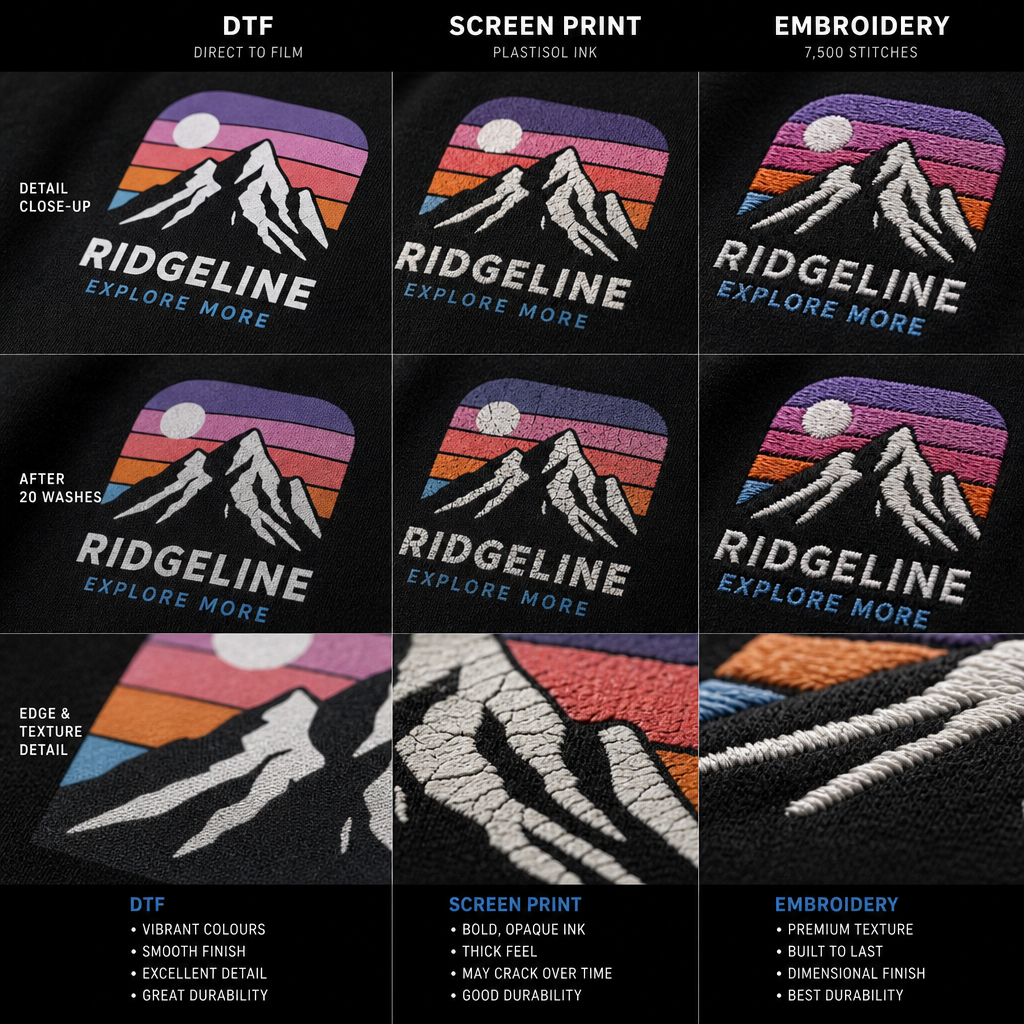
- Print Methods Compared: DTF, Screen Print, and Embroidery
- How Pricing Works for Branded Sweatshirts
- Design Tips for Branded Sweatshirts for Teams
- The Ordering Process: What to Expect from a UK Supplier
- Printing Method Comparison at a Glance
- Frequently Asked Questions
- References
Quick Takeaways
| Key Insight | Explanation |
|---|---|
| DTF printing handles full-colour designs without a minimum order | Unlike screen printing, DTF does not require separate screens per colour, making it cost-effective for small team orders of 5 to 20 units. |
| Garment weight directly affects print adhesion | Sweatshirts below 260gsm tend to pill faster and cause DTF transfers to crack at the edges after repeated washing. Opt for 280gsm or above. |
| Per-unit cost drops sharply after 24 units | Pricing for printed sweatshirts UK business orders typically sees a 20 to 35 percent reduction per unit when moving from 12 to 24 pieces. |
| Chest placement is safer than full-back for most branding | A left-chest logo print on a sweatshirt is versatile across casual and semi-professional settings. Full-back prints are better for events and sports teams. |
| ZIP hoodies print differently than crew-neck sweatshirts | The centre seam on a zip hoodie limits usable print width to approximately 12cm on each chest panel, which constrains logo-only designs. |
| Turnaround time varies by print method | DTF transfers can be ready in 3 to 5 working days for UK orders. Embroidery typically adds 2 to 4 days due to digitising lead time. |
| Free shipping thresholds change the economics of small orders | Suppliers like Psyque offer free UK shipping on orders over £45, which means adding one or two extra units often costs less than paying for delivery separately. |
Sweatshirt Styles for Businesses and Teams
Not all sweatshirt styles work equally well for every business context. The style you choose determines where the print sits, how the garment wears over time, and whether it looks professional in client-facing environments.
Crew-Neck Sweatshirts
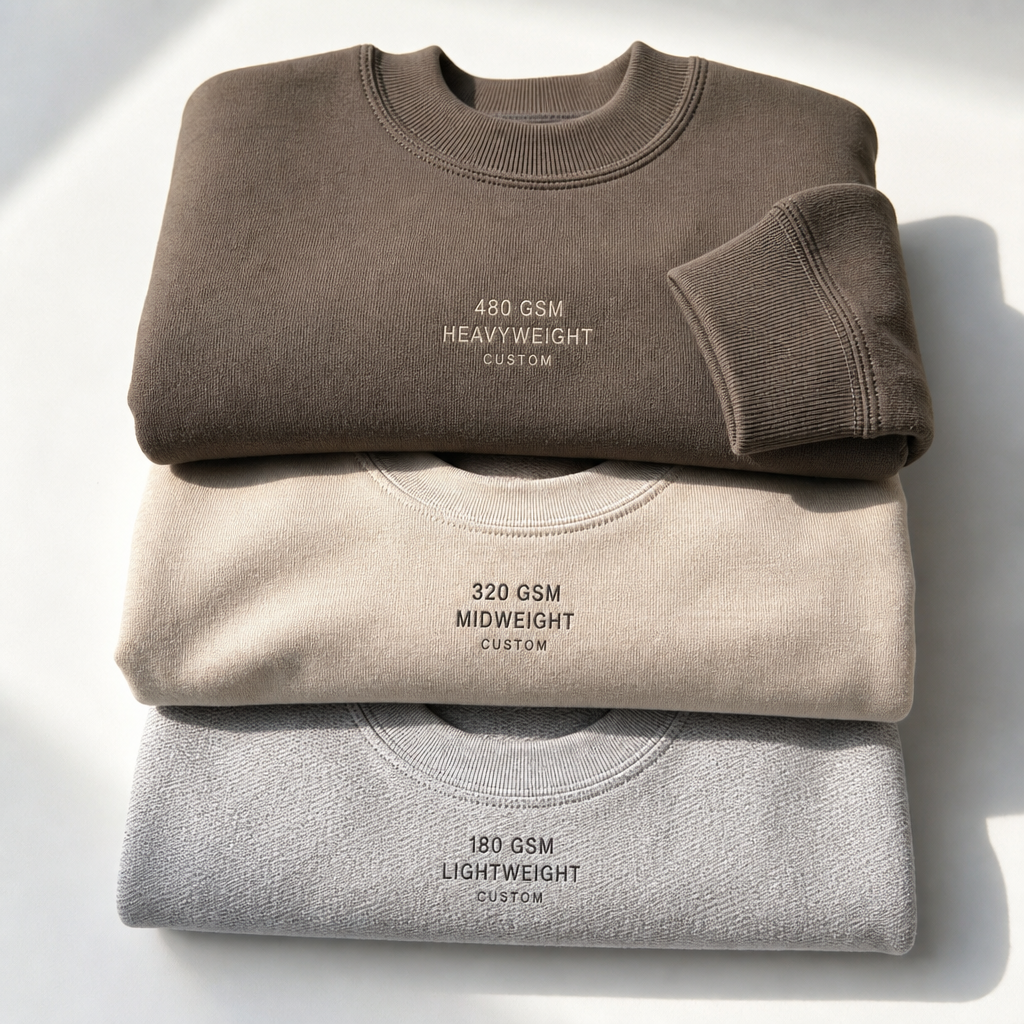
The crew-neck is the workhorse of branded sweatshirts for teams. It offers a flat, uninterrupted chest and back surface, which gives you the most usable print real estate of any sweatshirt style. For tradespeople, hospitality staff, and warehouse teams, crew-necks sit comfortably under high-visibility vests or jackets without bulking up at the collar.
In practice, a 320gsm crew-neck like those available in Psyque's workwear range holds DTF prints better than lighter alternatives. The denser fleece backing prevents the transfer edges from lifting after machine washing at 40 degrees.
Pullover Hoodies
Pullover hoodies are the most popular choice for event staff, brand ambassadors, and sports teams. The kangaroo pocket on the front can be a visual barrier if you want a centred chest print, so most businesses place their logo on the left chest above the pocket line. Alternatively, the back yoke area gives a generous print space of roughly 30cm x 35cm, ideal for bold graphics or team names.
A common mistake is ordering pullover hoodies in a single heavyweight cotton blend and expecting them to work year-round. A 50/50 poly-cotton blend at 280gsm manages temperature better and holds colour vibrancy longer on DTF prints.
Zip Hoodies
Zip hoodies work best for organisations that need a layering option, such as construction site staff or sports clubs. The constraint, as noted in the Quick Takeaways, is the chest seam. For zip-front styles, a left-chest logo of 8cm to 10cm width is typically the most readable option without the design being split by the zip.
Quarter-Zip and Funnel-Neck Sweatshirts
Quarter-zips have gained significant traction in corporate and professional services settings because they sit closer to a smart-casual aesthetic than a standard hoodie. For estate agents, consultancies, and client-facing retail teams, a quarter-zip with a discreet embroidered logo reads as polished rather than casual. They are also practical for outdoor events where temperature regulation matters.
Pro tip: If your team works both indoors and outdoors, order a mix: crew-necks for indoor-focused roles and zip hoodies or quarter-zips for anyone customer-facing or working in variable temperatures. This keeps your branding consistent without forcing one style on everyone.
Print Methods Compared: DTF, Screen Print, and Embroidery
The print method is arguably more important than the garment itself when it comes to how your branding holds up after 50 washes. Each method has a clear use case, and choosing the wrong one wastes money.
DTF (Direct to Film) Printing
DTF printing is currently the most versatile method for custom sweatshirts UK orders because it handles photographic-quality full-colour artwork with no minimum run and no colour-separation cost. The process transfers a printed film layer directly onto the fabric using a heat press, resulting in a slightly raised print that is wash-fast to 60 degrees when applied correctly.
Psyque's in-house DTF and heat-press setup means they control quality at every step, unlike print-on-demand platforms that outsource fulfilment. In practice, in-house DTF on a quality fleece garment produces sharper edges and more accurate brand colours than most screen-printed alternatives at small volumes.
Screen Printing
Screen printing makes economic sense at volumes above 50 units per design, particularly for single or two-colour artwork. Below that threshold, the cost of burning screens per colour quickly erodes any savings. Screen printing also struggles with gradients and photographic detail, which rules it out for businesses with complex logos.
For large events, uniform orders above 100 pieces, or promotional merchandise where durability is less critical, screen printing remains competitive on price. However, for the typical small business order of 10 to 40 branded sweatshirts for teams, DTF is the better choice on both quality and cost grounds.
Embroidery
Embroidery adds perceived value. A chest logo stitched in thread on a quarter-zip or crew-neck reads as premium in a way that a printed transfer simply does not. The trade-off is cost: embroidery requires a digitising setup fee (typically £20 to £35 for a new design in the UK market) and a higher per-unit cost at small quantities.
Embroidery also does not suit highly detailed artwork or designs with thin lines below 2mm. If your logo has fine typography or intricate linework, printed sweatshirts UK business orders via DTF will render your brand more accurately than embroidery can.
Pro tip: For a premium look at a managed cost, use embroidery for the left-chest logo and add a DTF print on the back or sleeve. The combination gives you the tactile quality of embroidery where it is most visible while keeping detailed artwork crisp on the secondary placement.
How Pricing Works for Branded Sweatshirts
Pricing for custom sweatshirts UK is built from four components: the blank garment cost, the print or decoration cost, setup fees, and shipping. Understanding each one stops you from being surprised by a quote that looks cheap upfront but has hidden add-ons.
Garment Cost
Blank sweatshirts for printing typically range from £8 to £22 per unit depending on weight, brand, and style. A 260gsm budget crew-neck sits at the lower end; a 320gsm organic cotton quarter-zip from a named brand sits at the upper end. For most small business and team orders, the 280 to 300gsm range at £10 to £14 per blank offers the best balance of quality and cost.
Print Cost
DTF print costs are usually calculated by print size and volume. A standard left-chest print (approximately 10cm x 10cm) on a run of 12 sweatshirts will typically add £4 to £7 per unit. A full-back print on the same run adds £8 to £14 per unit. At 50 units, those per-unit costs fall by roughly 30 to 40 percent.
Setup Fees and What They Cover
Reputable UK suppliers charge a one-time artwork setup or file preparation fee, typically £10 to £25 per design. Some include this in the per-unit price at higher volumes. Be cautious of suppliers who charge per-colour setup fees for DTF, since DTF does not require colour separation. That charge is often a holdover from screen printing pricing applied incorrectly.
Realistic Total Cost Scenarios
For a small business ordering 15 crew-neck sweatshirts with a left-chest DTF logo, a realistic all-in price in the UK market is £18 to £26 per unit. For 50 pieces with front and back prints, expect £22 to £32 per unit depending on garment grade. Orders over £45 at Psyque ship free across the UK, which meaningfully improves the economics of smaller orders that would otherwise attract a £5 to £8 courier fee.
"Branded workwear is consistently rated among the most cost-effective forms of business promotion because each garment generates repeated impressions at no recurring cost after the initial investment." - British Promotional Merchandise Association
Design Tips for Branded Sweatshirts for Teams
A well-designed sweatshirt creates cohesion across your team and communicates professionalism to anyone who sees it. A poorly designed one wastes the print budget and ends up at the back of a cupboard.
File Format Requirements
For DTF printing, submit artwork as a vector file (AI, EPS, or PDF) or a high-resolution PNG at 300 DPI with a transparent background. JPEG files with white backgrounds are the single most common cause of reprints and delays. If your designer works in Canva or a similar web tool, export to PDF print quality, not standard PDF, and confirm with your supplier before sending.
Colour Accuracy on Dark Fabrics
DTF handles white ink as an underbase layer, which means your full-colour artwork reproduces accurately on navy, black, and charcoal sweatshirts without colour shift. This is a significant advantage over other methods. Screen printing on dark fabrics requires a separate white underbase pass, adding cost. If colour accuracy matters for brand compliance, DTF on quality fleece is the most reliable choice for dark-garment orders.
Placement Best Practices
The left chest is the default for professional settings. Centre chest works for bold, single-element logos. Full back works for events, sports teams, and outdoor workwear where visibility at distance matters. Sleeve prints are growing in popularity for secondary branding (a website URL or strapline) on branded sweatshirts for teams. Keep sleeve text horizontal and limit it to 4cm in height for readability when the arm is at rest.
The Ordering Process: What to Expect from a UK Supplier
Knowing what the process looks like before you start saves time and prevents the most common ordering mistakes.
A good UK supplier will follow a clear sequence: garment selection, size breakdown, artwork submission, digital proof approval, production, and dispatch. The critical stage is proof approval. Do not approve a proof quickly without checking colour values against your brand guidelines, checking text for typos, and confirming placement measurements. Errors found after approval are typically chargeable.
Psyque's process is built around in-house printing and heat-pressing, which means they can turn around most UK orders faster than suppliers who outsource production. Fast UK dispatch matters when you have an event deadline or a team start date. Suppliers who outsource fulfilment to third-party print farms introduce variability in quality control that you simply cannot predict from an online preview.
Size breakdowns are another area where businesses frequently make avoidable errors. A team of 20 people ordered in equal numbers across S, M, L, XL will leave you with surplus smalls and short of mediums and larges in most UK workplace demographics. Ask your supplier if they have seen common size curve data for team orders, because experienced suppliers will have this from previous runs.
Printing Method Comparison at a Glance
| Print Method | Best Use Case | Key Limitations |
|---|---|---|
| DTF (Direct to Film) | Full-colour logos, small to mid-sized runs (5 to 100 units), dark and light fabrics, photographic artwork | Slight texture raise on print area; not ideal for all-over coverage on large panels |
| Screen Printing | Large volume runs (50 or more units), simple 1 to 3 colour designs, promotional merchandise | High setup cost at low volumes; poor gradient reproduction; separate screen per colour |
| Embroidery | Corporate and smart-casual branding, quarter-zip chest logos, premium perceived value | Digitising setup fee; cannot reproduce fine detail or thin lines below 2mm; slower turnaround |
Frequently Asked Questions
What is the minimum order quantity for custom sweatshirts UK?
Most DTF-based UK suppliers, including Psyque, have no minimum order requirement for printed sweatshirts, which makes it practical to order as few as 1 to 5 units for a trial run or small team. Screen printing typically requires a minimum of 25 to 50 units per design to be cost-effective because of screen setup costs.
How long do DTF prints last on sweatshirts after washing?
A properly applied DTF transfer on a quality 280gsm or heavier sweatshirt, washed at 40 degrees inside out, will typically last 50 to 80 wash cycles before any visible degradation. Washing at 60 degrees or using tumble dryers on high heat accelerates edge lifting. The garment weight and the quality of the heat-press application matter as much as the print itself.
Can I order branded sweatshirts for teams with different sizes in one batch?
Yes. Most UK suppliers, including Psyque, allow a single order to contain a mixed size breakdown across the same design. You specify the quantity per size when placing the order. There is no size surcharge for this, and it is the standard approach for team and workwear orders. The only constraint is that the design and garment colour must be consistent across the batch if you want volume pricing to apply.
What file format should I submit for my logo when ordering printed sweatshirts UK?
Submit a vector file (AI, EPS, or SVG) or a PNG at 300 DPI minimum with a transparent background. Avoid JPEG files, which have white backgrounds that print as white rectangles on dark garments. If you only have a low-resolution logo, a good UK supplier can advise on redrawing options, though this will usually incur a small artwork fee.
Is DTF printing or embroidery better for a professional business image?
It depends on the context, but the distinction is clear in practice. Embroidery reads as more premium and is the right choice for client-facing roles, corporate gifting, and smart-casual settings. DTF is better for bold, multi-colour, or detailed designs and for settings where durability and visual impact at distance matter more than tactile finish, such as event staff, outdoor teams, and warehouses. Many businesses use both: embroidery on the chest for everyday wear and DTF for event-specific back prints.
How do I get the best price per unit on branded sweatshirts for teams?
Order above the next pricing tier rather than exactly at your immediate need. If you need 18 units, check whether 24 units drops the per-unit cost enough to offset the extra garments. Most UK suppliers have visible pricing breaks at 12, 24, 48, and 100 units. Also, consolidate your order into a single design and colourway where possible, since splitting across multiple designs resets setup costs. Psyque's free shipping threshold at £45 means small orders that would otherwise attract a courier charge can be made cost-neutral by adding a unit or two.
Have you ordered custom sweatshirts for your business or team before? Share what worked, what did not, or any questions you have about sizing, print quality, or turnaround times in the comments.
References
- Statista: Market data and statistics on the branded apparel and promotional merchandise industry
- Forbes: Business insights on branded merchandise ROI and team identity in the workplace
- HubSpot Marketing Statistics: Data on brand visibility and promotional product effectiveness
- UK Government Business Hub: Guidance on workplace uniform policies and employment considerations for UK businesses
- Ahrefs Blog: Research and data on consumer search behaviour for custom apparel and print-on-demand products in the UK