
Custom Workwear Design That Builds Your Brand (Checklist)
Most businesses spend weeks choosing the right garment, then upload a logo file and call it a day. The result is workwear that fades after ten washes, looks inconsistent across the team, and does nothing for brand recognition. Custom workwear design is not just about printing a logo. It is about making every employee a walking advertisement that actually works. Research from the Advertising Specialty Institute found that branded apparel generates more impressions per item than almost any other promotional product, with a single garment producing an average of 3,400 brand impressions over its lifetime. That number only holds if the design is done properly.
Table of Contents
- Quick Takeaways
- Why Workwear Design Matters More Than You Think
- Choosing the Right Garments for Your Brand
- Design Principles That Make Branded Workwear Work
- DTF Printing vs Other Methods: What to Choose
- Common Mistakes That Kill Your Brand on Fabric
- Free Custom Workwear Design Checklist
- Frequently Asked Questions
- References
Quick Takeaways
| Key Insight | Explanation |
|---|---|
| Consistency beats creativity | Your workwear must match your brand guidelines exactly. Mismatched colours across garment types erode trust faster than a bad logo. |
| Fabric choice affects print quality | 100% cotton absorbs DTF prints better than synthetic blends. Choosing the wrong base garment will degrade print vibrancy and longevity. |
| Placement is a strategic decision | Left chest, full back, and sleeve prints each communicate differently. Left chest reads professional. Full back commands attention at events. |
| File resolution makes or breaks the result | Artwork submitted below 300 DPI will pixelate when heat-pressed. Always supply vector files or high-resolution PNGs with transparent backgrounds. |
| Order volume affects cost per unit significantly | Ordering a bundle of 10 or more garments from a supplier like Psyque drops your per-unit cost considerably compared to one-off orders. |
| Workwear is a retention tool, not just a uniform | Employees who feel proud of their workwear report higher job satisfaction. Poor quality or ugly uniforms have the opposite effect. |
| DTF printing outperforms screen printing for small runs | Screen printing requires costly setup fees and minimum order quantities. DTF allows full-colour, photorealistic prints from a single unit. |
Why Workwear Design Matters More Than You Think
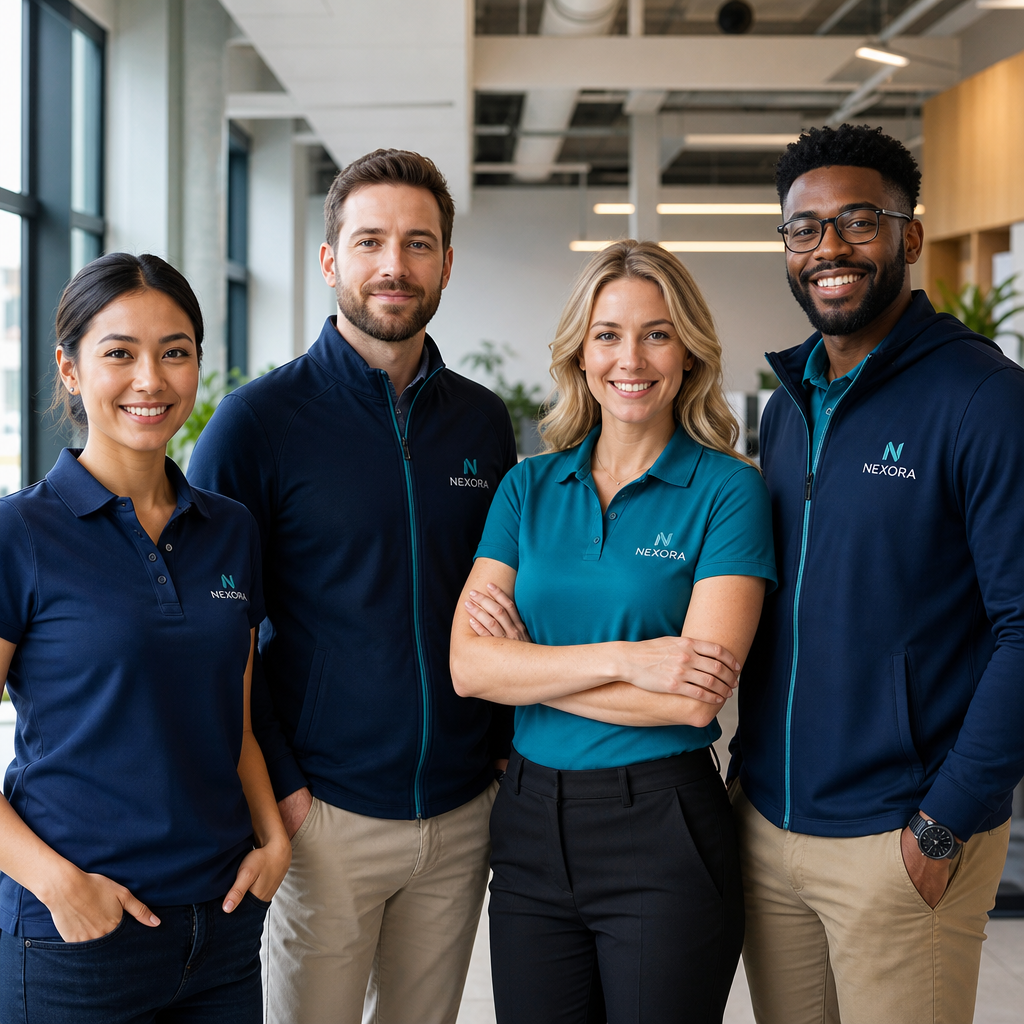
There is a persistent belief among small business owners that workwear is purely functional. It keeps staff identifiable, it meets health and safety requirements, and it saves employees from worrying about what to wear. That view is leaving serious brand equity on the table.
According to a study referenced by Forbes, consistent brand presentation across all touchpoints, including clothing, can increase revenue by up to 23%. Branded workwear is one of the most cost-effective touchpoints you control directly. Every site visit, trade show, delivery, or customer interaction is an impression.
In practice, the businesses that get this right treat their workwear brief the same way they treat a packaging brief. They think about colour hierarchy, typeface legibility at distance, and how the design reads on a moving human body rather than a flat screen.
Choosing the Right Garments for Your Brand
The garment is not a neutral canvas. It influences print quality, durability, comfort, and how premium your brand appears to customers. Getting this wrong means you are paying for prints that degrade quickly or garments your team refuses to wear.
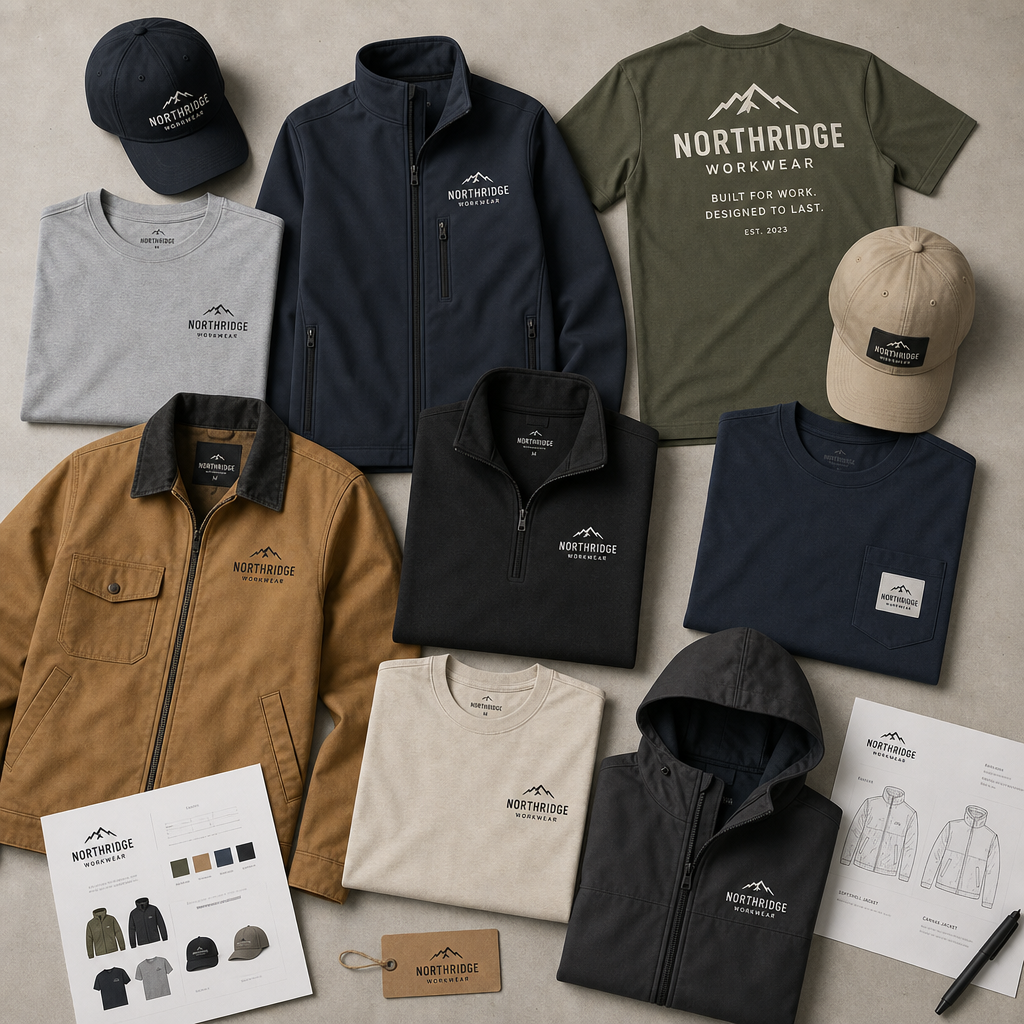
T-Shirts, Polos, and Hoodies: When to Use Each
T-shirts are the most versatile choice and work for events, trade shows, and casual customer-facing roles. They are also the most affordable base for custom printed clothing. Polos communicate a step up in professionalism and work well for retail staff, tradespeople, and anyone in a customer-service role where a sharp appearance matters.
Hoodies and sweatshirts are practical for outdoor teams, delivery drivers, or anyone working in a colder environment. They also have a longer visible lifespan than t-shirts, which means more impressions per garment over time.
Fabric Weight and Composition
For DTF printing specifically, a 180gsm to 220gsm cotton or cotton-rich fabric is the standard recommendation. Lighter fabrics can show print bleed or feel flimsy after washing. Polyester-heavy blends can repel the adhesive layer in DTF transfers, reducing print adhesion.
In practice, if you are ordering business workwear for UK field teams or tradespeople, a 280gsm sweatshirt fabric will hold up far better than a budget 260gsm alternative, especially through repeated industrial washing.
Pro tip: Ask your supplier for a wash-test sample before committing to a large bundle. A reputable DTF printer like Psyque will stand behind the print durability of their garments, so this should not be a difficult request to make.
Design Principles That Make Branded Workwear Work
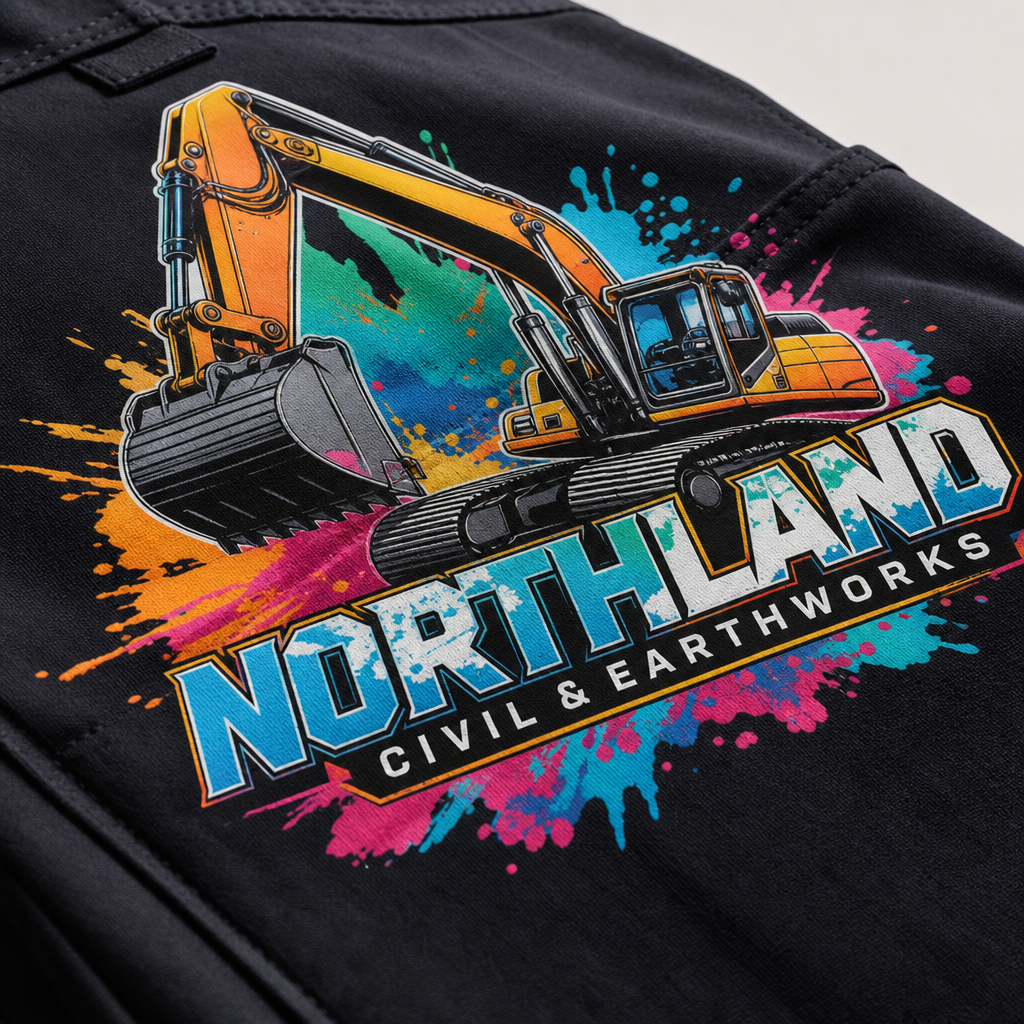
A good workwear design is not the same as a good screen design. Logos that look sharp on a website can fall apart when scaled to a chest print. The rules are different, and ignoring them is one of the most expensive mistakes in custom apparel.
Colour Contrast and Legibility
Your logo needs to read clearly at three metres. Dark garments with dark logos fail this test completely. Always check the contrast ratio between your artwork and the garment colour before ordering. The Web Content Accessibility Guidelines (WCAG) recommend a minimum contrast ratio of 4.5:1 for text, and that standard applies just as well to fabric as it does to screens.
If your brand uses a dark navy as its primary colour, consider printing on white or light grey garments, or use a reversed white version of your logo on navy fabric. Both work. A dark logo on dark fabric does not.
Print Placement Options and What They Signal
Left chest placement is the industry default for a reason. It sits at eye level during handshakes and face-to-face interactions. It reads as professional and understated.
Full back printing works brilliantly for event staff, tradesperson vans, and any role where people are seen from a distance or from behind. It is higher-impact but less intimate. Sleeve prints work as a secondary element, never as the primary brand identifier.
"Your uniform is your brand's handshake. Make it firm, make it clean, and make it consistent." - Branding principle widely cited in corporate identity design practice
Typography on Fabric
Thin serif fonts disintegrate on fabric, especially after washing. Avoid any typeface with stroke widths thinner than 1mm at print size. Bold sans-serif fonts, block lettering, and clean display typefaces hold up best on garments and remain legible after repeated laundering.
If your brand font is a delicate serif, create a companion version specifically for workwear use. This is not compromising your brand identity. It is applying it intelligently across different media.
DTF Printing vs Other Methods: What to Choose
There are four main methods used for custom printed clothing in the UK: DTF (Direct to Film), screen printing, embroidery, and DTG (Direct to Garment). Each has a different cost profile, quality outcome, and appropriate use case. Choosing the wrong method for your order type is a common and costly mistake.
| Method | Best For | Key Limitation |
|---|---|---|
| DTF (Direct to Film) | Full-colour designs, small to medium runs, photorealistic artwork, gradients | Requires proper garment preparation for best adhesion on synthetic fabrics |
| Screen Printing | Large volume orders with 1-3 spot colours | High setup costs, poor for gradients or multicolour designs on small runs |
| Embroidery | Premium workwear, polos, caps, outerwear where a raised texture signals quality | Cannot replicate fine detail or photographic images, higher per-unit cost |
DTF printing is now the dominant method for small business workwear orders in the UK because it eliminates setup costs entirely and handles full-colour artwork without any compromise. Psyque uses in-house DTF and heat-press capability, which means faster turnaround and direct quality control rather than outsourcing to a third party.
Screen printing still makes sense above 100 units for simple designs. Below that threshold, the screen setup fees make DTF the clear winner on cost per unit and flexibility.
Pro tip: If you are ordering a mixed bundle of t-shirts, polos, and hoodies with the same design, DTF is almost always the right choice. It applies consistently across different fabric types and colours without requiring separate colour separations for each garment style.
Common Mistakes That Kill Your Brand on Fabric
A common mistake is treating workwear as an afterthought rather than a brand asset. The businesses that order the cheapest available t-shirts and send a low-resolution JPEG logo file are the same ones complaining that their workwear looks cheap after one wash.
Here are the specific errors that consistently produce bad results.
Submitting Low-Resolution Artwork
Anything below 300 DPI at print size will pixelate. If your logo only exists as a social media file, you need to ask your designer for the original vector file (.ai, .eps, or .svg) before placing any workwear order. This is not optional. A rasterised logo stretched to chest-print size looks unprofessional and reflects poorly on your brand.
Ignoring Colour Modes
Screen colours use RGB. Print colours use CMYK. A logo that looks vibrant on a screen can print significantly duller if the file is not converted to CMYK before submission. Always supply CMYK files, or ask your printer to confirm how they handle colour conversion. Psyque's in-house team reviews artwork before printing, which catches these issues before they become expensive mistakes.
Ordering Without a Brand Guideline
If you cannot tell your printer exactly which Pantone or CMYK colour your logo uses, you will get a different shade every time you reorder. Inconsistency across garment batches is one of the fastest ways to make a growing brand look disorganised. Spend one hour writing a single-page brand guideline with your logo files, exact colours, and approved typefaces. That hour pays for itself on every future order.
Free Custom Workwear Design Checklist
Use this checklist before placing any custom workwear order. Print it, save it, or share it with your designer. Every item here corresponds to a real error that businesses make when ordering branded workwear for the first time.
Before You Design
- Confirm your brand colour values in CMYK and Pantone (not just HEX)
- Identify which garment types you need: t-shirts, polos, hoodies, sweatshirts
- Decide on print placement for each garment type (left chest, full back, sleeve)
- Choose your garment colour and check contrast against your logo
- Set your budget per unit and total order quantity
Artwork Preparation
- Supply vector files (.ai, .eps, .svg) or 300 DPI PNG with transparent background
- Convert all artwork to CMYK colour mode
- Check that no font strokes are thinner than 1mm at intended print size
- Test your design on a dark and a light garment mockup
- Remove any white background from your logo file (transparent PNG only)
Ordering and Approval
- Request a digital proof or physical sample before approving large runs
- Confirm the print method being used (DTF, screen, embroidery)
- Check wash-care instructions are compatible with your team's working environment
- Confirm dispatch timelines and whether your order qualifies for free shipping
- Keep a record of your order specifications for future reorders
Psyque offers custom workwear bundles with in-house DTF printing and free UK shipping on orders over £45, making it straightforward to work through this checklist and place an order without the typical complications of using a third-party print broker.
Frequently Asked Questions
What file format should I use for custom workwear design?
The best formats for DTF and screen printing are vector files (.ai, .eps, .svg) or high-resolution PNGs at 300 DPI with a transparent background. Avoid JPEG files for logos, as they use lossy compression that introduces artefacts visible on fabric prints. If you only have a JPEG, ask a designer to recreate your logo as a vector before ordering.
How many colours can I include in a DTF print?
DTF printing handles unlimited colours with no additional cost per colour. This is one of its biggest advantages over screen printing, which charges a separate setup fee for each colour in the design. Gradients, photographic images, and complex multicolour artwork all print accurately with DTF.
What is the minimum order quantity for branded workwear in the UK?
This varies by supplier. Psyque offers custom printed garments with no strict minimum order quantity on many products, though ordering in bundles of 10 or more reduces the cost per unit significantly. Screen printers typically require 25 to 50 units minimum due to setup costs, making DTF suppliers a better choice for smaller teams or pilot orders.
How long does custom workwear printing take?
In-house DTF printers like Psyque typically dispatch within a few business days of artwork approval. Screen printing takes longer due to screen preparation, especially for multicolour designs. If you have a hard deadline such as an event or launch date, confirm turnaround times before placing your order and factor in shipping time for your location.
Will the print crack or fade after washing?
A quality DTF print on the correct fabric, applied with a properly calibrated heat press, should withstand 40 to 50 washes without significant degradation when washed at 30 to 40 degrees Celsius inside out. Cheap transfers applied at incorrect temperatures are the primary cause of cracking and peeling. Always ask your supplier about their print durability guarantee before ordering.
Can I add my logo to multiple garment types in a single order?
Yes, and this is one of the most practical benefits of DTF printing. Because there are no per-garment setup costs, you can include t-shirts, polos, hoodies, and sweatshirts in a single order with the same design applied consistently across all garment types. Psyque's workwear bundles are structured exactly this way for businesses kitting out a full team.
Have you ordered custom workwear before? Share what worked, what did not, or what you wish you had known before placing your first order.
References
- Forbes business and branding insights on consistent brand presentation and revenue impact
- Statista data on the promotional products and branded apparel market in the UK and globally
- HubSpot marketing statistics on brand consistency and customer recognition
- Business of Fashion research on garment quality, fabric composition, and consumer perception
- BSI Group standards for workwear safety, fabric performance, and textile certification in the UK