
Custom Workwear for Small Business UK: Step-by-Step Guide
Most small business owners treat workwear as an afterthought, slapping a logo on whatever cheap polo they can find and calling it branding. That is a mistake that costs real money, not just in wasted print runs, but in missed first impressions. Research from Statista shows that uniforms and branded apparel directly influence customer perception of a business's professionalism. If you are searching for custom workwear small business UK guidance that goes beyond vague advice, this guide walks you through every decision, from fabric choice to final print method, with specific recommendations that actually hold up in practice.
Table of Contents
- Quick Takeaways
- Why Branded Workwear Matters for Small Businesses
- Step 1: Define Your Workwear Brief
- Step 2: Choose the Right Garments
- Step 3: Design Your Artwork for Print
- Step 4: Choose Your Print Method
- Comparing Print Methods for Workwear
- Step 5: Place and Proof Your Order
- Common Mistakes to Avoid with Branded Workwear
- Frequently Asked Questions
- References
Quick Takeaways
| Key Insight | Explanation |
|---|---|
| Lock your brand colours in CMYK or Pantone before ordering | RGB colours used on screens look different when printed. Convert values early to avoid colour mismatches on your finished garments. |
| DTF printing outperforms screen printing for small runs | Screen printing requires expensive setup per colour. DTF (Direct to Film) has no setup minimum, making it ideal for orders under 50 units. |
| Choose garment weight based on working environment | A 180gsm t-shirt is fine for retail staff. Tradespeople need at least 300gsm or a poly-cotton blend that resists tearing and fading. |
| Keep logo placement consistent across all garment types | Left chest placement at 8-9cm wide is the professional standard. Changing placement across styles breaks visual brand cohesion. |
| Always request a physical or digital proof before bulk production | Artwork files can scale incorrectly. A proof catches sizing and colour errors before they multiply across your entire order. |
| Order a size run, not just your most common size | A common mistake is ordering only mediums and larges. A proper size breakdown from XS to 3XL ensures every team member is covered from day one. |
| Factor in wash durability when choosing print method | DTF prints with a proper cure are rated for 50+ wash cycles. Cheaper heat-press vinyl methods can crack after 20 washes, damaging your brand image. |
Why Branded Workwear Matters for Small Businesses
Branded workwear is not a vanity expense. It is one of the most cost-effective forms of advertising available to a small business. A team of five wearing your branded polos in a customer-facing environment generates thousands of impressions per week at a one-time cost.
According to research from the British Promotional Merchandise Association, branded apparel consistently ranks among the most recalled and positively perceived forms of business promotion. Customers associate consistent uniforms with reliability and trust, two qualities that directly affect purchasing decisions.
In practice, small businesses that invest in branded clothing for business early, even with a minimal starting budget, project a more established image than their unbranded competitors. That perception gap translates directly into conversions, particularly for tradespeople, hospitality businesses, and retail operations where staff visibility is constant.
Step 1: Define Your Workwear Brief
Before you touch a design tool or contact any supplier, write down the answers to four questions. What environments will this workwear be used in? Who specifically will be wearing it? What is your total budget? And what brand message should the clothing communicate?
These are not soft questions. The answers determine every downstream decision. A plumbing company needs durable, dark-coloured workwear that hides grime. A hair salon wants something clean, fashionable, and colour-coordinated with their interior. Getting this brief wrong means paying twice.
Set a Realistic Budget from the Start
For custom workwear small business UK orders, realistic entry-level pricing sits between £8 and £18 per garment including printing, depending on garment quality and print complexity. Trying to go significantly below that range almost always means compromising on fabric weight, print durability, or both.
Work out your total unit count first. If you have seven staff and want two garments each, that is 14 units. At that quantity, DTF printing at a quality supplier like Psyque's printed workwear range gives you full-colour, durable prints without the setup costs that screen printing would add. Free shipping thresholds, such as Psyque's free delivery on orders over £45, also factor into your true cost per unit.
Define Brand Elements Before Designing
Pull together your logo in vector format (AI or EPS files), your brand hex codes, and any secondary typefaces before approaching any print supplier. If you do not have a vector logo, commission one from a graphic designer for £50-£150. It will save you far more in reprints.
Pro tip: Ask your printer to confirm the minimum resolution they need for non-vector artwork. Most DTF processes require at least 300 DPI at print size. Sending a logo pulled from a website at 72 DPI will produce a blurry result that no amount of software upscaling can fix.
Step 2: Choose the Right Garments
Garment selection is where most small businesses make their first expensive mistake. They pick the cheapest option available, then discover it either shrinks after washing, holds body odour, or makes their staff look untidy. None of those outcomes is acceptable for branded workwear.
T-Shirts
For casual branded use, a 180-200gsm combed cotton or cotton-polyester blend is the minimum acceptable weight. Pure cotton breathes better and prints more vividly. Poly-cotton holds its shape longer through repeated washing. For most retail and office environments, a 190gsm premium t-shirt is the right call.
Polos
Polos project a step above t-shirts without requiring a full shirt. A 220-240gsm pique polo is the standard for business use. Avoid very lightweight polos (under 180gsm) as they look cheap on the body and the fabric becomes see-through under bright lighting, which is a problem in customer-facing roles.
Hoodies and Sweatshirts
For outdoor teams or autumn and winter use, a 280-320gsm fleece-backed sweatshirt is practical and print-friendly. Hoodies with a full front print or a chest and sleeve combination are increasingly popular for event staff and construction teams. Check that your chosen supplier, such as Psyque's hoodie range, offers garments pre-washed to minimise post-print shrinkage.
Pro tip: Order a single sample garment in your chosen style before committing to your full run. Wear it for a day, wash it twice, and check the fit and feel. This costs you one unit price and can prevent a bulk-order disaster.
Step 3: Design Your Artwork for Print
Learning how to design branded workwear artwork properly is genuinely the most technical part of this process, and the step where small business owners most often need guidance.
Artwork File Formats
Vector files (AI, EPS, SVG) are the gold standard for logos and text-based designs. They scale to any size without quality loss. If your design includes photographic elements or complex gradients, a high-resolution PNG (300 DPI minimum at actual print size) is acceptable for DTF printing.
Avoid JPEGs for workwear artwork. The compression artefacts that are invisible on a screen become visible on fabric, especially around the edges of logos and text.
Colour Considerations
Convert your brand colours from RGB or HEX to CMYK before sending artwork to any printer. The RGB colour model produces colours that screens can display but printers physically cannot reproduce. A bright electric blue in RGB will print noticeably duller in CMYK unless your printer compensates with a colour profile, which requires explicit communication upfront.
For DTF printing specifically, white ink is used as a base layer on dark garments. This is handled automatically by the printer's RIP software, but it means you should always clarify with your supplier whether your white elements will appear clean on dark fabric backgrounds.
Placement and Sizing
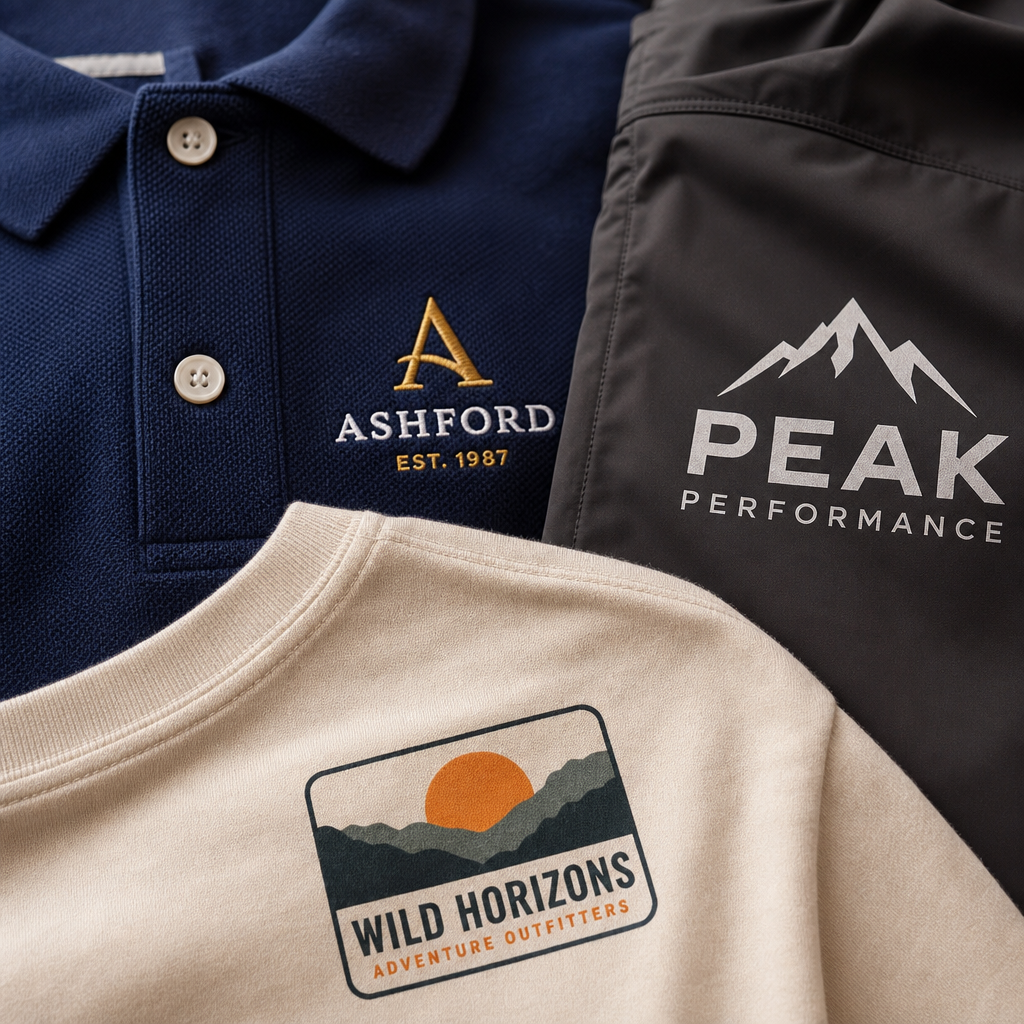
The standard positions for workwear decoration are: left chest (logo, 8-10cm wide), full front (large graphic, up to 30cm wide), back neck (small URL or tagline, 8cm wide), and sleeve (stripe or small logo). For most small business workwear, left chest is sufficient and most professional. Full back prints work well for event staff who need visibility from a distance.
"The most common artwork mistake we see from small businesses is submitting a logo that looks sharp on a white background but has not been optimised for dark garments. Always prepare a reversed or knockout version of your logo for dark fabric." Source: Practical guidance consistent with industry print production standards.
Step 4: Choose Your Print Method
The print method determines print quality, wash durability, cost per unit, and minimum order quantity. For small business workwear in the UK, the three most relevant methods are DTF (Direct to Film), embroidery, and screen printing. Each has a clear use case.

DTF Printing
DTF is currently the best-value method for small runs with multi-colour or photographic artwork. There is no setup fee per colour, no minimum order quantity at most DTF suppliers, and the prints bond well to most fabric types including cotton, polyester, and blends. Wash durability from quality DTF suppliers is 50 wash cycles or more when the transfer is properly cured.
Psyque operates with in-house DTF and heat-press capabilities, which means quality control happens at the same facility rather than being outsourced. That matters for colour consistency across a multi-garment order.
Embroidery
Embroidery is the premium choice for corporate polos, caps, and jackets. It is perceived as higher quality and has effectively unlimited wash durability. The drawback is that it does not reproduce fine detail or gradients well, making it unsuitable for complex artwork. It also adds cost per unit compared to DTF, typically adding £3-£8 per placement.
Screen Printing
Screen printing produces vivid, durable prints but requires a screen to be made for each colour in your design. Setup costs typically run £20-£50 per colour, making it cost-effective only at quantities of 50 units or more with simple, limited-colour artwork. For most small business workwear needs, DTF will undercut screen printing on both cost and flexibility.
Comparing Print Methods for Workwear
The table below compares the three main print methods directly on the criteria that matter most for small business workwear orders.
| Print Method | Best For | Minimum Order / Setup Cost |
|---|---|---|
| DTF (Direct to Film) | Small runs, full colour, photographic or complex logo artwork on t-shirts, hoodies, and polos | No colour setup fee. No strict minimum order. Cost-effective from 1 unit upwards. |
| Embroidery | Corporate polos, caps, jackets. Simple logo with limited colours. Premium perceived quality. | Digitising fee of £10-£30 per design. Works from small quantities but cost per unit is higher. |
| Screen Printing | High-volume orders (50+) with simple, 1-3 colour artwork. Strong, matte colour results. | Setup cost of £20-£50 per colour. Not economical for complex or low-volume orders. |
Step 5: Place and Proof Your Order
Once your artwork is finalised and your garments are selected, you move into order placement. This step has two critical checkpoints that determine whether you receive what you actually designed.
Request a Digital Proof
Always request a digital mockup from your supplier before production begins. A good supplier will overlay your artwork on a product photograph showing accurate placement, size, and colour. Review this against your original brand files, not from memory. Check that logo edges are clean, text is readable at the printed size, and colours match your approved CMYK values.
Suppliers like Psyque provide proofing as part of the order process. If a supplier refuses to provide a proof or charges extra for it, that is a red flag worth taking seriously.
Size Breakdown Strategy
A practical size breakdown for a team of 10 in a UK business context would typically be: 1x S, 3x M, 4x L, 2x XL. Adjust based on your actual team. If your business is growing and you expect to hire, order 2-3 extra units in the most common sizes rather than reordering later at a higher per-unit cost.
For garments intended as client gifts or event merchandise, a broader size range including XS and 2XL is worth the extra units to avoid the awkwardness of having nothing that fits certain recipients.
Delivery and Dispatch Timelines
UK-based suppliers with in-house printing, such as Psyque, can typically dispatch within 5-10 working days for standard orders. Build in buffer time for proofing revisions. If you have a hard event or launch deadline, communicate that clearly at the point of ordering, not after production has started.
Common Mistakes to Avoid with Branded Workwear
These are the errors that repeat consistently across small business workwear orders. Knowing them in advance saves you money and frustration.
Choosing a supplier based on price alone. The cheapest quote almost always reflects a compromise somewhere, whether in garment quality, print durability, or customer support. Compare total delivered value, not just unit price. A supplier offering free UK shipping on orders over £45 with in-house quality control is worth more than a slightly cheaper per-unit price with outsourced printing and unpredictable turnaround.
Skipping the proof stage. In practice, roughly one in three first-time orders has at least one artwork correction needed after initial proofing. Skipping this step and going straight to production turns a fixable problem into a costly reprint.
Ordering a single style for the entire team. A t-shirt that works for warehouse staff is not appropriate for your sales team meeting clients. Mixing garment types, for example t-shirts for operational roles and polos for client-facing staff, while keeping consistent branding across both, is a smarter workwear strategy.
Using low-resolution artwork. A logo downloaded from your own website is typically 72 DPI and optimised for screen, not print. This is the single most common cause of blurry or pixelated workwear prints. Always supply 300 DPI artwork or a vector file.
Small businesses exploring workwear bundle options often find that ordering mixed garment types together in a bundle reduces cost per unit while giving the team flexibility across different working environments.
Frequently Asked Questions
What is the minimum order quantity for custom workwear in the UK?
It depends entirely on the print method. DTF printing has no strict minimum, meaning you can order a single custom garment if needed. Screen printing becomes cost-effective only at 50 or more units due to per-colour setup fees. Embroidery is also available from small quantities, though the digitising setup cost means larger orders reduce the per-unit impact. For most small businesses starting out, DTF printing with no minimum order is the most flexible and cost-effective starting point.
How long does it take to get custom workwear printed in the UK?
A realistic turnaround for a standard order with a UK-based in-house printer is 5 to 10 working days from artwork approval. Complex orders with multiple garment types or large quantities may take longer. Always factor in 1 to 3 days for proof review and any artwork revisions before production starts. If you have a fixed deadline such as an event or launch date, communicate it clearly when placing the order.
What file format should I send for my logo or artwork?
Vector files are the preferred format. AI (Adobe Illustrator), EPS, and SVG files all work. If you only have a raster image, supply a PNG at 300 DPI or higher, measured at the actual intended print size, not at the size it appears on your website. Avoid JPEG files for workwear printing as compression artefacts become visible on fabric.
Can I print full-colour photographic designs on workwear?
Yes, DTF printing handles full-colour photographic artwork without limitations on colour count. This is one of the key advantages DTF has over screen printing, which charges a setup fee per colour. For photographic designs, supply the image at 300 DPI at print size and confirm with your supplier that the fabric type you have chosen is compatible with DTF transfers, which almost all cotton and poly-cotton garments are.
What is the difference between DTF printing and heat-press vinyl?
DTF (Direct to Film) printing transfers a full printed film layer onto the garment, producing detailed, flexible, and wash-durable results. Standard heat-press vinyl is cut from single-colour vinyl sheets and has significant limitations on detail and colour complexity. DTF is superior for most small business workwear needs because it handles multi-colour logos, gradients, and fine text without the limitations of vinyl cutting. Wash durability for quality DTF prints is also generally better than basic vinyl application.
Is branded workwear tax-deductible for a UK small business?
In most cases, yes. HMRC allows business clothing that carries a permanent and conspicuous logo as a business expense, as it qualifies as a uniform rather than everyday clothing. This distinction matters because clothing without branding, even if bought for work, is generally not allowable. Always confirm with your accountant as circumstances vary, but branded workwear with a visible company logo typically qualifies as a deductible business expense under HMRC guidelines.
Have you already gone through the process of ordering branded workwear for your business? Share what worked, or what you would do differently, in the comments below.
References
- Statista: market data and consumer research on branded merchandise and apparel industry trends
- Forbes: business advice and small business branding strategy insights
- UK Government (HMRC): official guidance on allowable business expenses including staff uniforms and workwear
- HubSpot: marketing and brand perception research relevant to small business customer trust
- Business of Fashion: industry reporting on apparel production, print methods, and garment quality standards