
DTF vs Screen Printing: Best Method for Your Business
Most small business owners ordering custom workwear for the first time assume screen printing is the gold standard. They quote it, wait on minimum order requirements, and discover halfway through the process that it was the wrong choice for their job. The reality is that dtf printing vs screen printing is not a matter of quality hierarchy. It is a matter of matching the method to your specific job requirements. Get that match wrong and you pay more, wait longer, and end up with a product that underperforms. This guide cuts through the confusion with direct, practical comparisons built for UK businesses ordering branded workwear and merchandise.
Table of Contents
- What Is DTF Printing and How Does It Work
- What Is Screen Printing and How Does It Work
- Quick Takeaways
- Cost Comparison: DTF Printing vs Screen Printing
- Print Quality and Durability: What Actually Lasts
- Order Quantities and Lead Times
- Best Use Cases for Each Method
- Side-by-Side Comparison: DTF vs Screen Printing
- Which Custom Printing Method Is Best for Business Workwear
- Frequently Asked Questions
- References
What Is DTF Printing and How Does It Work
DTF printing, short for Direct to Film printing, works by printing a design onto a specialist PET film using pigment inks, applying a hot-melt adhesive powder, and then curing the film with heat. The resulting transfer is then heat-pressed directly onto the garment. No pre-treatment of the fabric is required, and the process works on virtually any fabric type including cotton, polyester, nylon, and blended materials.
In practice, this means a DTF-printed garment can be produced in small runs without any setup cost per design. A single custom t-shirt costs nearly the same per unit as a run of ten. That fundamentally changes the economics for businesses that need flexibility rather than volume.
The inks used in DTF printing sit on top of the fabric rather than being absorbed into it, which gives the print a slightly raised texture. The adhesive layer bonds strongly to fibres under heat, and when done correctly, the result is vibrant, wash-resistant, and capable of reproducing gradients and photographic detail that screen printing simply cannot match at comparable price points.
What Is Screen Printing and How Does It Work
Screen printing forces ink through a mesh screen stencil onto fabric. Each colour in the design requires a separate screen, which must be prepared and aligned. Setup costs are charged per screen, and those costs are only economical when spread across large order quantities, typically 24 units or more to make the unit price competitive.
The inks used in screen printing are absorbed into the fabric fibres, which gives the print a different tactile quality and produces colours that can feel bolder and more saturated on light-coloured garments, particularly when using plastisol inks. However, screen printing is limited to a fixed number of spot colours per job. Photorealistic designs, gradients, and fine detail are difficult or impossible to reproduce accurately without significantly increasing cost through additional screens.
Screen printing has been the dominant custom printing method in the apparel industry for decades. Its durability on high-volume runs is well established, but the method requires significant setup investment upfront, making it poorly suited to low quantities, complex multicolour designs, or businesses that need to test designs before committing to large orders.
Quick Takeaways
| Key Insight | Explanation |
|---|---|
| DTF has no minimum order requirement | You can order a single custom garment cost-effectively, making it ideal for small businesses, samples, or events with varied sizes. |
| Screen printing becomes cheaper above 50 units | Once setup costs are spread across a large run, screen printing drops in unit price, often beating DTF for simple 1-2 colour designs at volume. |
| DTF handles full-colour and photographic designs | Gradients, logos with multiple tones, and complex artwork print cleanly with DTF. Screen printing charges per colour screen, making complex designs expensive. |
| Screen printing ink embeds into the fabric | Plastisol and water-based screen inks bond with fabric fibres, producing a different hand-feel than DTF transfers which sit on top of the fabric surface. |
| DTF works on dark and light fabrics equally well | DTF uses a white ink underbase layer as standard, making colours accurate on black, navy, and other dark garments without extra cost. |
| Business workwear orders under 30 units suit DTF | Psyque's workwear bundles using DTF printing are particularly cost-efficient for small businesses that need branded uniforms without bulk commitments. |
| Screen printing requires vectorised artwork | Spot colour screens need clean, separated artwork. DTF accepts JPEG and PNG files, reducing the artwork preparation burden for most business customers. |
Cost Comparison: DTF Printing vs Screen Printing
Cost is where most business owners make their first mistake. They compare per-unit prices without accounting for setup fees, and screen printing looks artificially cheap. Here is how the numbers actually break down.
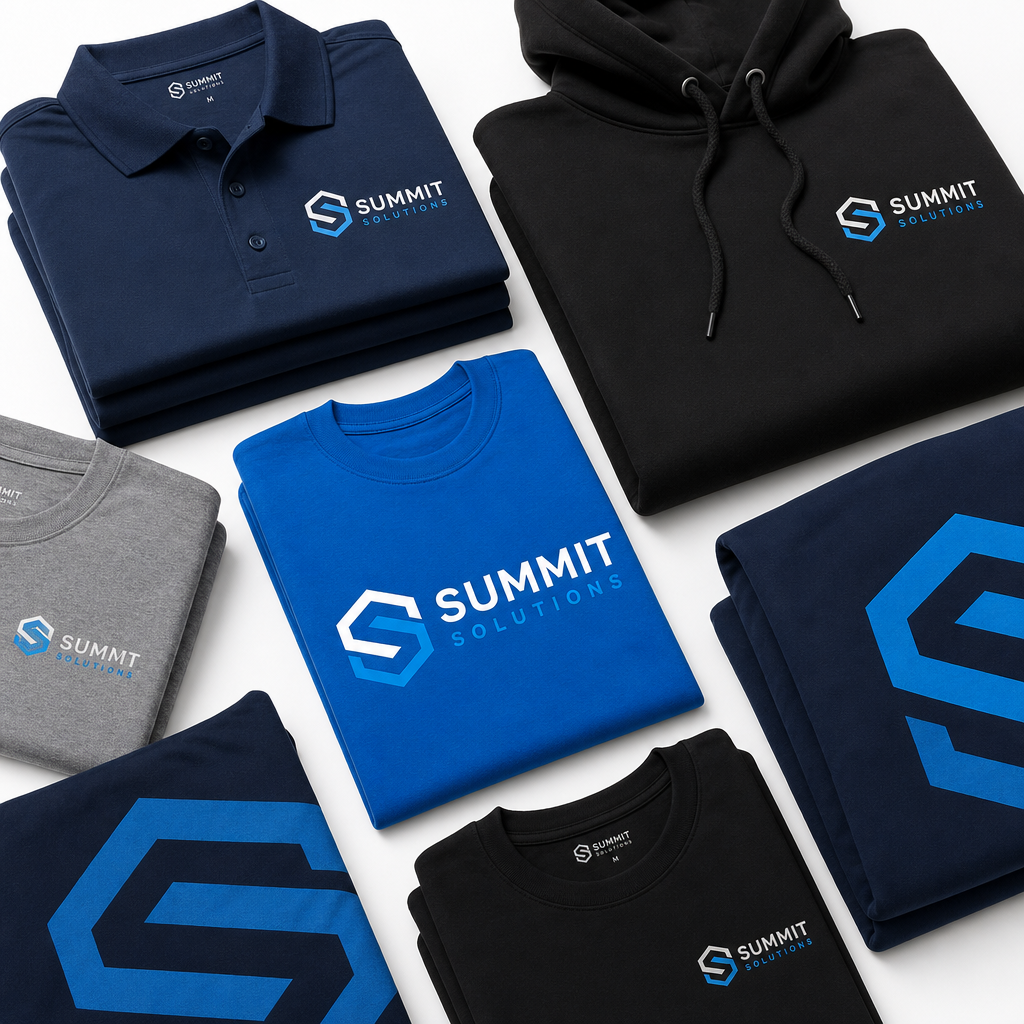
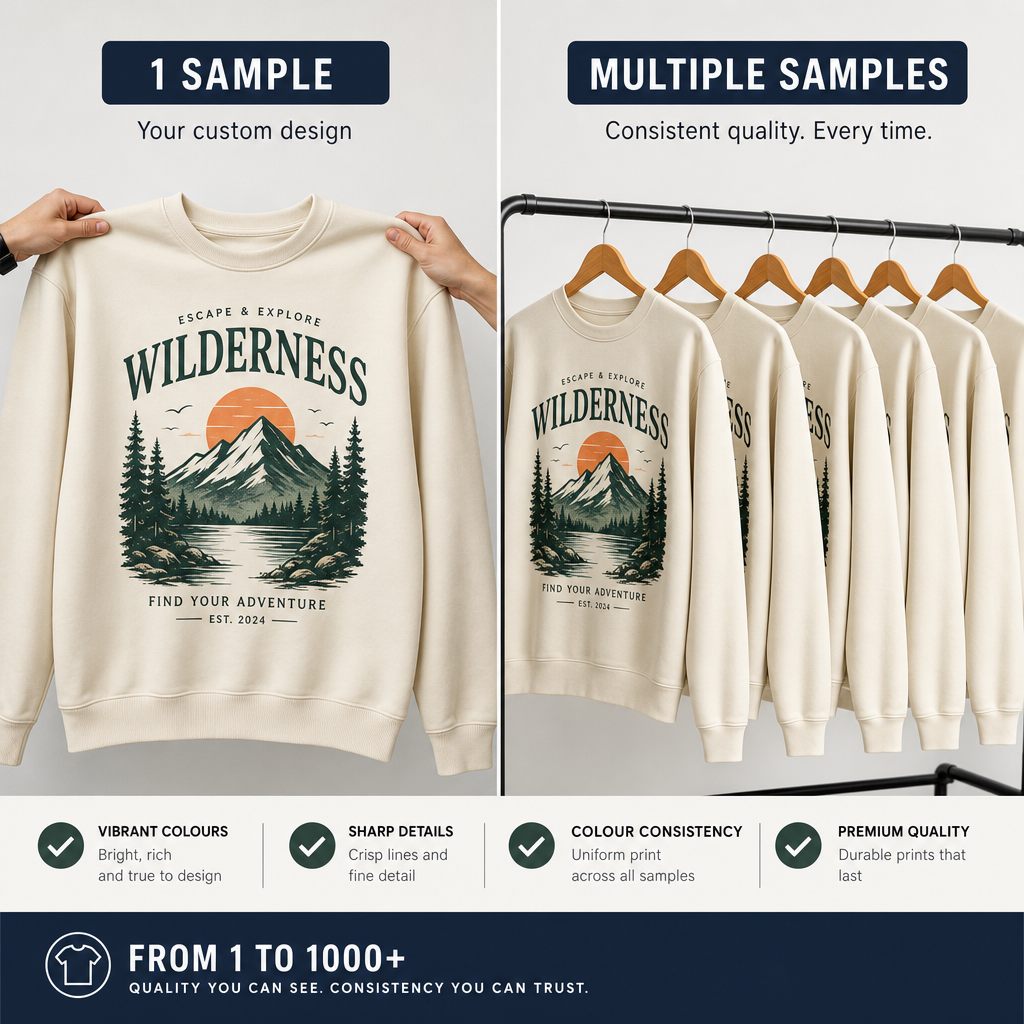
Screen printing typically charges a screen setup fee of between £15 and £35 per colour. A two-colour logo printed on 10 t-shirts could cost £50 to £70 in setup alone before a single shirt is printed. Spread across 100 shirts, that setup cost becomes negligible, which is why screen printing dominates large-volume uniform orders for major retailers and sports teams.
DTF printing has zero screen setup costs. A 10-unit order of branded polos with a full-colour company logo costs almost the same per unit as a 1-unit order. In practice, this makes DTF printing dramatically cheaper for runs under approximately 30 to 50 units, and the break-even point shifts further in DTF's favour as design complexity increases.
Hidden Costs That Change the Calculation
Screen printing also charges for artwork separation and colour matching if your logo uses Pantone references. If your brand uses three or more colours, you are looking at three or more screens. A five-colour design can attract setup costs exceeding £100 before print begins.
With DTF printing, the only variable that affects price is the size of the print area and the number of garments. A five-colour logo costs the same as a two-colour logo. For businesses with detailed, colourful branding, this is a significant financial advantage.
Pro tip: If your branded workwear order is under 40 units or your logo contains more than two colours, run a quote comparison that includes screen setup fees. In most cases, DTF will be cheaper in total even if the listed per-unit price looks higher.
Print Quality and Durability: What Actually Lasts
The durability question is one that comes up constantly in business workwear printing, and the honest answer is that both methods are durable when applied correctly. The difference is in how that durability is achieved and what conditions affect it.
Screen printed garments, particularly those using plastisol inks, have a proven long-term track record. The ink cures into the fabric fibres at high temperature, creating a mechanical bond that holds up well to industrial washing cycles. This is why screen printing remains popular for high-volume uniform programmes where garments are laundered frequently and aggressively.
DTF transfers, when applied correctly with the right temperature, pressure, and dwell time, create an extremely strong adhesive bond. Independent wash tests on correctly applied DTF transfers show 50 or more washes without significant cracking, fading, or peeling. The key phrase is applied correctly. Poor heat-press calibration is the primary cause of premature DTF failure, not the method itself.
Colour Vibrancy and Design Reproduction
On light-coloured garments, both methods produce vibrant results. On dark garments, DTF has a clear edge. Screen printing on dark fabrics requires an additional white underbase print, adding cost and sometimes affecting colour accuracy. DTF automatically includes the white underbase layer, keeping colour output consistent regardless of garment colour at no additional charge.
For photographic or gradient-heavy designs, DTF is the clear winner. Screen printing reproduces gradients using halftone dot patterns, which produces a noticeably different visual effect than the smooth tonal transitions DTF delivers. For business logos with detailed shading or photography-based artwork, DTF simply produces a better-looking result.
"The print-on-demand and direct-to-film market is projected to grow significantly as businesses demand more flexible, short-run custom apparel with no minimum order constraints." - Statista, Global Custom T-Shirt Printing Market Analysis
Order Quantities and Lead Times
Screen printing facilities rarely accept orders under 12 to 24 units because the economics of screen setup make smaller runs unprofitable for the printer. Some facilities enforce minimums of 50 units. For a small business ordering branded uniforms for a team of 8, this is an immediate problem.
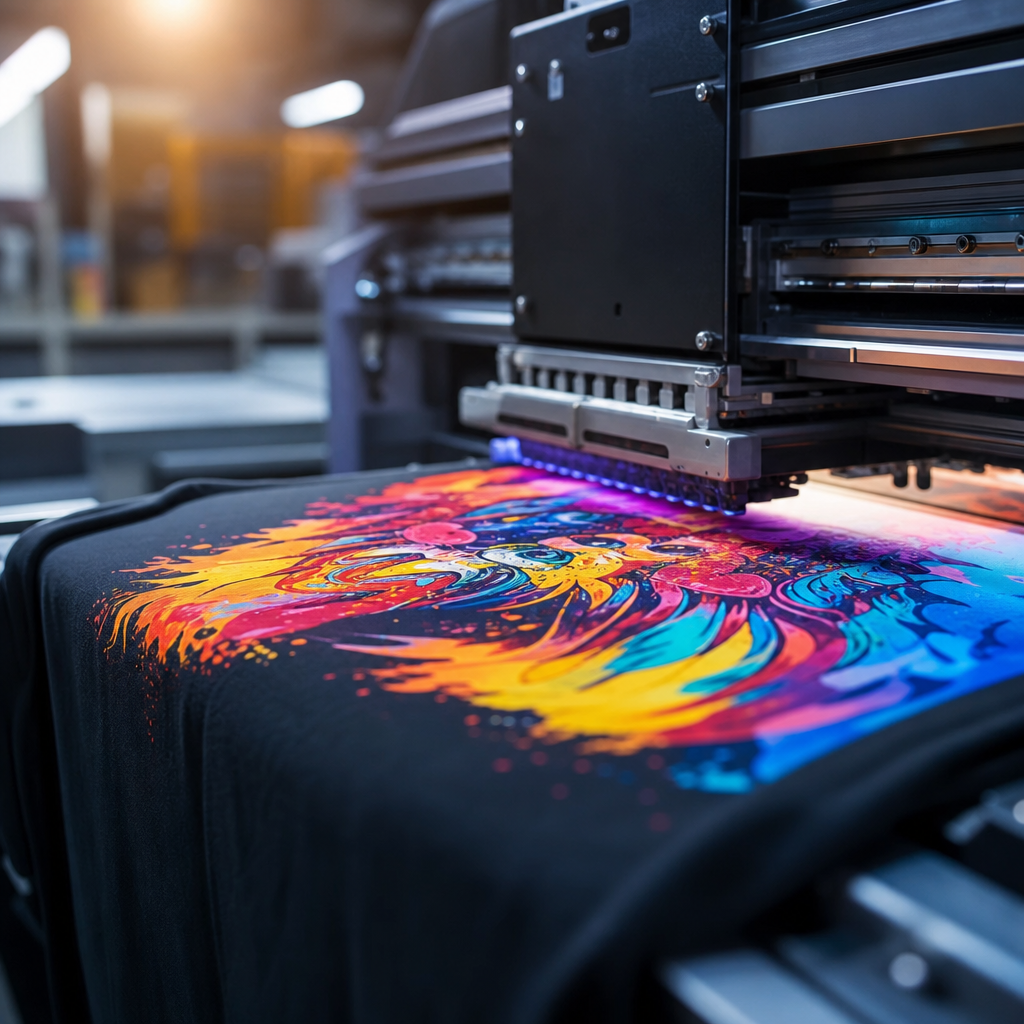
DTF printing carries no meaningful minimum order. Whether you need 1 custom hoodie for a giveaway or 200 branded t-shirts for a trade show, the same process applies. This flexibility is particularly valuable for event organisers who need mixed quantities across different garment types and sizes.
Turnaround Time in Practice
Screen printing lead times are longer because screen preparation adds a day or more to the production schedule before a single item is printed. For complex jobs requiring multiple colour registrations, proofing can extend this further. A typical small screen print order takes 5 to 10 business days from artwork approval.
DTF printing can move from approved artwork to dispatched order in 1 to 3 business days in many cases. For businesses ordering workwear ahead of a staff start date, a product launch, or a client event, that time difference is often the deciding factor. Psyque's in-house heat-press and DTF setup means UK orders are handled without the third-party delays that affect many competitors relying on outsourced print facilities.
Pro tip: If you are ordering branded workwear for a specific event or deadline, always add 3 working days to your required date as a buffer. DTF is faster than screen printing, but courier transit time in the UK varies. Psyque's free shipping on orders over £45 already factors into the value calculation for most small business orders.
Best Use Cases for Each Method
Both methods have a clear territory where they deliver the best outcome. The mistake is assuming one is universally superior.
When DTF Printing Is the Right Choice
DTF printing is the correct choice for small business workwear bundles, event merchandise, team kits with individual names or numbers, and any order using a complex or colourful design. It is also the better option when ordering across multiple garment types from a single artwork file, such as matching t-shirts, hoodies, and polos for a brand launch, because the same transfer file works across all garment styles without reprinting screens.
Businesses using Psyque for their branded workwear typically fall into exactly this category: small to medium order sizes, full-colour logos, and a need for fast turnaround without committing to bulk quantities upfront.
When Screen Printing Makes More Sense
Screen printing wins on very large, simple runs. If you are ordering 200 or more t-shirts with a one or two-colour logo for a promotional giveaway or a large sports team, screen printing's lower per-unit cost at that volume makes it the economically sensible choice. The setup cost becomes negligible, and the faster press speed means large runs can be completed efficiently.
Screen printing also suits jobs where a specific tactile feel is part of the product specification, such as vintage-feel merchandise with intentional ink texture, or puffy ink effects that cannot be replicated with DTF transfers.
Side-by-Side Comparison: DTF vs Screen Printing
| Factor | DTF Printing | Screen Printing |
|---|---|---|
| Minimum Order Quantity | No minimum. Single unit orders accepted. | Typically 12 to 50 units minimum per design. |
| Setup Cost | None. No screens or plates required. | £15 to £35 per colour screen, charged per order. |
| Colour Complexity | Unlimited colours at no extra cost. Full CMYK reproduction. | Each colour requires a separate screen and additional cost. |
| Dark Fabric Performance | Excellent. White underbase is standard at no surcharge. | Additional cost for underbase screen on dark garments. |
| Turnaround Time | 1 to 3 business days for most UK orders. | 5 to 10 business days including screen preparation. |
| Best Order Size | 1 to approximately 50 units per design. | 50 units and above for cost efficiency. |
| Fabric Compatibility | Works on cotton, polyester, nylon, and blends. | Best on 100% cotton. Performance varies on synthetics. |
| Photographic Detail | Reproduces gradients and photos accurately. | Limited to spot colours or halftone simulation of gradients. |
| Durability | 50 or more washes when correctly applied. | Very high durability on high-volume runs with plastisol ink. |
Which Custom Printing Method Is Best for Business Workwear
For the majority of small UK businesses ordering branded workwear, DTF printing is the more practical and cost-effective choice. The reasons are structural, not promotional.
Most small business workwear orders fall below 50 units. Most business logos use more than one or two colours. Most businesses need their branded garments quickly, not in 10 business days. DTF printing satisfies all three of these realities where screen printing consistently falls short.
A common mistake is assuming that screen printing is inherently more professional or durable. In practice, a well-executed DTF print on a premium heavyweight cotton hoodie looks and wears just as well as a screen-printed equivalent. The difference in customer perception is negligible. The difference in lead time, cost, and flexibility is significant.
For businesses using Psyque's custom workwear bundles, the DTF process means you can order your exact team size, in your exact garment mix, with your full-colour logo, at a price that works for a small business budget. Competitors like jrsindustrial.co.uk and orderuniform.co.uk often impose minimum order thresholds or limit design complexity that Psyque's in-house DTF setup avoids. Spreadshirt.co.uk offers flexibility but at the cost of print quality and UK dispatch speed that businesses with professional brand standards cannot accept.
If your business is scaling and you anticipate a single-design run exceeding 100 units on a regular basis with a simple logo, it is worth requesting a screen print quote at that point. Below that threshold, DTF is almost always the better decision for UK business workwear.
Frequently Asked Questions
Is DTF printing as durable as screen printing for workwear?
Yes, when applied correctly. DTF transfers bond firmly to fabric fibres under heat and pressure, and properly applied DTF prints hold up to 50 or more wash cycles without cracking or peeling. The key is correct heat-press calibration. Psyque uses in-house heat-press equipment calibrated for each garment type, which is why durability is consistent across their custom workwear orders.
What is the minimum order quantity for DTF printing?
DTF printing has no meaningful minimum order. You can order a single garment cost-effectively. This is the fundamental difference from screen printing, which requires spreading screen setup costs across a minimum run of 12 to 50 units to make the per-unit price viable.
Can DTF printing handle my company logo with multiple colours?
Yes. DTF printing uses CMYK pigment inks and reproduces unlimited colours at no additional cost per colour. This makes it well suited to business logos that include gradients, multiple tone values, or photographic elements. Screen printing would charge a separate screen setup fee for each colour in your logo.
Which printing method is better for dark-coloured workwear like navy or black?
DTF printing performs equally well on dark and light garments because a white ink underbase is applied as standard. Screen printing on dark fabric requires an additional underbase screen, adding cost and sometimes reducing colour accuracy. For businesses ordering navy or black uniforms with bright or colourful logos, DTF is the more reliable and cost-effective choice.
How long does DTF printed workwear take to produce and dispatch?
Most DTF custom workwear orders at Psyque are produced and dispatched within 1 to 3 business days from artwork approval. This is significantly faster than screen printing, which typically requires 5 to 10 business days to account for screen preparation, proofing, and print production.
Is screen printing ever the better choice for business branded merchandise?
Yes, for high-volume runs of 100 units or more with a simple one or two-colour logo. At that scale, the screen setup cost per unit drops to near negligible, and screen printing's press speed makes large runs highly efficient. For promotional t-shirts ordered in bulk at a single size and design, screen printing can undercut DTF on unit price. Below that volume or with complex designs, DTF is almost always more practical and cost-effective.
What file formats does DTF printing accept compared to screen printing?
DTF printing accepts standard raster and vector files including PNG, JPEG, and PDF. Screen printing typically requires vectorised artwork with separated spot colours, often in AI or EPS format. This makes DTF printing more accessible for small business customers who have logo files in common formats but no access to professional design software for colour separation.
If you have ordered branded workwear using either of these methods, share what worked or what you would do differently with your next order in the comments.
We would love your feedback and any insights you would share with others. What perspective would you add?
References
- Statista: Global custom apparel and print-on-demand market size data and growth projections
- Forbes: Small business branding and branded merchandise strategy insights for entrepreneurs
- HubSpot Marketing Statistics: Brand consistency and visual identity impact on customer trust and recognition
- Ahrefs Blog: Research on niche content strategy and organic search behaviour for product-led businesses
- Moz: SEO learning resources covering commercial intent keyword strategy for e-commerce and service businesses