
DTF vs Screen Printing vs Embroidery: Best for UK Business
Choosing the wrong printing method for your business workwear or merchandise can cost you money, time, and credibility. Many UK small business owners order screen-printed uniforms only to discover the print cracks after a dozen washes, or commission embroidered polos that look flat and unreadable at small sizes. The question of DTF vs screen printing is not academic. It directly affects your brand perception, your budget, and your turnaround speed. This guide cuts through the noise and gives you a direct answer based on real-world print production, not marketing copy.
Table of Contents
- Quick Takeaways
- What Each Method Actually Does
- DTF vs Screen Printing: Cost and Quantity
- DTF vs Embroidery UK: Durability and Detail
- Best Printing Method for Business by Use Case
- Comparison Table: DTF, Screen Printing, and Embroidery
- Common Mistakes UK Businesses Make When Ordering Printed Apparel
- Frequently Asked Questions
- References
Quick Takeaways
| Key Insight | Explanation |
|---|---|
| DTF wins for small runs with full colour | Direct to Film printing requires no screens or setup fees, making it cost-effective from a single unit and ideal for photographic or gradient-heavy designs. |
| Screen printing becomes cheaper at high volumes | Once you exceed roughly 50 units of the same design, screen printing typically lowers the per-unit cost, though setup charges apply per colour. |
| Embroidery signals premium quality but limits detail | Embroidered logos work brilliantly on polo shirts and caps but cannot reproduce fine text below 6mm or photographic images accurately. |
| DTF transfers bond to virtually any fabric | Unlike screen printing, DTF works on cotton, polyester, nylon, and blended fabrics without separate ink systems or pre-treatment chemicals. |
| Wash durability varies significantly by method and application | Professionally heat-pressed DTF prints typically last 40 to 60 washes before noticeable fading, comparable to plastisol screen print durability when applied correctly. |
| Embroidery adds tactile weight not suitable for lightweight garments | Thread density on thin summer tees can pucker and distort the fabric, making DTF the more practical choice for lightweight branded merchandise. |
| Setup time matters for event deadlines | DTF and embroidery can both be produced quickly in small batches, while screen printing requires screen preparation time that can add two to five working days to your order. |
What Each Method Actually Does
Before comparing costs and use cases, it helps to understand what each process physically involves. These are not interchangeable techniques with minor differences. They produce fundamentally different results on fabric.
Direct to Film (DTF) Printing
DTF printing involves printing a design onto a special film using pigment inks, applying a hot-melt adhesive powder, curing it, and then heat-pressing the finished transfer onto the garment. The result is a vibrant, flexible print with a soft hand feel. No screens are required, which means no setup fee per colour. A single custom t-shirt is just as easy to produce as a batch of one hundred.
In practice, DTF is the most versatile method currently available for small to medium UK businesses. It handles full-colour photographic designs, gradients, fine lines, and white ink on dark garments without requiring separate processing steps for each colour.
Screen Printing
Screen printing uses a mesh screen to push ink directly through onto the fabric. Each colour in a design requires its own screen, which is exposed using a film positive of that colour layer. The process produces extremely saturated, opaque prints with excellent wash durability. However, each colour in your design adds to setup costs, and changing the design between print runs requires new screens entirely.
Screen printing suits businesses that need large quantities of the same design in a limited number of colours. A construction firm ordering 200 hi-vis vests with a two-colour logo is a perfect candidate. A restaurant ordering 12 staff t-shirts with a six-colour illustrated design is not.
Embroidery
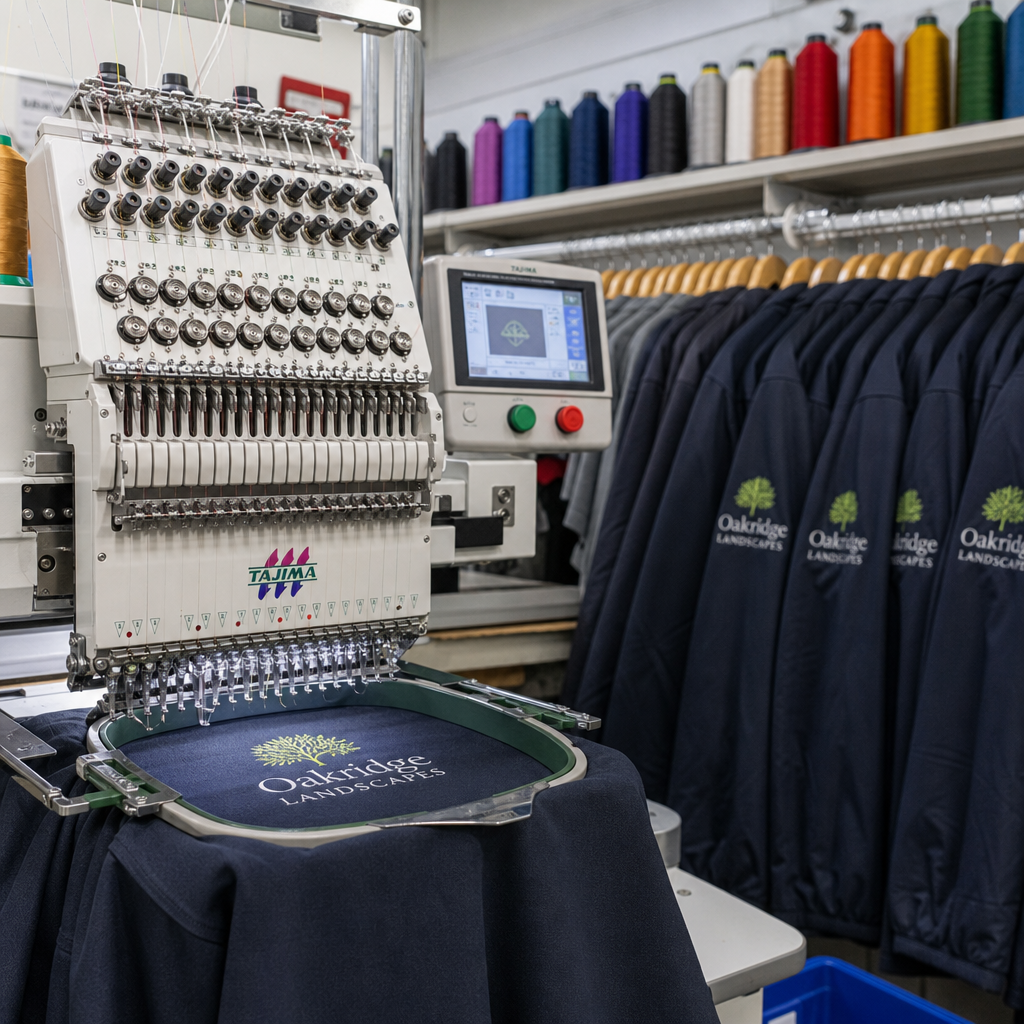
Embroidery uses a computerised machine to stitch thread directly into the fabric. The design must first be converted into a stitch file, a process called digitising, which typically carries a one-off setup fee between £15 and £40 in the UK. Once digitised, the same file can be reused for future orders. Embroidery produces a three-dimensional, tactile finish that conveys a sense of quality and permanence. It is the method most associated with corporate workwear, sports teams, and hospitality uniforms.
Pro tip: If your logo contains very thin lettering or intricate detail smaller than 4mm, ask your printer to simplify it before digitising. Embroidery machines cannot replicate hairline strokes accurately, and the result will look blurry or unreadable on the finished garment.
DTF vs Screen Printing: Cost and Quantity
The most common question Psyque receives from small business owners is straightforward: which method is cheaper? The honest answer is that it depends entirely on your order quantity, your design complexity, and whether you expect to reorder the same design in the future. But those factors do lead to clear, definitive guidance.
Low Quantity Orders (1 to 49 units)
For orders below 50 units, DTF printing is almost always more cost-effective than screen printing. Screen printing requires screen setup fees that typically range from £15 to £30 per colour per screen. A four-colour design therefore adds £60 to £120 in setup costs before a single garment is printed. DTF has no such overhead. You pay per transfer, which makes low-run jobs financially predictable.
A sole trader ordering 20 branded hoodies for a market stall will pay far less per unit with DTF than with screen printing, once setup costs are factored in. The per-unit cost on DTF for a small run is typically between £3 and £6 for the print alone, depending on print area and design complexity.
High Quantity Orders (50 units and above)
Above 50 units of an identical design, screen printing begins to compete on per-unit cost, particularly for designs with fewer than four colours. The setup cost is amortised across more units, and the actual printing speed of screen printing at volume is very fast. Large brands ordering staff uniforms in the hundreds will often find screen printing delivers a lower cost per print.
However, DTF is closing this gap. Improvements in DTF film production speeds and ink costs over the past three years mean the break-even point between DTF and screen printing is shifting. Many UK printers now report that DTF remains competitive up to 75 or even 100 units for multi-colour designs.
Pro tip: If you are ordering workwear in multiple sizes with slightly different name or number personalisation on each item, screen printing simply cannot accommodate that. DTF handles per-item personalisation at no extra setup cost, which makes it the only practical choice for personalised team kits or staff name badges on garments.
DTF vs Embroidery UK: Durability and Detail
The DTF vs embroidery UK debate often comes down to the garment type and the intended use of the finished product. Both methods are durable when applied correctly, but they age very differently and suit different brand aesthetics.
Wash Durability in Real Conditions
Embroidery is essentially permanent. Thread stitched into fabric does not crack, peel, or fade in the way printed inks can. A well-embroidered logo on a polo shirt will still look sharp after two years of weekly washing. This is why hospitality and healthcare businesses frequently choose embroidery for uniforms that go through commercial laundering.
DTF, when heat-pressed correctly at the right temperature and pressure, produces prints that last 40 to 60 wash cycles before visible degradation begins. For seasonal promotional merchandise or event t-shirts, this durability is more than sufficient. For workwear used daily in physically demanding environments, embroidery or screen printing on a heavyweight garment may be more appropriate.
Design Detail and Colour Range
This is where DTF wins decisively over embroidery. Embroidery cannot reproduce photographic images, gradients, or very fine detail. Thread has a physical diameter that sets a hard limit on how small or fine a design element can be. A 10mm section of text in embroidery may be legible but will always look slightly chunky compared to the same text printed via DTF.
DTF handles the full RGB colour spectrum, including gradients and photographic artwork, without any additional cost per colour. If your brand identity relies on a complex, multi-colour logo or a detailed illustrated design, DTF is the only method that will reproduce it faithfully on fabric at a small-business budget.
"The printed garment market in the UK is seeing a significant shift toward shorter run, higher-personalisation orders. Technologies that allow cost-effective single-unit production are reshaping what small businesses can afford to offer their customers." - British Promotional Merchandise Association, 2023 industry overview
Best Printing Method for Business by Use Case
Rather than speaking in abstractions, here is a direct recommendation for each of the most common scenarios faced by UK small business owners, event organisers, and team managers ordering custom apparel.
Corporate Workwear and Staff Uniforms
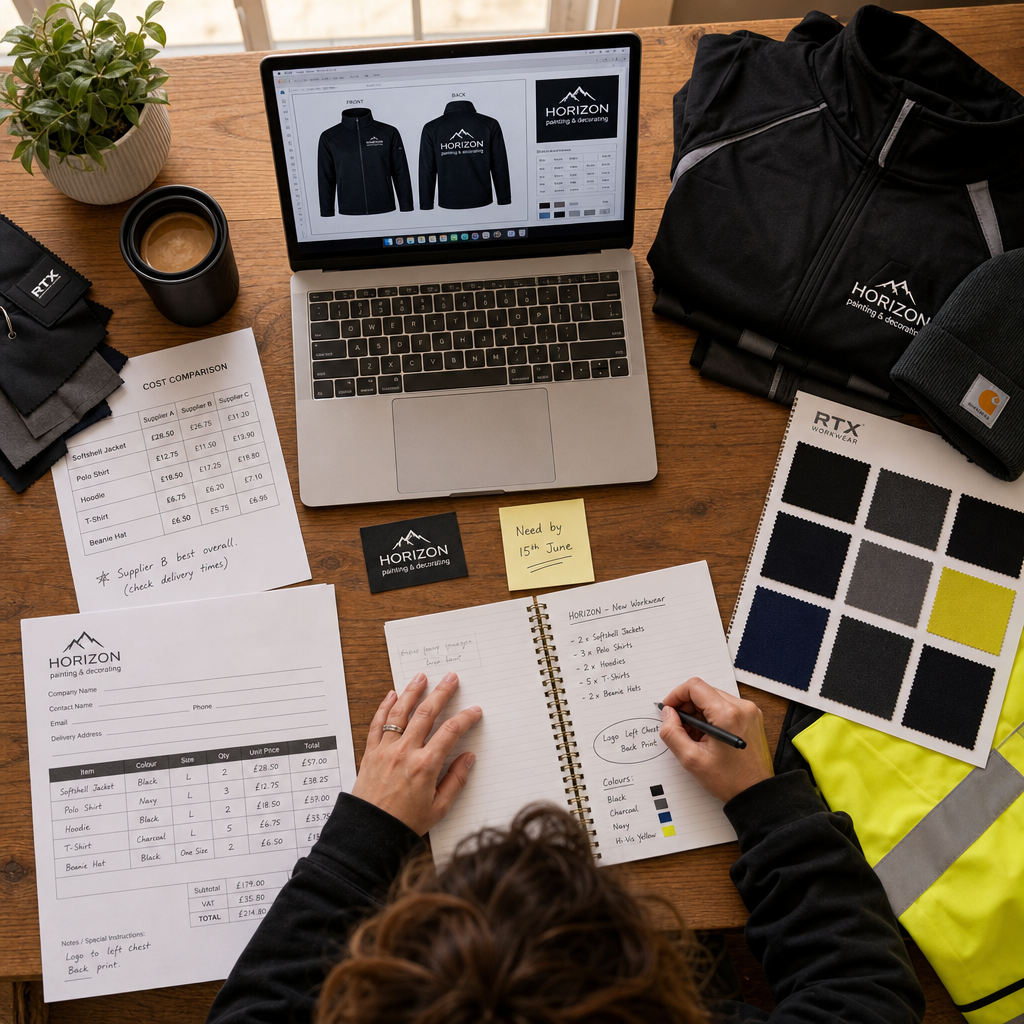
For daily-wear uniforms such as polo shirts, fleeces, or embroidered caps, embroidery remains the preferred choice for businesses in customer-facing industries like hospitality, property, and finance. The tactile quality signals investment in brand presentation. For businesses where garments are refreshed more frequently or where budgets are tighter, DTF on a quality polo provides excellent results at a lower price point.
Psyque's workwear bundles are specifically designed for exactly this decision point, offering printed options that give small businesses a professional appearance without a large minimum order requirement.
Event T-Shirts and Promotional Merchandise
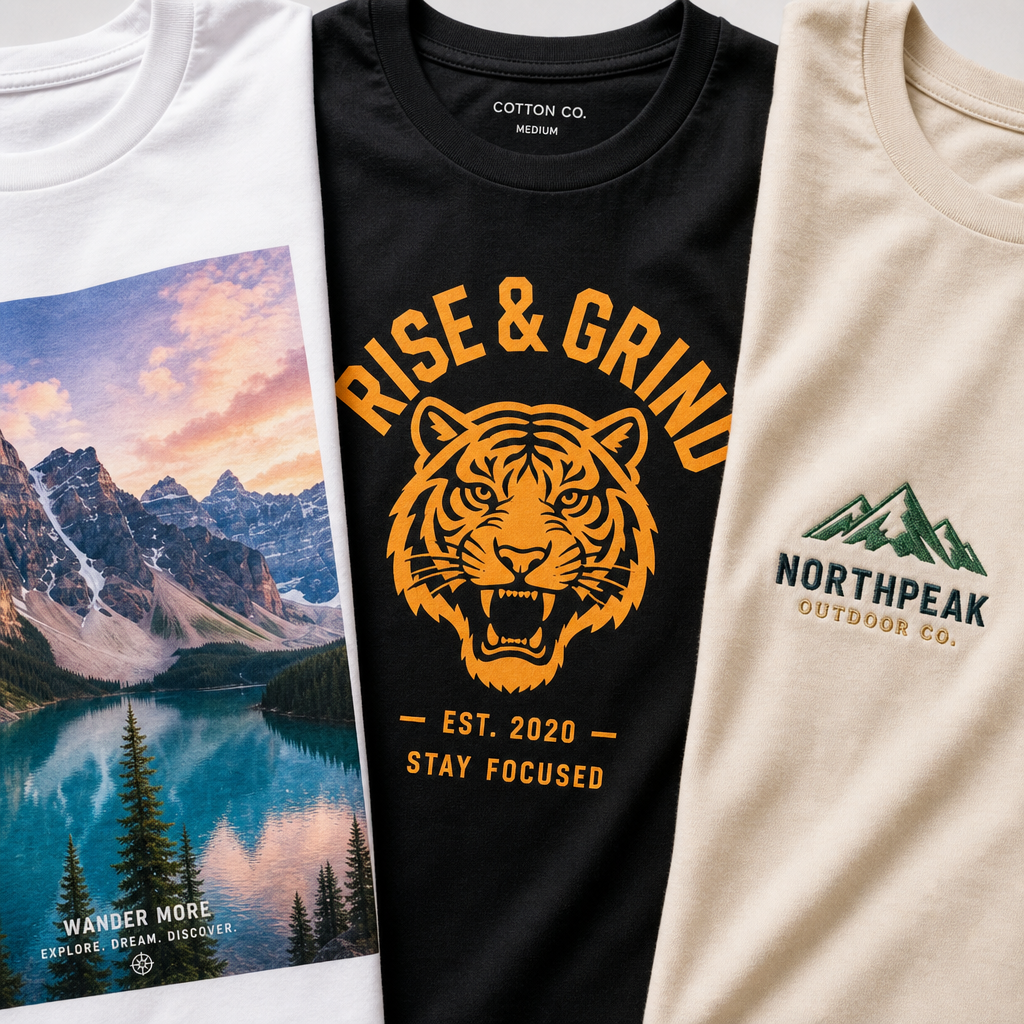
For one-time events such as charity runs, festivals, corporate away days, or sports tournaments, DTF is the clear winner. The ability to print small quantities with full-colour, complex designs at a predictable per-unit cost makes planning straightforward. There is no waste from overproduction, and personalisation per item is possible at no additional setup cost.
Sports Kits and Team Apparel
Sports kits typically require player numbers, names, and team logos. This combination of personalisation and multi-location printing is exactly where DTF excels. Screen printing cannot handle per-garment personalisation without separate screen setups for each variation. Embroidery handles lettering and numbers well but struggles with detailed badge artwork on synthetic performance fabrics, which do not hold thread as securely as woven cotton.
Branded Merchandise for Resale
If you are producing branded merchandise to sell, such as printed t-shirts for a band, a community group, or a lifestyle brand, the quality of the print directly affects perceived product value. DTF produces print quality that is indistinguishable from screen printing to most consumers, at small-run quantities that do not require upfront inventory investment. Once your designs prove popular and you are ordering 100 units or more of the same design, revisiting screen printing for cost savings makes sense.
Comparison Table: DTF, Screen Printing, and Embroidery
The table below summarises the key practical differences across the three methods for UK businesses ordering custom apparel. Use this as a reference when deciding which approach fits your current order requirements.
| Factor | DTF Printing | Screen Printing | Embroidery |
|---|---|---|---|
| Minimum order quantity | 1 unit | Typically 20 to 50 units | 1 unit (after digitising) |
| Setup cost | None | £15 to £30 per colour screen | £15 to £40 one-off digitising fee |
| Colour range | Unlimited, including gradients | Limited by number of screens | Limited by thread colour availability |
| Fine detail capability | Excellent (sub-1mm lines possible) | Good (limited by mesh count) | Poor below 4mm detail size |
| Fabric compatibility | Cotton, polyester, nylon, blends | Best on 100% cotton | Woven fabrics, limited on very thin fabric |
| Wash durability | 40 to 60 washes typical | 50 to 70 washes with plastisol inks | Essentially permanent |
| Per-unit personalisation | Yes, no extra cost | No (new screen required per variation) | Yes, at additional cost per item |
| Best volume range | 1 to 75 units | 50 to 500 units | 1 to 100 units |
| Typical turnaround | 3 to 5 working days | 5 to 10 working days | 5 to 7 working days |
Common Mistakes UK Businesses Make When Ordering Printed Apparel
After working with hundreds of UK business clients, the same ordering errors surface repeatedly. Knowing these in advance saves both money and frustration.
Choosing the Method Based on Name Recognition Alone
Many buyers default to embroidery because it sounds more premium, or to screen printing because it sounds more established, without considering whether the method suits their specific design and quantity. A common mistake is commissioning embroidery for a logo that contains thin lettering, shadows, or gradient colours, then being disappointed when the finished result looks nothing like the original artwork. Always send your artwork to your printer and ask for an honest assessment before committing.
Underestimating the Impact of Garment Choice
The garment quality affects how any print method performs. A cheap 150gsm t-shirt will not hold a DTF transfer or embroidery thread as well as a 280gsm premium cotton tee. If your printed garments are representing your brand to customers or clients, the garment itself is as important as the print method. Psyque's custom t-shirt range uses premium base garments specifically selected to produce the best results with DTF printing.
Not Accounting for Print Location and Size
Embroidery on a left chest position works well because the print area is small and the method suits that scale. The same embroidery design scaled up to a full back print becomes dense, heavy, and expensive because the number of stitches increases dramatically with size. DTF scales from a small chest logo to a full back print with no change in cost structure, making it more flexible for businesses that want the same logo applied consistently across different garment positions.
Pro tip: When designing for embroidery, always request a stitch count estimate before approving the digitised file. Stitch count directly determines cost, and a complex back-print design can easily carry three times more stitches than expected, pushing the per-garment embroidery cost significantly higher than quoted for smaller placements.
Ignoring Reorder Planning
Screen printing and embroidery both involve setup work that creates an asset for future reorders. Your screens and digitised stitch files can be reused. With DTF, the print file is digital and trivially easy to rerun. None of the methods lock you into a single supplier indefinitely, but it is worth confirming file ownership and portability with your printer before placing a large initial order.
Frequently Asked Questions
Is DTF printing durable enough for workwear used every day?
Yes, when applied correctly using the right temperature and pressure settings, DTF prints on quality garments will withstand 40 to 60 wash cycles without significant fading or peeling. For workwear that goes through daily heavy use and commercial laundering, embroidery offers greater long-term durability, but for most standard business workwear environments, professionally applied DTF transfers perform very well.
What is the minimum order quantity for DTF printing at Psyque?
DTF printing can be produced from a single unit, which is one of its primary advantages for small businesses and event organisers. There are no minimum order requirements tied to the printing method itself, though free shipping thresholds and bundle pricing apply. Check the workwear bundles page for current pricing tiers that offer better per-unit value at higher quantities.
Can I mix embroidery and DTF printing on the same garment?
Yes, and many businesses do exactly this for a premium effect. A common combination is an embroidered brand logo on the left chest for a structured, tactile brand mark, paired with a DTF-printed design or slogan on the back or sleeve. Both methods can be applied to the same garment in sequence, though this does add to the per-unit cost and production time.
Why is screen printing still used if DTF is so flexible?
Screen printing remains relevant for very large uniform orders where cost per unit is the primary decision factor, and for applications requiring specialist inks such as glow-in-the-dark, metallic, or discharge printing effects that are not replicable with DTF technology. For the majority of small to medium UK business orders, however, DTF has overtaken screen printing as the more practical and cost-efficient choice.
How do I know if my logo is suitable for embroidery?
Send your artwork to your printer and request a digitising assessment before ordering. Key warning signs that your logo may not suit embroidery include: text smaller than 5mm in height, gradients or drop shadows, photographic elements, and very thin strokes less than 1mm wide. A good printer will advise on simplification rather than proceed with a design that will look poor in stitched form.
Does DTF printing work on dark-coloured garments?
Yes. DTF uses a white underbase layer built into the transfer itself, which means full-colour designs reproduce accurately on black, navy, charcoal, and other dark fabrics without any additional process or cost. This is a significant advantage over water-based screen printing, which requires a separate white underbase screen and associated additional setup cost for printing on dark garments.
What printing method has worked best for your business, and were there any surprises with the results? Share your experience in the comments so other UK business owners can learn from what you have found in practice.
References
- Statista: UK custom apparel and promotional merchandise market data and industry statistics
- Forbes: Business branding and branded merchandise strategy insights for small businesses
- British Promotional Merchandise Association: UK industry standards and market research for printed and branded products
- Ahrefs Blog: Data on consumer search behaviour around custom printing and branded apparel in the UK
- HubSpot Marketing Statistics: Research on brand recognition and the role of consistent visual identity in business growth