
DTF vs Screen Printing vs Vinyl: Best for Workwear
If you are ordering custom workwear for your business and you have no idea whether to go with DTF printing, screen printing, or vinyl heat transfer, you are not alone. Most small business owners make this decision based on price alone and end up with prints that crack after ten washes or colours that look nothing like the logo they submitted. The method you choose affects durability, colour fidelity, minimum order quantities, and your total cost per garment. This guide breaks down DTF printing vs screen printing vs vinyl, tells you which method wins for specific workwear scenarios, and saves you from an expensive mistake.
Table of Contents
- Quick Takeaways
- What Is DTF Printing and How Does It Work
- What Is Screen Printing and When Does It Make Sense
- What Is Vinyl Heat Transfer and Where Does It Fall Short
- Side-by-Side Comparison: DTF vs Screen Printing vs Vinyl
- Best Printing Method for Workwear: The Honest Verdict
- Cost Breakdown for Small Business Orders
- Frequently Asked Questions
- References
Quick Takeaways
| Key Insight | Explanation |
|---|---|
| DTF wins for low-quantity, full-colour orders | No screens or setup fees mean you can order 5 to 20 garments without paying a premium per unit for setup costs. |
| Screen printing is cost-effective only above 50 units | Each colour in your design requires a separate screen, which adds setup costs that only become worthwhile on larger runs. |
| Vinyl is the weakest option for professional workwear | Vinyl transfers crack, peel, and fade faster than both DTF and screen prints, making them unsuitable for uniforms worn daily. |
| DTF handles complex logos without colour limits | Gradients, photographic images, and multicolour logos transfer perfectly via DTF with no additional cost per colour added. |
| Screen printing produces the most vibrant solid colours | For simple, bold logos in one to three colours on large orders, screen printing delivers unmatched vibrancy and longevity. |
| DTF works on virtually any fabric type | Unlike screen printing, which struggles on performance fabrics, DTF adheres reliably to cotton, polyester, blends, and nylon. |
| Fast turnaround favours DTF for urgent workwear orders | DTF requires no screen setup time, so orders can move from artwork approval to dispatch significantly faster than screen printing. |
What Is DTF Printing and How Does It Work
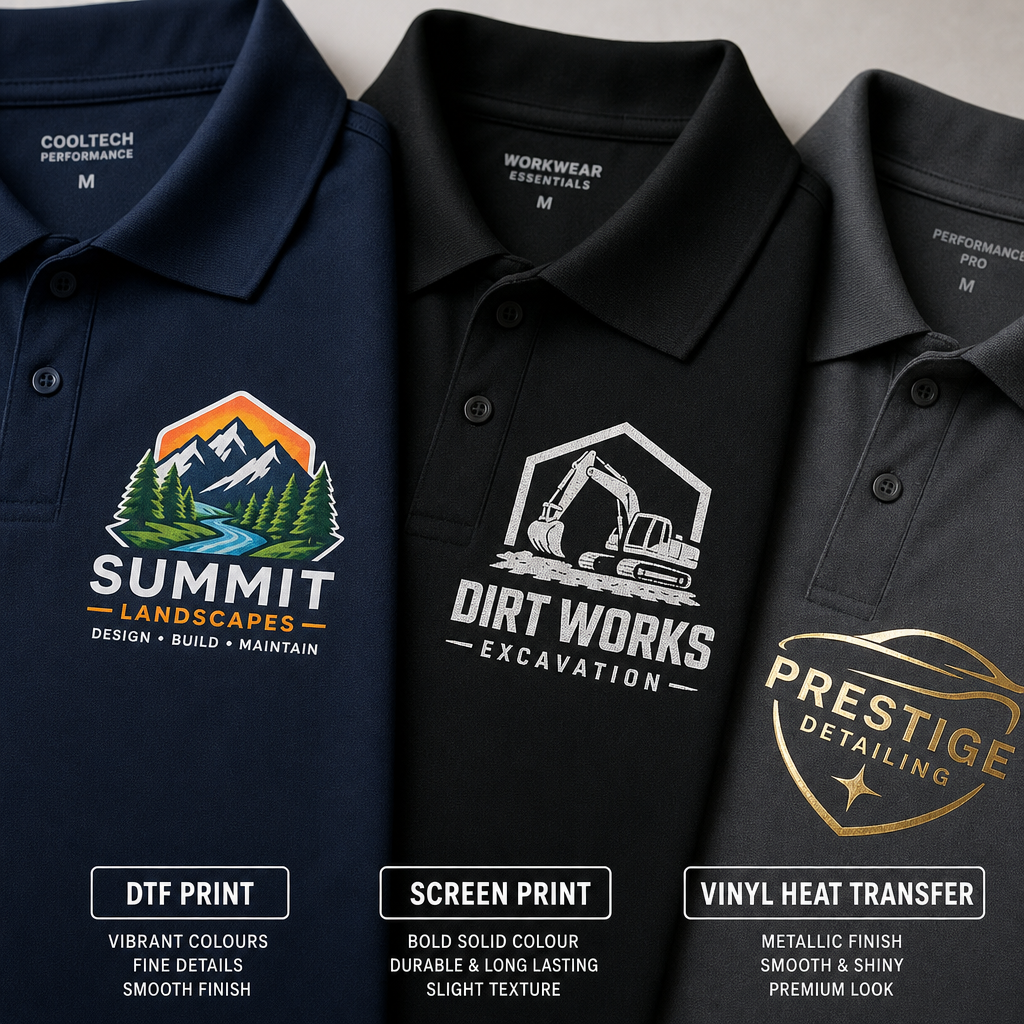
DTF stands for Direct to Film. The design is printed onto a special PET film using a modified inkjet printer loaded with CMYK inks plus a white underbase. A hot-melt adhesive powder is then applied to the wet ink and cured with heat. The resulting transfer is pressed onto the garment using a heat press, bonding the print permanently to the fabric.
In practice, the white underbase layer is what makes DTF so versatile. It creates an opaque foundation that allows colours to sit on top of dark fabrics without looking washed out. This is something standard DTG (Direct to Garment) printing struggles with on darker textiles.
DTF prints typically last 50 to 80 wash cycles before any noticeable degradation, according to industry testing by apparel print specialists. At Psyque, DTF transfers are applied using calibrated heat press equipment, which means the bond is consistent across every garment in a batch rather than varying by operator pressure or technique.
Why Small Businesses Prefer DTF for Short Runs
The single biggest advantage DTF has over screen printing for small businesses is the complete absence of setup fees. Screen printing charges per screen per colour. A four-colour logo can add anywhere from £30 to £100 in setup costs before a single shirt is printed. DTF has no such overhead, which means the cost per unit stays predictable regardless of how complex your logo is.
For a business ordering 10 branded polo shirts for a trade show, DTF is almost always the correct choice. The economics are clear and the quality is more than acceptable for professional use.
Pro tip: If your company logo contains a gradient, multiple tones, or photographic elements, DTF is the only method in this comparison that reproduces it accurately without a significant price premium. Screen printing would require separating those gradients into halftone dots, which reduces visual quality.
What Is Screen Printing and When Does It Make Sense
Screen printing pushes ink through a mesh stencil directly onto the garment. Each colour in the design requires its own screen, and each screen must be created, aligned, and cleaned after the job. It is a batch process with real setup costs and minimum quantities that make economic sense only at scale.
The data consistently shows that screen printing produces the most saturated, vibrant colours for simple solid designs. The ink sits on top of the garment fibres rather than bonding to them, which gives it an almost tactile presence that many brands associate with premium apparel. This is why major fashion and sportswear brands use screen printing for large production runs.
The Real Minimum Order Threshold for Screen Printing
Most UK print suppliers will not take screen printing orders below 25 to 50 units per design. Even at that level, you are absorbing setup costs that push your cost per garment higher than DTF. The break-even point where screen printing becomes cheaper per unit than DTF typically sits around 75 to 100 identical units of the same design.
A common mistake is ordering screen printing for a run of 30 workwear shirts because it sounds more professional, then realising the per-unit cost is higher than DTF would have been and the minimum reorder quantity is inflexible. If your team changes or you need to add one or two new starters, you cannot reorder five shirts at the same per-unit rate.
"The appeal of screen printing is real, but most small businesses are ordering volumes where DTF delivers better value without any compromise on professional appearance." Garment printing industry practitioner, UK trade publication, 2023.
When Screen Printing Is the Right Call
If you are running a hospitality business ordering 150 identical staff T-shirts with a two-colour logo every six months, screen printing makes sense. The setup cost is absorbed across the volume, and the per-unit price drops below what any DTF supplier can match at scale. The print will also have a slightly different texture and colour saturation that some brands specifically want.
What Is Vinyl Heat Transfer and Where Does It Fall Short
Vinyl heat transfer involves cutting a design from coloured vinyl sheets and pressing them onto a garment with a heat press. Each colour is a separate layer of vinyl. The result is a print that has a noticeable raised, rubbery surface feel.
Vinyl is the oldest of these three methods and, for professional workwear, it is also the weakest. The vinyl layer sits on top of the fabric rather than bonding with it, which means edges begin to lift and peel with repeated washing and wearing. Most vinyl transfers show visible degradation within 25 to 40 wash cycles, roughly half the lifespan of a well-applied DTF print.
Where Vinyl Still Has a Use Case
Vinyl is genuinely useful for one-off personalisation, such as adding an individual name or number to a sports kit for a single event. It is fast, cheap per unit at very low quantities, and requires minimal equipment. But for a business buying branded workwear that employees will wear for months, vinyl is not a professional solution.
The best printing method for workwear is almost never vinyl unless the budget is severely constrained and the garments will only be worn a handful of times. The visual result is also limiting since vinyl cannot reproduce gradients or photographic designs at all.
Pro tip: If a supplier is quoting you vinyl heat transfer for a workwear order and presenting it as equivalent to DTF or screen printing, push back. Ask specifically whether the transfer film is a full-colour DTF transfer or cut vinyl. The difference in longevity is significant and worth clarifying before you commit.
Side-by-Side Comparison: DTF vs Screen Printing vs Vinyl
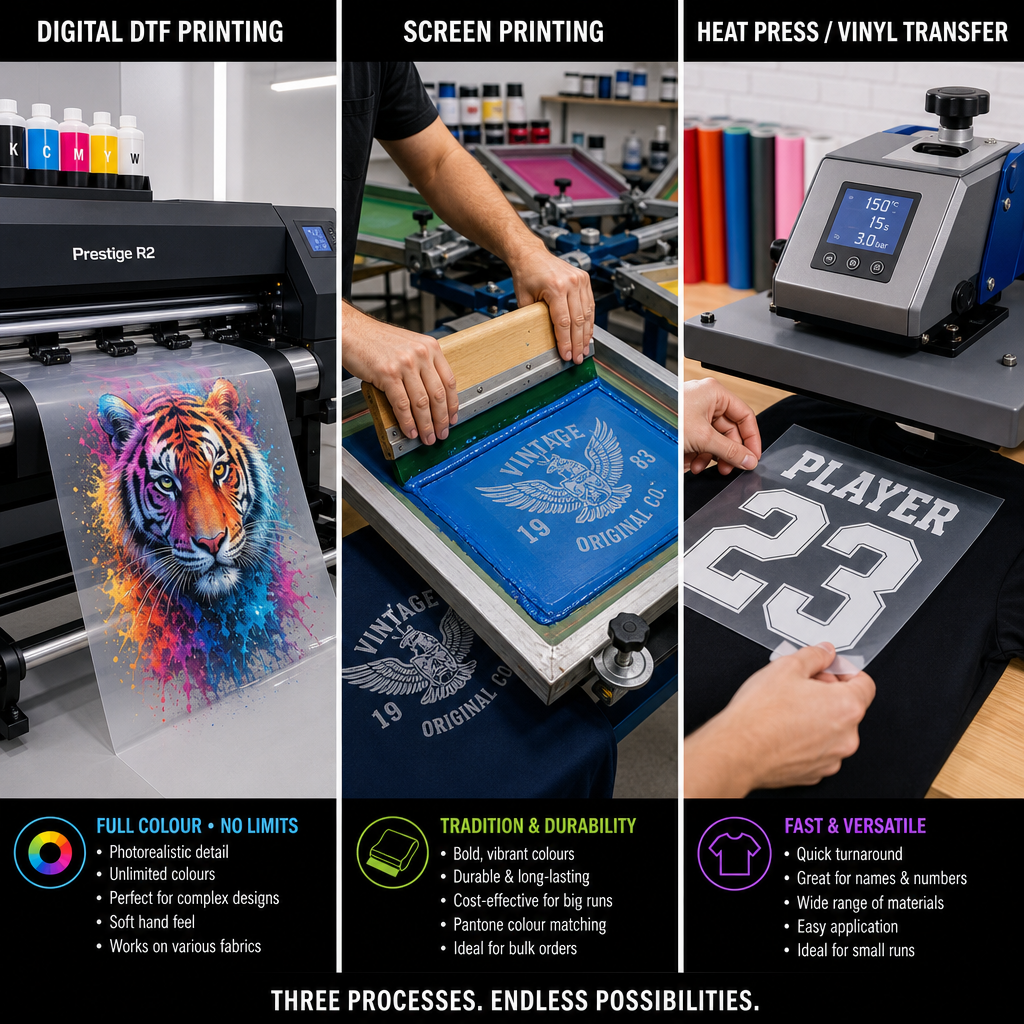
The table below is built around the specific decisions a small business owner faces when ordering branded workwear in the UK. The ratings reflect real-world outcomes, not ideal conditions.
| Factor | DTF Printing | Screen Printing | Vinyl Heat Transfer |
|---|---|---|---|
| Minimum order quantity | 1 to 5 garments | 25 to 50 garments | 1 garment |
| Colour complexity | Unlimited, including gradients | Limited by number of screens (cost increases per colour) | Solid colours only, no gradients |
| Wash durability | 50 to 80 wash cycles | 70 to 100+ wash cycles (cured correctly) | 25 to 40 wash cycles |
| Setup cost | None | £30 to £100+ per colour | None |
| Fabric compatibility | Cotton, polyester, blends, nylon | Best on cotton, limited on synthetics | Most fabrics but poor on textured surfaces |
| Turnaround time | Fast (no screen prep) | Slower (screen creation adds 1 to 3 days) | Very fast |
| Cost per unit at 10 garments | Competitive | Expensive (setup costs dominate) | Cheap but low quality |
| Cost per unit at 100 garments | Moderate | Cheapest option | Cheap but lowest quality |
| Professional appearance | Excellent | Excellent | Acceptable for casual use only |
Best Printing Method for Workwear: The Honest Verdict
For the majority of UK small businesses ordering branded workwear, DTF printing is the correct method. It covers the most common scenarios: orders of 5 to 75 garments, logos with multiple colours or gradients, mixed fabric types, and fast turnaround needs. The durability is sufficient for professional use and the cost structure rewards small orders rather than punishing them.
Screen printing becomes the better choice only when you consistently order above 75 to 100 identical units per design and your logo is simple enough to reproduce in one to three solid colours. At that volume and design complexity, the per-unit cost advantage of screen printing is real and worth the longer setup time.
Vinyl heat transfer should not feature in most professional workwear decisions. It is a shortcut that looks like a shortcut within a few weeks of regular wear.
Specific Workwear Scenarios and the Right Method
A construction company ordering 15 high-vis polos with a four-colour company logo: DTF printing is the clear answer. No setup fees, full colour reproduction, and the polyester-blend fabric is compatible with DTF adhesive.
A restaurant chain ordering 200 identical cotton T-shirts with a single-colour logo for front-of-house staff: screen printing makes economic and visual sense at this volume. The per-unit cost will be lower than DTF and the bold, saturated result suits a simple logo perfectly.
A personal trainer ordering 8 branded hoodies to sell at a fitness event: DTF printing at a supplier like Psyque handles this comfortably. The free shipping threshold on orders over £45 makes small personalised orders genuinely affordable without hidden delivery costs eating into the budget.
Cost Breakdown for Small Business Orders
Pricing varies by supplier, but the structure is consistent across the UK market. Understanding the cost model helps you ask the right questions before placing an order.
For DTF printing, you pay for the garment, the print area, and a base application fee. There are no per-colour charges and no setup fees. At Psyque, workwear bundles include the garment and print together, so the pricing is transparent from the first unit.
Where Screen Printing Costs Catch Small Businesses Out
Screen printing quotes often look competitive on the per-shirt line item but omit setup fees in the initial estimate. A quote of £8 per shirt for 30 units sounds reasonable until you add three screen setup fees at £40 each, which pushes the effective cost to approximately £12 per shirt. At 30 units, DTF at £10 to £11 per shirt all-in is the better deal.
The DTF vs vinyl heat transfer cost comparison is more straightforward. Vinyl is cheaper per unit at very low quantities but the print quality and longevity are worse. For anything meant to represent a business professionally, the extra cost of DTF is justified by the result.
Frequently Asked Questions
Is DTF printing better than screen printing for small business workwear?
For most small businesses ordering under 75 units, DTF printing is better. There are no setup fees, no colour limits, and the method works on a wider range of fabrics. Screen printing only becomes more cost-effective at higher volumes with simple, solid-colour designs.
How long does a DTF print last on workwear?
A properly applied DTF print lasts approximately 50 to 80 wash cycles before any visible degradation. Washing garments inside out in cold water on a gentle cycle extends this lifespan further. For daily workwear, this represents months of regular use under normal conditions.
Can DTF printing go on high-vis and performance fabric workwear?
Yes. This is one of DTF's genuine advantages over screen printing. DTF transfers adhere reliably to polyester, nylon, and performance blends that screen printing inks struggle to bond with properly. High-vis jackets, moisture-wicking polos, and softshell jackets are all suitable for DTF application.
What is the minimum order for DTF printed workwear at Psyque?
Psyque offers DTF printed workwear with very low minimum quantities, making it practical for small teams, start-ups, and event organisers who need branded garments without committing to large batch orders. Free shipping on orders over £45 further reduces the cost for small runs.
Why is vinyl heat transfer not recommended for professional workwear?
Vinyl sits on the surface of the garment rather than bonding with the fibres at a microscopic level. With regular washing and wearing, the edges begin to lift and crack within 25 to 40 wash cycles. For branded workwear that employees wear daily, this means visible print failure within weeks, which damages the professional image the workwear was meant to project.
Does screen printing work on dark fabric workwear?
Screen printing on dark fabrics requires an underbase layer of white ink, which adds to cost and complexity. It is achievable but increases the price per unit. DTF printing includes a white underbase as a standard part of the process, making it better suited and more cost-transparent for dark garment orders.
Which printing method is fastest for urgent workwear orders?
DTF printing is the fastest option for urgent orders. There is no screen creation time, no registration alignment process, and no minimum batch requirement that forces you to wait for stock to accumulate. At Psyque, DTF orders benefit from in-house printing and fast UK dispatch, which matters when a deadline is firm.
Have you ordered workwear using any of these printing methods? Share what worked well and what you would do differently next time, your experience could help another business owner make a better decision.
References
- Statista industry data on custom apparel and branded merchandise market size
- Forbes small business resources on branded merchandise and team identity
- Ahrefs blog covering e-commerce and product content strategies for small business
- HubSpot marketing statistics on brand consistency and customer trust
- Moz learning resources on content strategy and authority building for product businesses