

How to Wash DTF Printed Clothing and Keep Prints New
Most people ruin their custom printed garments before they even get a chance to show them off properly. A single hot wash cycle or a rough tumble dry session can crack, fade, or peel a DTF print that was otherwise built to last for years. If you have invested in branded workwear or custom apparel from a print specialist like Psyque, knowing how to wash DTF printed clothing correctly is not optional - it is the difference between a garment that looks sharp after 50 washes and one that starts peeling after five.
Table of Contents
- What Is DTF Printing and Why Washing Matters
- Quick Takeaways
- The Correct Washing Method for DTF Printed Garments
- Drying DTF Prints Without Wrecking Them
- Ironing and Storing Custom Printed Clothing
- Washing Methods Compared
- Common Mistakes That Destroy DTF Prints Faster
- DTF Print Care Guide for Workwear Bundles
- Frequently Asked Questions
- References
What Is DTF Printing and Why Washing Matters
DTF printing works by printing a design onto a special film using water-based pigment inks, applying a hot-melt adhesive powder, and then heat-pressing that transfer directly onto the garment. The result is a vibrant, durable print with excellent colour saturation and fine detail. But the adhesive bond, while strong, is not indestructible.
Unlike screen printing, which sits inside the fabric weave, DTF prints sit on top of the fabric surface. This means mechanical stress from washing, high heat, and aggressive detergents are the primary enemies. The bond between the print and the garment fibres weakens every time you expose it to conditions it was not designed to handle.
The good news is that with correct care, a quality DTF print applied by a specialist like Psyque should comfortably survive 50 to 80 wash cycles without visible degradation. Most premature print failures trace back directly to avoidable washing errors.
Quick Takeaways
| Key Insight | Explanation |
|---|---|
| Wash inside out, every time | Turning the garment inside out before washing reduces direct friction on the print surface and protects ink layers from abrasion. |
| 30°C is the sweet spot | Washing at 30°C (cold-warm) cleans effectively without weakening the heat-melt adhesive that bonds the DTF film to the fabric. |
| Avoid bleach and fabric softener | Both break down the adhesive layer. Bleach strips pigment; fabric softener leaves residue that reduces bond strength over time. |
| Skip the tumble dryer for prints | High heat from tumble drying reactivates and then degrades the adhesive, causing edges to lift and colours to dull after repeated cycles. |
| Use a gentle cycle setting | High-spin cycles create mechanical stress that stretches the fabric and pulls at the print edges. A gentle or delicate cycle extends print life significantly. |
| Do not wring or twist | Wringing wet garments physically cracks the ink film. Press water out gently and reshape before air drying flat or on a hanger. |
| Wait 24 hours after pressing before first wash | Freshly applied DTF transfers need time to fully cure. Washing too soon, before the adhesive has fully set, is the fastest route to early print failure. |
The Correct Washing Method for DTF Printed Garments
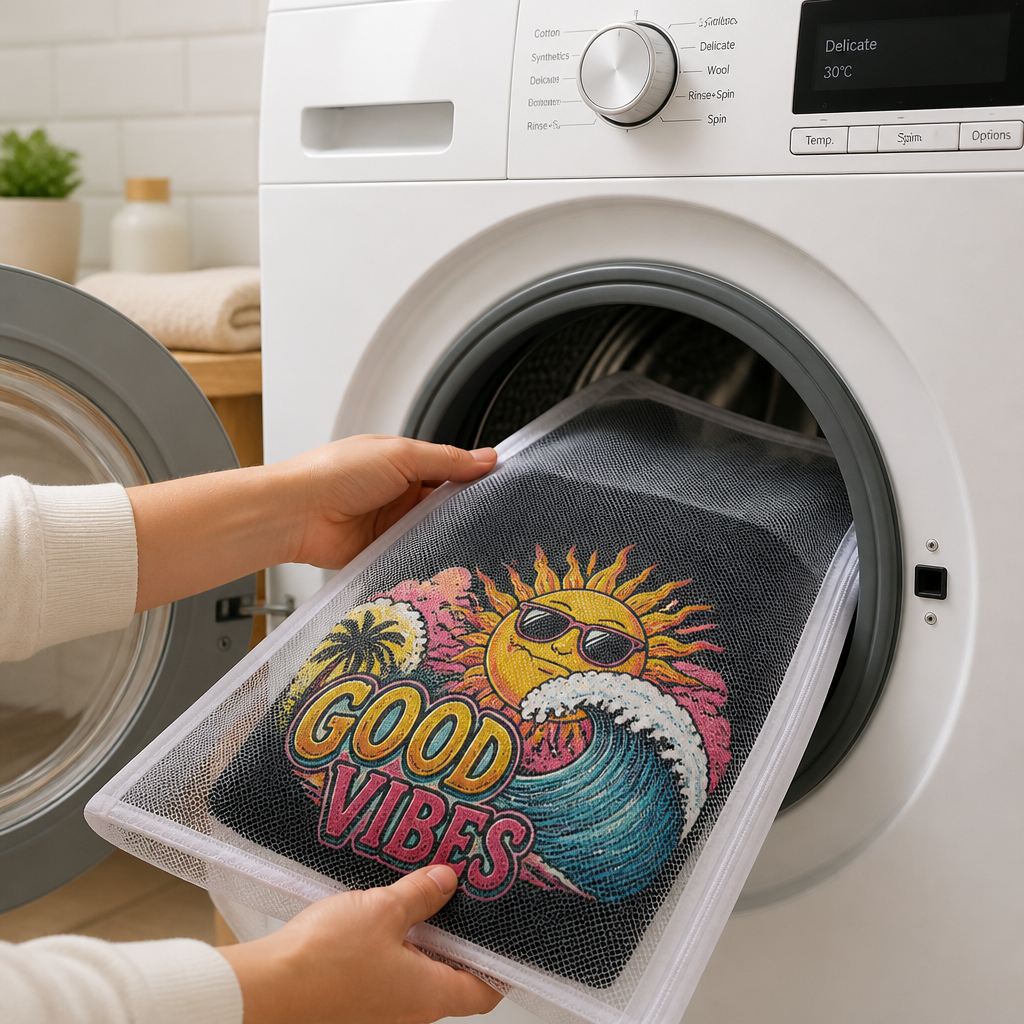
The single most effective thing you can do for any custom printed garment is to turn it inside out before it enters the washing machine. This one habit protects the print from direct contact with other garments, drum surfaces, and zips during the wash cycle. It is simple, free, and consistently makes a measurable difference to print longevity.
Set your machine to a maximum of 30°C. In practice, most everyday dirt and odour from workwear, team uniforms, or event merchandise releases perfectly well at this temperature. You do not need a hot wash to get branded clothing clean, and the small gain in cleaning power at 40°C or higher is not worth the accelerated adhesive degradation.
Choosing the Right Detergent
Use a mild liquid detergent rather than a powder. Powder detergents can leave undissolved granules that abrade the print surface, particularly if the machine is overloaded or the water temperature is too low to dissolve them fully. Liquid detergents rinse out more cleanly and are consistently gentler on printed surfaces.
Avoid any detergent marketed as a biological formula if your garments have frequent, heavy use. Biological enzymes are effective at breaking down protein stains but they also break down the adhesive compounds in DTF transfers over repeated washing. A non-biological liquid detergent at the correct dosage is the right choice for printed garments intended for regular commercial use.
Pro tip: When washing branded workwear in bulk, separate printed garments from items with metal zips, studs, or Velcro. Hardware snags the print surface during the wash cycle and creates micro-tears that expand over time.
Machine Settings That Protect the Print
Select the gentlest available cycle on your machine, labelled as delicate, hand wash, or synthetics depending on your appliance. The key variable is spin speed. Keep it at or below 800 RPM. High spin speeds, typically 1200 to 1400 RPM, stretch the garment fabric rapidly and repeatedly, and that mechanical stress pulls at the edges of the DTF transfer where adhesion is naturally thinnest.
Do not overload the machine. A crowded drum means garments twist around each other, which is exactly the kind of mechanical stress that lifts print edges and causes cracking along design boundaries.
Drying DTF Prints Without Wrecking Them
Air drying is the gold standard for any DTF printed garment. Hang or lay flat to dry away from direct sunlight. UV exposure fades pigment inks noticeably over time, and the combination of heat and UV from direct sun dries the print out unevenly, which causes surface cracking.
If you must use a tumble dryer, run it on the lowest heat setting possible, and remove the garment while it is still slightly damp. Finishing the drying process flat at room temperature eliminates the final burst of heat that most damages the adhesive layer. Never dry DTF printed garments on a high heat setting. The adhesive used in DTF transfers is activated at around 150 to 165°C during pressing, and repeated exposure to high dryer temperatures progressively degrades that bond.
"Textile care labelling standards exist precisely because garment composition and surface treatments respond very differently to heat and mechanical stress. The care label is not a suggestion - it is engineering data." - The Textile Institute, Manchester
Pro tip: For event merchandise or team kits that need to be turned around quickly, reshape the garment while damp and hang in a well-ventilated space. A small fan speeds up air drying dramatically without the heat damage of a tumble dryer.
Ironing and Storing Custom Printed Clothing
Never iron directly over a DTF print. Direct iron contact, even at a medium setting, will melt the surface of the ink film and permanently damage the print texture and colour fidelity. The polyurethane layer that gives DTF prints their durability and slight sheen is heat-sensitive by design.
If the garment is creased, iron on the reverse side with the print face down on a clean, smooth surface. Alternatively, use a pressing cloth or parchment paper between the iron and the print if you need to iron the outer surface. A steam iron held slightly above the garment surface, without direct contact, can also relax creases without damaging the print.
Storage Habits That Extend Print Life
Store printed garments folded with the print on the inside, or hang them to avoid fold crease lines pressing into the print surface over extended periods. For long-term storage of branded stock, avoid compressing garments tightly in plastic bags without ventilation. Moisture can become trapped and encourage mildew, which attacks both fabric and adhesive.
For businesses storing workwear bundles ordered from Psyque, a simple solution is to store garments inside out on open shelving or breathable garment bags. This keeps them ready to wear, protected from dust and light, and free from the fold-line pressure that eventually cracks prints on heavily stored garments.
Washing Methods Compared
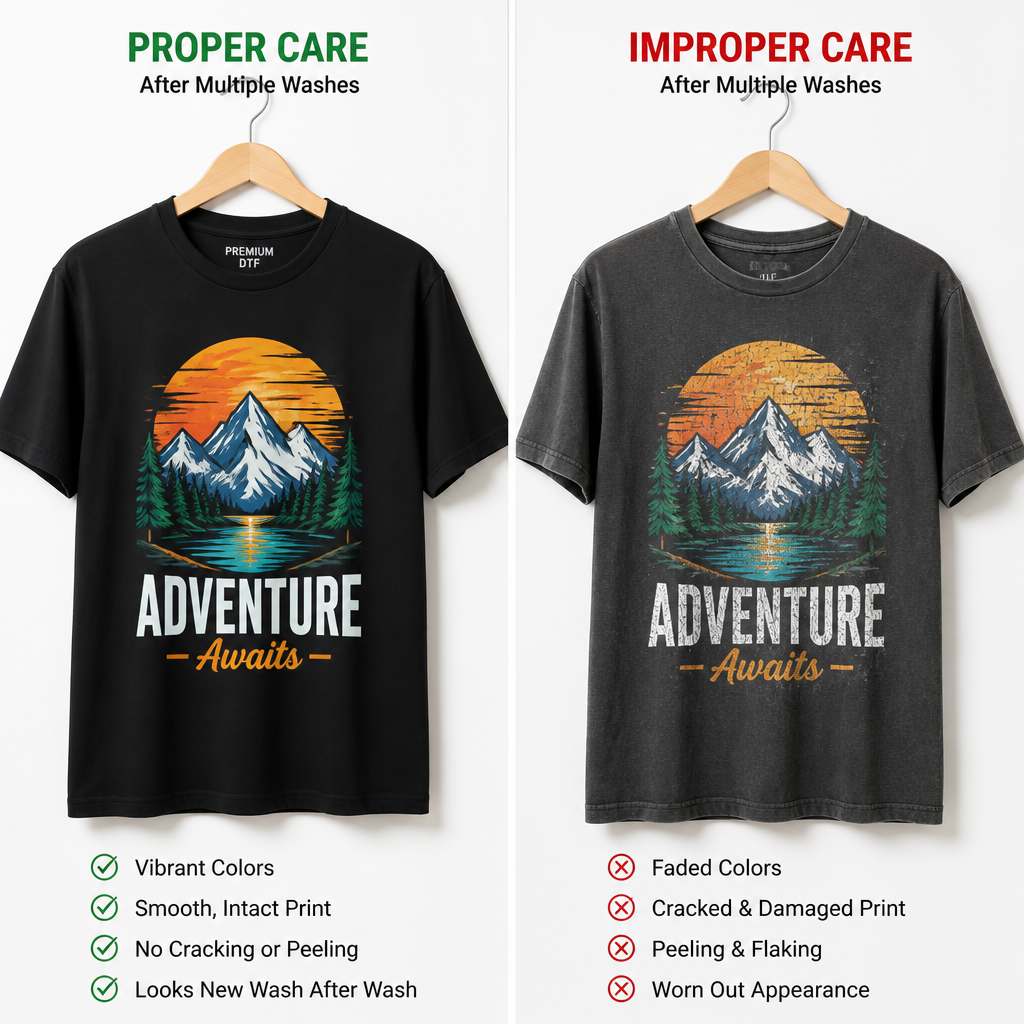
Not all washing approaches are equal when it comes to protecting DTF prints. The table below compares the three most common methods used for custom printed garments, with a clear assessment of their impact on print longevity.
| Washing Method | Impact on DTF Print Longevity | Best For |
|---|---|---|
| Machine wash, 30°C gentle cycle, inside out, liquid detergent | Excellent. Minimal adhesive degradation, low mechanical stress. Consistent results over 50 to 80 wash cycles. | Workwear bundles, team kits, event merchandise, regular use garments |
| Machine wash, 40-60°C, standard cycle, powder detergent | Poor. Heat weakens adhesive; powder granules abrade print surface; high spin stress lifts edges. Visible degradation within 20 to 30 washes. | Not recommended for any DTF printed garment |
| Hand wash, cold water, mild liquid soap, gentle press to remove water | Best possible. Zero mechanical stress from drum or spin. Ideal for limited edition prints, delicate fabrics, or heavily detailed designs. | Premium branded merchandise, special event garments, polyester and performance fabrics |
Common Mistakes That Destroy DTF Prints Faster
A common mistake is washing branded garments immediately after receiving them, without allowing time for any heat-transfer adhesive to fully cure. Even though Psyque garments are dispatched ready to wear, the best practice is to wait at least 24 hours before the first wash, particularly if any re-pressing has occurred in packaging or handling. This applies to any DTF printed item regardless of supplier.
Another frequent error is using a stain removal spray or stick directly on the print area. Most stain removers contain solvents or oxidising agents that attack the ink film and adhesive. If a stain falls on or near the printed design, treat the fabric around the print from the inside of the garment, not directly on the print surface.
Dry Cleaning Is Not a Safe Alternative
Some people assume dry cleaning is a gentler option for printed garments. It is not. The chemical solvents used in dry cleaning dissolve the adhesive compounds in DTF transfers. A single dry cleaning cycle can destroy a DTF print entirely. The garment care label on any DTF printed item should never recommend dry cleaning, and if a dry cleaner suggests it is safe, they are wrong in the context of DTF printed textiles.
Washing multiple printed garments together is fine, provided they are all inside out and there are no metal fixings to cause abrasion. What you want to avoid is mixing printed garments with rough-textured items like denim, canvas work trousers, or anything with external hardware.
DTF Print Care Guide for Workwear Bundles
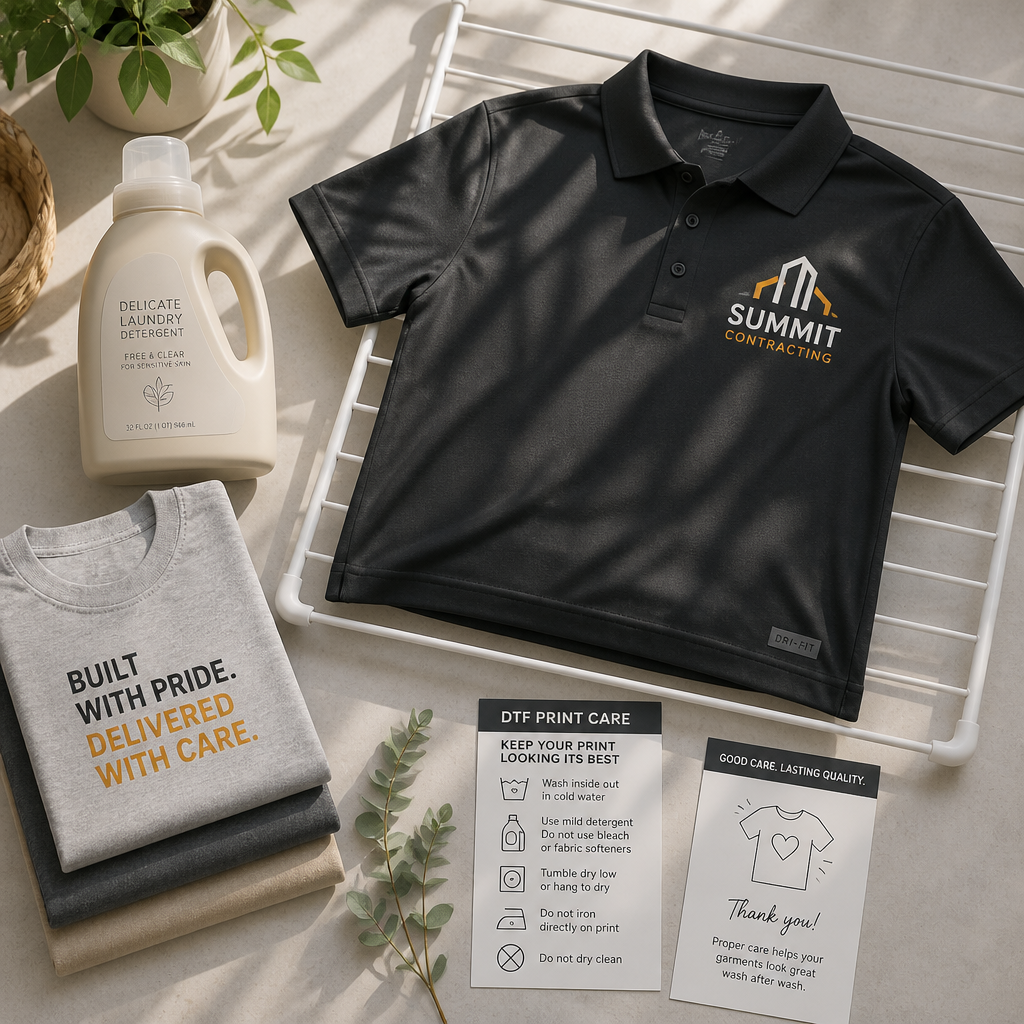
For small businesses and teams that have ordered custom workwear bundles through Psyque, consistent care across the entire team makes a real commercial difference. A team of ten people all washing their branded polo shirts correctly means those garments stay looking sharp and on-brand for the full working life of the order. One person washing on a hot cycle with biological detergent means their shirt looks noticeably different from their colleagues within a few months.
The practical solution is a simple printed care card included with each garment, or a short briefing note shared with the team when workwear is distributed. This is not overcomplicated - the key rules are short enough to fit on an index card: wash inside out at 30°C, gentle cycle, no bleach or softener, air dry.
What to Tell Event Teams and Volunteers
Event organisers who order custom printed t-shirts or hoodies for volunteer teams face the added challenge that garments may be washed by people with no prior awareness of print care. A single page of care instructions tucked inside each garment bag costs nothing and prevents the kind of print damage that makes reordering necessary far sooner than it should be.
Psyque customers ordering branded event merchandise should specify care instructions when ordering, as print-ready garments are dispatched promptly and the care guidance is straightforward. The DTF print care guide principles above apply equally whether you are managing a staff uniform programme, a sports team kit, or a one-off event run.
Pro tip: If your business orders replacement workwear regularly, track how your garments are holding up over time. If prints are fading or lifting before 30 washes, the problem is almost certainly washing technique rather than print quality. Adjust the team's care routine before reordering.
Frequently Asked Questions
Can I wash DTF printed clothing in a washing machine?
Yes, machine washing is fine for DTF printed garments. The key requirements are turning the garment inside out, using a gentle cycle at 30°C or below, choosing a mild liquid detergent, and keeping the spin speed at 800 RPM or lower. Following these four rules consistently will keep prints looking new across dozens of wash cycles.
How many times can you wash DTF printed clothing before it fades?
A quality DTF print applied with proper adhesive and cured correctly should withstand 50 to 80 wash cycles without significant fading or peeling, provided the correct washing method is used each time. Prints washed at high temperatures on standard cycles with biological detergent typically start showing visible degradation within 20 to 30 washes. Correct care roughly doubles print lifespan.
Is fabric softener safe for DTF prints?
No. Fabric softener should not be used on any DTF printed garment. The conditioning agents in fabric softener coat the garment fibres and progressively reduce the adhesive bond between the DTF transfer and the fabric. Over repeated washes, this causes the print edges to lift and the ink film to develop a dull, cloudy appearance. Use a plain mild liquid detergent instead.
Can you iron over a DTF print?
Direct ironing on a DTF print will damage it. The heat from an iron, even at medium settings, can melt or distort the polyurethane surface layer of the print. Always iron on the reverse of the garment, or place a clean pressing cloth between the iron and the print if ironing from the front is unavoidable. A steam iron held above the surface without direct contact is a safer option for removing light creases.
How do I remove stains from a DTF printed garment without damaging the print?
Treat stains from the reverse of the garment where possible, keeping stain remover products away from the print surface itself. For surface stains near the print, use a small amount of mild liquid soap applied gently with a damp cloth, working from the edges of the stain inward. Avoid scrubbing the print directly. Rinse with cold water and allow to air dry before assessing whether further treatment is needed.
Does hand washing make DTF prints last longer than machine washing?
Yes, hand washing at cold temperature is the gentlest option and produces the best print longevity results because it eliminates all mechanical stress from drum action and spin cycles. For everyday workwear or team kits, machine washing on a gentle cycle at 30°C is a practical and effective alternative. Hand washing is most worthwhile for premium garments, detailed prints, or items you want to keep in the best possible condition for a long time.
Have you found a specific washing routine that works well for your custom printed garments? Share your experience in the comments below.
References
- The Textile Institute - textile care standards, fabric performance, and garment engineering research
- WRAP UK - data and guidance on extending garment lifespan, textile care, and clothing sustainability
- UK Government guidance on sustainable clothing practices and textile product durability
- Statista - consumer data on clothing care habits, laundry frequency, and textile product lifespan statistics
- Forbes - business insights on branded merchandise quality, customer retention, and commercial apparel investment