

Industries That Benefit Most from Custom Workwear UK
Custom printed workwear is not a nice-to-have for most UK businesses. It is a working tool that builds trust on the job site, identifies staff on a shop floor, and turns every employee into a walking advert for your brand. Yet many business owners still treat it as an afterthought, ordering the cheapest option at the last minute and wondering why the prints fade after a dozen washes. The reality is that industries custom workwear UK choices differ significantly, and the right garment paired with the right print method makes a measurable difference to how customers perceive your operation. This guide covers the sectors where branded clothing for businesses UK delivers the clearest, most immediate return.
Table of Contents
- Quick Takeaways
- Construction and Trades
- Hospitality and Food Service
- Retail and Customer Service
- Healthcare and Care Services
- Sports Clubs and Leisure
- Events and Promotions
- Corporate and Office-Based Businesses
- Print Method Comparison for Workwear
- Frequently Asked Questions
- References
Quick Takeaways
| Key Insight | Explanation |
|---|---|
| Construction and trades see instant ROI from branded workwear | A crew in matching branded hoodies and hi-vis jackets looks more professional on a residential job than one in mixed casual wear. That alone affects whether a homeowner recommends you to their neighbour. |
| Hospitality relies on quick staff identification | In a busy restaurant or bar, customers need to spot staff immediately. A branded polo or apron removes all doubt and prevents the frustrating experience of a customer approaching the wrong person. |
| DTF printing outperforms screen printing for small-batch workwear orders | Direct to Film handles full-colour logos, gradients, and fine detail without minimum colour limitations, and the prints survive frequent commercial washing cycles that workwear demands. |
| Sports clubs benefit from consistent multi-size ordering | Clubs buy in batches across many sizes. DTF printing reproduces the same design consistently whether the shirt is an XS or a 3XL, which screen printing struggles to achieve economically at low quantities. |
| Branded clothing is a continuous marketing asset, not a one-off cost | Unlike paid advertising, a printed hoodie or polo shirt keeps your brand visible every working day, for as long as the garment lasts. |
| Care sector workwear must balance branding with practicality | Printed tunics and scrubs for care workers need to survive high-temperature washes. Print method and fabric choice are not cosmetic decisions in this sector. |
| Event organisers have urgent, exact-quantity requirements | Events do not allow for reorders. Fast dispatch and accurate size fulfilment matter more here than in almost any other use case. |
Construction and Trades
Of all the sectors covered in this article, construction and trades businesses have the most to gain from custom printed workwear UK. The job site is a public-facing environment whether the business owner thinks of it that way or not. Homeowners, passers-by, and neighbouring properties all see your crew at work. A team in matching branded hoodies, printed hi-vis jackets, or quality polo shirts with a clear logo signals a legitimate, organised operation. A team in mismatched casual clothing signals the opposite.
The practical argument is equally strong. For construction, highways, warehouses, and industrial environments, durable printed outerwear keeps workers visible and warm while carrying the company brand at no additional cost to the business. There is no need to choose between safety compliance and branding. The two goals coexist on the same garment.
What garments work best for tradespeople
Branded hoodies and sweatshirts are the most-worn garments on UK trade sites during autumn and winter. They layer easily under hi-vis vests and take DTF prints cleanly on both chest and back. Polo shirts serve the same purpose during warmer months, especially for sole traders and small crews who are regularly dealing directly with the customer at the property. The front-left chest position for a logo is the most reliable placement for recognition, but a back print adds visibility when crew members are working away from the client.
Pro tip: If you are a sole trader or run a small team of two to five, a bundle of five printed hoodies and five polo shirts gives you year-round coverage at a unit cost that makes the investment sensible. Do not order one garment type and assume it covers every scenario on a job site.
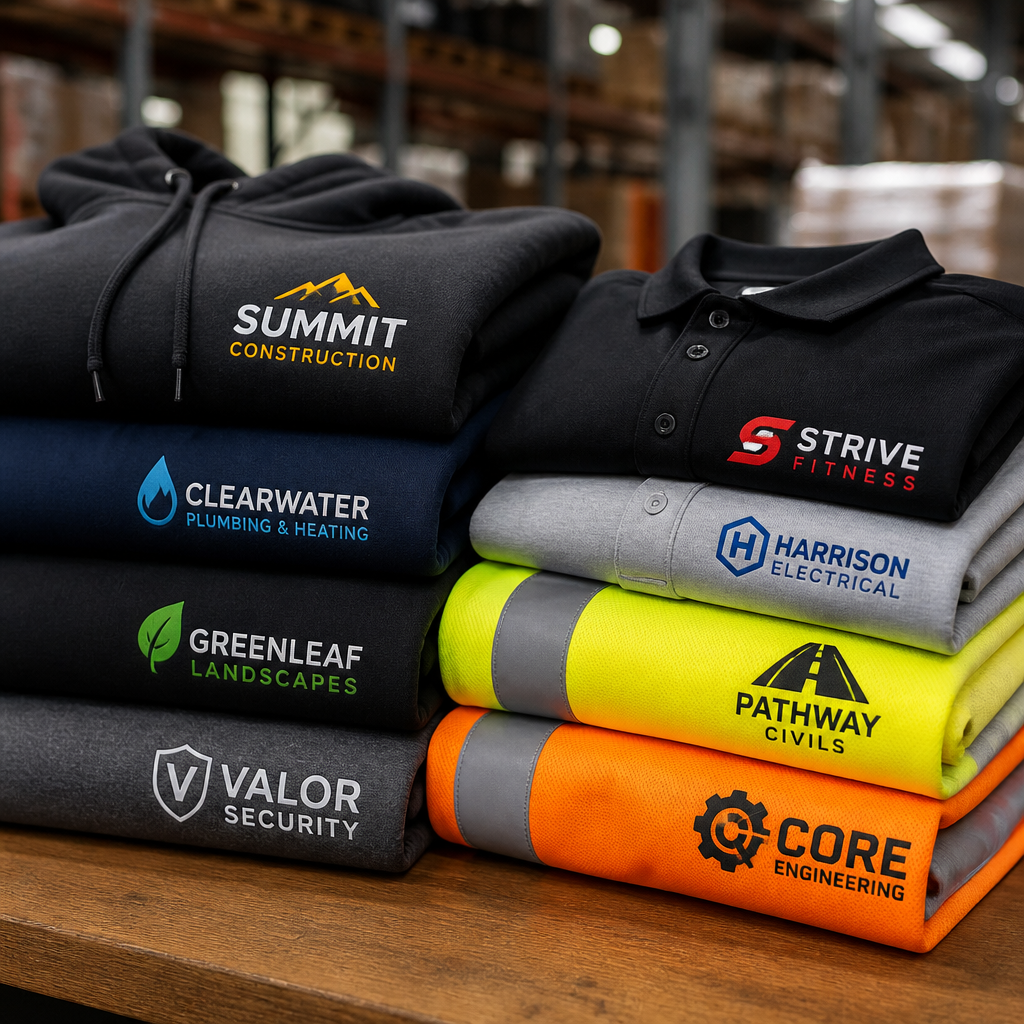

Trades businesses that use branded workwear consistently report that it reduces the awkwardness of the sales conversation. When a customer can see your logo clearly, your business name is already in their memory before they ask for a quote. That small head start matters in a competitive local market where word-of-mouth referrals drive most new work.
Hospitality and Food Service
Restaurants, cafés, bars, and hotels operate on the basis of a customer experience that starts the moment someone walks through the door. Staff identification is not a minor detail in that experience. A customer who cannot find a member of staff to take their order or answer a question is already having a worse experience than they should. Branded clothing for businesses UK in the hospitality sector solves this problem directly and cheaply.
Printed polo shirts and branded aprons are the most common choice for front-of-house hospitality staff. They create a welcoming and professional appearance without requiring a full formal uniform budget. For kitchen teams, printed t-shirts under aprons maintain the brand identity even in the back of house.
Why hospitality branding differs from other sectors
Hospitality workwear needs to look good after repeated washing at high temperatures and survive the physical demands of a fast-moving environment. This is where print quality matters more than in almost any other sector. A faded or cracked logo on a front-of-house polo shirt actively damages the brand impression it was meant to create. DTF printing, which uses heat-pressed film transfers, produces prints that remain vibrant through the wash cycles hospitality garments face.
Colour consistency also matters more in hospitality than in most other settings. A branded uniform programme across a café or restaurant chain needs every garment to match, regardless of whether it was ordered in the first batch or as a replacement six months later. Businesses printing in-house with consistent DTF processes can match colours reliably across multiple orders.
"Uniforms are a silent contract between a business and its customers. They communicate reliability before a single word is exchanged."
Pro tip: For hospitality businesses ordering for mixed front-of-house and kitchen teams, specify different colourways for each team on the same base garment design. It makes staff immediately recognisable to customers without requiring two entirely separate uniform budgets.
Retail and Customer Service
The fundamental problem retail businesses solve with branded workwear is staff identification. In a busy store, a customer who cannot find a staff member is a customer who may leave without purchasing. Branded t-shirts, polos, and hoodies make the answer to "who works here?" immediately obvious, which is especially important for independent retailers competing with larger chains where extensive signage and staffing make this easier.
For small independent retailers, branded workwear also creates the impression of a structured, professional operation even for a two-person business. A consistent colour scheme and a clearly printed logo on a polo shirt projects the same confidence that a large chain communicates through its scale. That visual parity matters when a customer is deciding whether to trust you with a purchase or a service.
Customer service roles beyond the shop floor
Call centres, showrooms, and service desks benefit from the same logic. Staff in branded polo shirts project a level of authority that casual clothing does not. Even in environments where the customer is on the phone rather than face-to-face, there is an internal benefit: a team in matching branded clothing approaches their role with a different sense of professional identity than one in uncoordinated casual wear. The research behind this is straightforward. The Chartered Institute of Personnel and Development's Good Work Index has identified organisational identification as a core driver of employee engagement, and branded workwear directly supports that alignment.
Healthcare and Care Services
The care sector has specific requirements that set it apart from other industries in the branded workwear conversation. Printed tunics, scrubs, and polo shirts for care workers serve a functional and regulatory purpose alongside a branding one. Patients and their families need to identify care staff quickly. In a residential care home or a busy clinic, a clearly branded tunic removes ambiguity about who is responsible for a patient's care.
The durability requirement in this sector is the most demanding of any industry covered here. Care sector garments are washed at high temperatures frequently, often multiple times per week. Print methods that cannot withstand this wash cycle are a false economy. DTF printing produces prints that adhere to the fabric at a deeper level than standard heat-transfer vinyl, making them more resistant to the conditions care sector laundry creates.
Branded workwear for beauty and wellness businesses
Salons, barbershops, spas, and clinics fall into a related category. Branded tunics and printed polo shirts give these businesses a consistent visual identity that reinforces the quality positioning they are trying to communicate. A beauty therapist in a clean, well-printed branded tunic is communicating something specific about the standard of the service before the client sits down. That communication costs nothing beyond the price of the garment and the print.
Sports Clubs and Leisure
Sports clubs represent one of the clearest and most consistent use cases for custom printed clothing in the UK. Every club needs branded kit, training wear, and often a casual range for matchday travel or warm-up sessions. The ordering pattern is also well-suited to businesses that offer in-house DTF printing: clubs buy in batches, across multiple sizes, with the same design reproduced consistently across every unit.
The DTF printing process handles club logos, sponsor branding, and season year in a single clean print, without limitations on colour count that screen printing would impose. For clubs with detailed or multicolour crests, this matters significantly. A screen-printed crest with four or more colours becomes expensive quickly. A DTF-printed version of the same crest costs the same regardless of how many colours the artwork contains.
Leisure centres, gyms, and fitness businesses
Beyond competitive clubs, gyms and fitness studios use branded workwear for two distinct purposes. Staff workwear identifies instructors and builds the brand identity of the facility. Merchandise, sold or gifted to members, extends that brand outside the building. A gym that brands its PT staff in matching printed t-shirts and sells the same garment in a retail colourway creates a consistent visual identity that members associate with quality and belonging. Psyque's custom printed t-shirts and hoodies and sweatshirts are built for exactly this dual-use scenario.
Events and Promotions
Event organisers face a specific challenge that most workwear buyers do not encounter: they need garments quickly, in exact sizes, with no margin for error on quantities. An event that runs short on volunteer t-shirts or staff uniforms has no way to recover. The combination of fast UK dispatch and reliable in-house printing is not just a convenience for this sector, it is a requirement.
Custom printed t-shirts and hoodies for events also serve a marketing function that extends well beyond the event itself. Attendees who wear their event t-shirt on the street, at the gym, or on social media are generating brand exposure that the event organiser did not have to pay for separately. That residual value makes event workwear one of the most cost-effective custom printed clothing use cases UK businesses operate in.
Promotional campaigns and brand activations
Businesses running promotional campaigns or brand activations need printed clothing that looks sharp, reproduces their brand colours accurately, and arrives on time. A promotional t-shirt with a washed-out or slightly off-colour logo undermines the entire point of the exercise. DTF printing reproduces Pantone-referenced artwork accurately, which matters when a brand has strict colour standards that its marketing team enforces rigorously.
Corporate and Office-Based Businesses
Office-based and corporate businesses are often the last to think about branded workwear, which is a missed opportunity. Branded polo shirts, sweatshirts, and hoodies for client-facing team members or for use at trade shows and exhibitions carry the same marketing logic as any other sector. A team on a trade show stand in matching branded clothing looks like a credible business. A team in different outfits looks like a group of individuals who happen to be standing near each other.
Corporate workwear bundles also serve an internal purpose. They reduce the daily friction of dress code decisions for employees, create a sense of shared identity, and provide a tangible representation of the business's investment in its team. Psyque's workwear bundles are designed for exactly this kind of multi-garment order, where businesses need a coordinated set rather than individual items.
Logistics and warehouse operations also belong in this category. High-visibility branded clothing for warehouse and distribution teams meets both the safety requirements of the working environment and the branding goals of the business. Branded logistics workwear is also a practical differentiator in a sector where multiple companies may be operating from the same site.
Print Method Comparison for Workwear
Not all printing methods perform equally across the industries covered above. The choice of print method affects colour accuracy, wash durability, minimum order quantity, and suitability for different fabric types. Here is how the three most common methods compare for UK workwear buyers.
| Print Method | Best For | Key Limitations |
|---|---|---|
| DTF (Direct to Film) | Small to medium batches, full-colour logos, mixed fabric types, workwear with high wash frequency. Handles pique polo fabric, cotton, and poly-cotton blends equally well. | Not ideal for very large print runs where screen printing becomes more cost-effective per unit at very high volumes. |
| Screen Printing | Very large single-colour or limited-colour runs where per-unit cost needs to be minimised. Good for basic event t-shirts in bulk. | Each additional colour adds cost. Complex logos become expensive. Not suitable for photo-realistic or gradient artwork. High setup costs at low quantities. |
| Embroidery | Premium corporate workwear where a raised, tactile logo is a quality signal. Caps, polo shirts, and fleece jackets for corporate and healthcare branding. | Cannot reproduce photographic detail or fine gradients. Thread count limits colour complexity. Adds weight to lightweight garments. Higher cost per placement than print methods. |
For the majority of UK businesses ordering branded workwear in quantities of 5 to 200 units, DTF printing is the most practical and cost-effective method. It handles full-colour artwork accurately, works at any order quantity from five units upward, and produces prints that survive the washing frequency that workwear in most of the industries above demands. Psyque operates its own in-house DTF printer and heat press, which means no outsourcing delays and consistent quality control across every order. You can explore the full range of custom workwear bundles or printed polo shirts available for UK businesses.
Frequently Asked Questions
Which industry in the UK spends the most on custom workwear?
Construction and trades consistently account for a large share of UK workwear spend because the requirements are year-round, the teams are frequently public-facing, and safety-compliant branded garments serve multiple purposes simultaneously. Hospitality is a close second due to the volume of front-of-house staff requiring consistent, replaceable uniforms.
What is the minimum order quantity for custom printed workwear in the UK?
This varies by supplier and print method. Businesses using DTF printing, such as Psyque, can handle orders from as few as five units upward. Screen printing typically requires higher minimums to justify the setup cost. For most small businesses and teams, DTF printing is the right method precisely because it removes minimum quantity barriers that make smaller orders uneconomical with traditional methods.
How durable are DTF prints on workwear garments?
DTF prints on quality poly-cotton or cotton garments are highly durable when applied correctly and washed at appropriate temperatures. The heat-press process bonds the film transfer to the fabric fibres rather than sitting on the surface, which means the print resists cracking and peeling through repeated wash cycles. Workwear in the hospitality, construction, and care sectors specifically benefits from this durability compared to cheaper heat-transfer vinyl methods.
Can I mix different garment types in a single workwear order?
Yes, and for most businesses this is the most practical approach. A workwear bundle that includes printed polo shirts for summer and hoodies or sweatshirts for winter covers the full year at a single order point. Psyque's workwear bundles are designed for exactly this kind of mixed order, with consistent branding reproduced across garment types in a single production run.
Is custom workwear a tax-deductible business expense in the UK?
Branded workwear that is clearly identifiable as a company uniform, rather than everyday clothing that an employee could wear outside of work, is generally allowable as a business expense for UK tax purposes. Businesses should confirm this with their accountant based on their specific circumstances, but the key test is whether the clothing is integral to the job or simply a personal clothing choice.
What is the difference between branded workwear and promotional clothing?
Branded workwear is primarily for staff use in a working environment, designed to identify employees, meet any safety requirements, and reinforce the company's professional image. Promotional clothing is primarily designed to be distributed to customers, event attendees, or as merchandise. The garment types often overlap, and many businesses order the same printed t-shirt or hoodie for both purposes, which makes the per-unit cost of the order more efficient.
If your business is in one of the industries above and you are still wearing unbranded clothing on the job, at events, or in front of customers, we would be interested to hear what has been stopping you. Share your experience in the comments below.
References
- B4B Promotional Products: The benefits of branded workwear for UK small and medium-sized businesses
- Printing Hive: Guide to branded workwear and promotional clothing for UK businesses
- Absolute Workwear: How custom uniforms help UK businesses stand out from competitors
- T-Shirt Design Studio: Best custom workwear options for UK businesses by industry