
A Guide to transfer printer for t shirts: Quick Start Tips
So, what exactly is a transfer printer for t-shirts? In simple terms, it's a system that prints your design onto a special film first. That printed film is then heat-pressed onto a t-shirt, becoming a permanent part of the fabric.
It’s a different approach from methods that print ink directly onto the garment. Instead, you're creating a vibrant, incredibly durable "transfer" that feels like it was always part of the shirt.
What Is a T-Shirt Transfer Printer
Think of it like creating a high-end, flexible sticker made specifically for fabric—one that’s engineered not to peel, crack, or fade away after a few trips through the wash. That’s the magic behind transfer printing, especially with the game-changing Direct-to-Film (DTF) method. This technology has completely reshaped the custom apparel scene here in the UK, bringing professional-grade printing within reach for everyone from small businesses to DIY creators.
The whole process is much cleaner and more versatile than sloshing inks directly onto a shirt. It's a precise, multi-step system that delivers brilliantly detailed and colourful results, time and time again. This reliability is exactly why it has become a cornerstone of the UK's thriving custom apparel market.
How Transfer Printing Works
The process can be broken down into a few straightforward stages. Each step cleverly builds on the last, all leading to a final product that looks and feels like it came straight from a high-end shop.
- Printing the Design: It all starts with a specialised printer that uses textile inks to print your artwork onto a sheet of clear PET film. The clever part? It prints a layer of white ink first. This white base is crucial because it ensures your colours pop with brilliant opacity, no matter what colour the t-shirt is.
- Applying the Adhesive: While the ink is still wet, a fine adhesive powder is sprinkled over the entire design. This powder is formulated to stick only to the inked areas. This is what will act as the "glue," bonding your design to the fabric later on.
- Curing the Transfer: The film, now coated with ink and powder, is gently heated. This melts the adhesive powder and cures the ink, creating a single, stable, ready-to-press transfer.
At its heart, a transfer printer creates a bridge between your digital design and a physical garment. It turns pixels into a tangible, wearable piece of art without the limitations of traditional printing methods.
This accessible technology is a huge reason the UK custom t-shirt printing market has exploded. In fact, the market is projected to hit USD 4,243.6 million by 2030, a surge driven by the sheer cost-effectiveness and flexibility of methods like transfer printing for custom jobs.
Once the transfer is cured, it’s ready for the final, satisfying step. You place the film onto the t-shirt, position it perfectly, and press it with a heat press. The combination of heat and pressure activates the adhesive, permanently bonding the design into the very fibres of the fabric. After letting it cool for a moment, you peel away the film, leaving only your stunning, detailed artwork behind.
To see this process in more detail, check out our complete guide on how t-shirt transfers are printed.
Comparing Top T-Shirt Printing Methods
Trying to pick the right printing method can feel a bit like spinning plates. You've got DTF, DTG, vinyl, and screen printing all vying for your attention. To make the right call, you need to look past the sales pitch and compare what really matters for your project or business.
We’re going to dig into the details that make or break a great T-shirt: how the print feels, what it costs to make a single shirt, the ideal batch sizes for each method, and crucially, how well the colours hold up in the wash.
The Four Main Contenders
Think of these methods like different tools in a workshop. You wouldn't use a sledgehammer to hang a picture frame, and the same logic applies here. Each one has a job it’s perfect for.
- Direct-to-Film (DTF): This is the versatile all-rounder. A DTF transfer printer creates a stunning, flexible design on a special film, which is then heat-pressed onto pretty much any fabric you can think of.
- Direct-to-Garment (DTG): The detailed artist. This works just like an inkjet printer, but for fabric. It sprays water-based inks directly onto the garment, leaving a super-soft finish.
- Heat-Transfer Vinyl (HTV): The precision cutter. Perfect for bold, simple graphics like logos and text. HTV involves cutting designs from sheets of coloured vinyl and pressing them onto the shirt.
- Screen Printing: The bulk production powerhouse. This is the old-school technique of pushing ink through a mesh stencil. It creates incredibly durable prints, making it the king for large orders with just a few colours.
To give you a clearer picture of how a transfer printer for T-shirts fits into this landscape, the diagram below shows the straightforward journey from digital design to finished product.
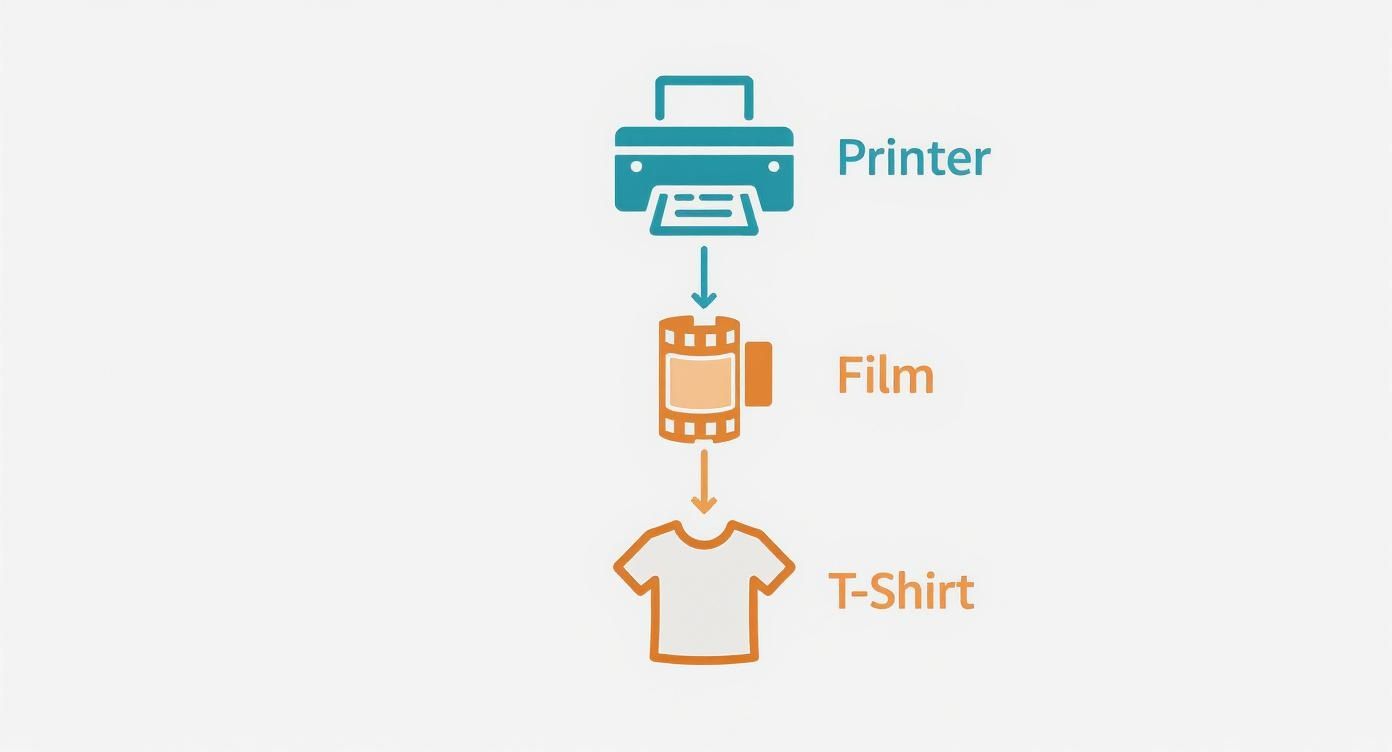
As you can see, it's a clean, efficient process that brings together the printer, the film, and the T-shirt to deliver professional results without a massive learning curve.
Head-to-Head Comparison: The Big Four
So, how do these methods actually stack up against each other? The best way to see the differences is to put them side-by-side.
T-Shirt Printing Method Comparison
Here’s a breakdown of how the four main contenders compare across the most important factors for any custom apparel project.
| Feature | DTF Transfer | DTG (Direct-to-Garment) | Heat-Transfer Vinyl (HTV) | Screen Printing |
|---|---|---|---|---|
| Feel on Fabric | Soft, flexible, slightly raised | Very soft, breathable, ink-dyed feel | Thicker, can feel plasticky | Slightly raised, very durable |
| Best For | Full-colour, complex designs on any fabric | Photorealistic images on 100% cotton | Simple logos, text, and numbers | Large runs of simple, bold designs |
| Fabric Types | Cotton, polyester, blends, any colour | Best on light-coloured 100% cotton | Cotton, polyester, blends | Cotton and some blends |
| Durability | Excellent (50+ washes), resists cracking | Good, but can fade over time | Very good, but can peel if applied poorly | Excellent, often outlasts the garment |
| Cost per Item | Low for small to medium batches | Higher for single items, lower setup cost | Moderate, depends on vinyl used | Very low for large batches (100+) |
It’s pretty clear from the table that a transfer printer for T-shirts using DTF technology cleverly bridges the gap. It gives you the full-colour complexity of DTG but with the incredible fabric versatility you’d normally only get from screen printing or vinyl.
For a deeper dive into how it really measures up against the industry veteran, check out our analysis of DTF vs. screen printing for graphic tees.
So, Where Does DTF Fit In?
While screen printing has been the industry giant for decades—still accounting for 54.13% of the UK’s custom printing market revenue—the ground is shifting. Digital methods are catching up fast, and transfer printing has become the hero for on-demand production.
This shift is what’s fuelling the market's projected 11.84% annual growth rate. It’s being driven by startups, designers, and small businesses who need the freedom to create without being forced into huge, costly print runs.
The rise of DTF printing is a direct response to the market's need for a solution that combines high-quality, full-colour prints with the freedom to print on any fabric—something no other single method could offer so effectively.
What does this mean for you? No more compromises. You can now print a vibrant, photorealistic design on a dark polyester sports jersey just as easily as you can on a classic white cotton tee. It’s this adaptability that makes DTF such a powerful tool for anyone in the apparel game today.
Who Should Use T-Shirt Transfer Printing?
So, who is a transfer printer for t shirts really for? It’s a fair question. The truth is, this technology isn’t just for one type of person. Its incredible flexibility opens up possibilities for a huge range of creators and entrepreneurs.
It's the perfect answer for anyone who needs brilliant, full-colour designs without the eye-watering setup costs or fabric headaches that come with other methods. From a side hustle taking shape in a spare room to an established brand that needs to stay nimble, transfer printing is a genuinely practical way to create professional-looking apparel. Let's look at who gets the most out of it.
The Small Business Owner
Picture a small business owner launching a new merchandise line. They've got a dozen killer designs ready to go, but they can't afford to bet the farm by ordering a massive batch of screen-printed tees for each one. This is where transfer printing, especially DTF, completely changes the game.
The minimal setup cost for each design means they can dip their toes in the water with small, varied batches. Instead of ordering 100 of a single T-shirt, they can print ten different designs, ten times each. This agility lets them see what’s actually selling, quickly restock the hits, and drop the misses—all without getting buried under a mountain of unsold stock.
For a small business, a transfer printer for T-shirts or an outsourced transfer service offers the ultimate flexibility. It allows for on-demand production, minimising financial risk while maximising creative potential.
This approach turns inventory management from a high-stakes gamble into a smart, responsive process. Being able to print vibrant designs exactly when you need them is a massive advantage for any growing brand.
The Etsy Seller and DIY Crafter
For the creative soul running an Etsy shop from their kitchen table or the crafter making unique gear in a home studio, transfer printing is the bridge to professional quality. It closes the gap between a digital file on a screen and a real, sellable product you can be proud of, without needing an industrial-sized workshop.
A graphic designer can take their digital illustrations and turn them into wearable art with incredible colour accuracy and detail. The whole process is straightforward enough to manage from home with a decent heat press, giving you total control over the finished product.
This kind of creative freedom empowers makers to:
- Create one-of-a-kind pieces: Turn digital paintings, complex patterns, or custom typography into totally unique garments.
- Offer personalisation: Easily add names, dates, or bespoke messages for weddings, birthdays, and other special occasions. For more inspiration, check out our guide to creating personalised T-shirt printing.
- Maintain top quality: Produce durable, professional-grade clothing that earns those five-star reviews and keeps customers coming back.
Event Managers and Fashion Startups
The versatility of transfer printing also shines in time-sensitive and specialised projects. An event manager who needs 50 branded T-shirts for a conference next week can get them sorted quickly, skipping the long setup times of traditional screen printing. The prints will be sharp and durable, perfect for staff uniforms or promotional giveaways.
In the same way, a fashion startup can use this method to create high-quality prototypes. They can play around with different designs, colours, and fabrics—from cotton to polyester and blends—to get their collection just right before committing to a big production run. It lets them innovate freely and bring a unique vision to life with precision and style, making it a vital tool for any modern apparel brand.
How to Choose Your Printing Solution
Picking the right printing solution—whether that’s a new transfer printer for t shirts or a top-notch supplier—is a big decision. To get it right, you need to look past the upfront price and think about the real-world factors that will shape your daily workflow, your budget, and the quality of the T-shirts you’re proud to sell.
Think of it like choosing a business partner. You need someone reliable, who fits your budget, and can deliver the kind of quality your customers will rave about. This guide is your no-nonsense checklist, designed to give you the right questions to ask so you can make a decision you feel good about.
Total Cost of Ownership
That initial price tag on a printer? That’s just the start of the conversation. The real cost comes from all the bits and pieces you need to keep it running day in, day out. For a DTF setup, these consumables are your lifeblood.
- Inks: You’ll need high-quality textile inks for those punchy, vibrant colours that last. Their cost adds up, so it's a key part of your budget.
- Film: The special PET film is a recurring purchase, and its price can vary depending on the quality and how much you buy at once.
- Powder: This is the magic adhesive powder that bonds your design to the fabric. You'll need to keep this stocked up.
Before you commit, do a quick calculation of your estimated cost per print. Add up all these ongoing expenses. It’ll give you a far more honest look at your potential profit margins than the machine's price ever could.
Production Volume and Throughput
You need to be brutally honest about how many T-shirts you'll actually be printing. Are you a hobbyist making a few shirts a month for friends and family, or a growing business that needs to churn out a hundred a day to keep up with orders? Your answer changes everything.
If your volume is low or unpredictable, sinking thousands into your own transfer printer for t shirts might not be the smartest play. The initial cost, plus the responsibility of maintenance, could quickly become a headache. In this case, outsourcing your transfers to a dedicated service is often a much more sensible and cost-effective route.
Choosing the right solution isn't about getting the most powerful machine; it's about matching the capability to your actual, everyday needs. An overpowered printer sitting idle is just as inefficient as an underpowered one struggling to keep up.
On the flip side, if you’re consistently printing in high volumes, the savings on cost-per-print and the total control you get with an in-house setup can absolutely make the investment pay off.
Fabric Compatibility and Versatility
Here’s where DTF really shines: its incredible versatility. Unlike other methods that can be really picky about fabrics, DTF plays nicely with a massive range of materials.
This is a game-changer if you dream of printing on more than just standard cotton tees.
- Cotton: Delivers soft, bright results on any colour.
- Polyester: Perfect for sportswear and performance gear where other methods like DTG just can't cope.
- Blends: Works flawlessly on popular poly-cotton blends for hoodies and sweatshirts.
- Other Materials: You can even press designs onto denim, canvas, and more.
This flexibility means you’re not boxed in. You can confidently build out a diverse product line, from classic T-shirts to branded activewear, knowing your printing method can handle whatever you throw at it.
Printer Maintenance and Realism
Let's be real: a transfer printer for t shirts is a serious piece of kit, and it needs regular TLC to perform at its best. If you neglect maintenance, you're practically inviting clogged print heads, wonky colours, and expensive repair bills.
Daily routines often involve cleaning the print head, checking ink levels, and giving the white ink cartridges a good shake to stop the pigment from settling. It’s not a massive time suck, but it is absolutely non-negotiable. If you’re not up for that hands-on responsibility, outsourcing starts to look very appealing, as the supplier takes care of all the upkeep. To get a better sense of what's involved, it's worth exploring different types of T-shirt print machines and what their typical maintenance schedules look like.
Colour Accuracy and Wash Durability
At the end of the day, what really matters is the quality of the final product. Two things define this: how accurate the colours are and how well the design holds up in the wash. Your prints have to match what you see on screen, and they need to last.
High-quality DTF transfers are known for being incredibly durable, often lasting for 50 washes or more without cracking, peeling, or fading. But this all depends on using quality inks, powder, and film, and getting the application just right with a decent heat press. When you're vetting a printer or a supplier, ask to see examples of their work and find out about their quality control. You need to be sure they can deliver the vibrant, long-lasting prints that will keep your customers happy and coming back for more.
Should You Buy a Printer or Outsource Transfers?
This is the big question every growing T-shirt business bumps up against sooner or later. Do you take the plunge and invest in your own transfer printer for t shirts, or do you partner with a specialist service to handle the printing for you?
Truthfully, there’s no single right answer. The best choice really boils down to your production volume, your budget, and how much hands-on control you actually want over the whole process.
Making this call means weighing the freedom and long-term savings of owning your own machine against the pure convenience and zero-maintenance reality of outsourcing. Let’s break down both sides of the coin to help you figure out which path makes the most sense.
The Case for Buying Your Own Printer
Investing in your own equipment is a serious step, but the rewards can be massive if your business is ready for it. The biggest perk is total control. You become the master of your production schedule, able to print designs on a whim and turn around last-minute jobs without being at the mercy of someone else’s timeline.
This kind of autonomy is a huge competitive edge. When a customer needs an urgent order, you can confidently say "yes." What’s more, once you get past that initial investment, your cost-per-print plummets, which directly boosts your profit margins on every single shirt you sell.
Consider buying a printer if you:
- Have consistent, high-volume orders: If you're printing dozens of shirts every day, the in-house savings will quickly pay back the initial cost.
- Need immediate turnarounds: Owning the machine means you can go from a design file to a finished product in hours, not days.
- Enjoy the technical side of things: You're comfortable with the idea of daily maintenance and troubleshooting to keep your printer running smoothly.
The Argument for Outsourcing Your Transfers
On the flip side, outsourcing offers a brilliantly simple, low-risk way to produce professional-quality apparel. The most compelling reason is the zero upfront investment. You don’t have to fork out thousands for a printer, inks, and all the other gear. You just pay for the transfers you need, when you need them.
This approach also completely lifts the burden of maintenance and repairs from your shoulders. You get access to industrial-grade, perfectly calibrated machines that deliver flawless results every time, and you never have to clean a print head yourself. When thinking about your business strategy, remember that your marketing efforts, like using effective ecommerce link building tactics, are just as important as your production method.
Outsourcing is the ultimate 'plug-and-play' solution. It frees you up to focus 100% on what you do best—designing and selling great T-shirts—while a dedicated partner handles the complex printing part for you.
Outsourcing is the perfect choice if you:
- Are just starting out or have fluctuating order volumes: You can avoid a huge capital investment when your sales are still unpredictable.
- Want to avoid all maintenance: This frees you from the responsibility of upkeep, troubleshooting, and technical headaches.
- Prioritise premium, consistent quality: You can lean on the expertise and high-end equipment of a specialist printing service.
How Outsourcing Works in Practice
The process of ordering from a UK-based supplier like Psyque is incredibly straightforward—it’s designed to be as simple as possible.
You just upload your finished design, tell us the quantity you need, and the transfers arrive at your door, fully cured and ready to press. For a deeper dive, our guide on working with custom T-shirt printers offers more detail. This streamlined workflow makes professional printing accessible to everyone, no matter their technical skill or budget.
Got Questions? We've Got Answers
Stepping into the world of custom T-shirts can feel like learning a new language. To help you get your bearings, we've put together some straightforward answers to the questions we hear most often.
How Long Do DTF Transfers Last on a Shirt?
This is a big one, and the answer is simple: a long time! A high-quality DTF transfer, pressed correctly and looked after, will easily survive 50-100 washes. You won't see any of that dreaded cracking, peeling, or fading you get with lesser methods.
In fact, its staying power is right up there with traditional screen printing, and sometimes even better. It’s a genuinely reliable choice for creating professional gear that’s built to last.
Can I Use a Regular Printer for Heat Transfers?
Afraid not. You can't just use your standard office inkjet to print professional DTF transfers. The whole process hinges on a specialised DTF printer, which is built from the ground up to handle the specific textile inks and print onto the unique PET film.
Think of it like this: you wouldn't put diesel in a petrol car and expect it to run. The printer, ink, and film are a finely tuned system. Using the wrong gear will only end in disappointment and possibly a broken machine.
What Equipment Do I Need to Start?
This really comes down to whether you plan on printing the transfers yourself or buying them ready-to-press.
- To apply outsourced transfers: All you really need is a quality heat press. That's it. One solid piece of kit is enough to get you applying professional-grade transfers to your garments.
- To print your own transfers: Now, that’s a different story. You'll need the full setup: a DTF printer, the right DTF inks, PET film, adhesive powder, and a curing oven (or a heat press) to prep the transfers before they even touch a T-shirt.
Is DTF Printing Better Than Sublimation?
When it comes to T-shirts, DTF is in a different league of versatility. Sublimation has one huge catch: it only really works on light-coloured, 100% polyester fabrics. That's a pretty narrow window.
DTF, on the other hand, just works. It delivers stunning results on almost any fabric you can throw at it – cotton, polyester, poly-blends, you name it. Light colours, dark colours, it doesn't matter. This makes it a far more flexible and practical solution for pretty much any custom apparel project you can dream up.
Ready to bring your designs to life with transfers that just work? Psyque offers premium, ready-to-press DTF transfers that deliver brilliant colours and incredible durability on any fabric. Check out our services and get your next project rolling today at https://psyque.co.uk.