

Finding the Best DTF Transfers in the UK
When you're on the hunt for the best DTF transfers, it really boils down to three things: vibrant inks, a flexible adhesive, and a film that releases cleanly. These are the elements that separate a print that feels soft and durable from one that's stiff, plasticky, and cheap. Getting these right is the key to creating designs that look professional and can handle countless trips through the washing machine.
Your Quick Guide to Choosing the Best DTF Transfers
Let's cut through the technical jargon and get straight to what makes a DTF transfer truly premium. Picking the right one isn't about memorising complex specs; it's about spotting a few core signs of quality. The aim is to find a transfer that blends right into the fabric, feeling like it's part of the shirt rather than a plastic sticker sitting on top.
Think of this as your personal checklist. It'll help you size up different suppliers and feel confident in your choice from day one.
Key Quality Indicators
The difference between an average transfer and a top-notch one is night and day once you know what to look for. For professional results that will wow your customers and stand the test of time, these three elements are completely non-negotiable.
- Ink Vibrancy and Saturation: The best transfers use high-pigment inks to deliver rich, deep colours that really pop. A great transfer shouldn't look washed out or dull, even before it's seen a single wash cycle.
- Adhesive Flexibility: The adhesive powder is the secret sauce behind the final feel, or "hand," of the print. The best suppliers use a fine, high-quality powder that creates a soft, stretchable finish that moves naturally with the fabric. No cracking here.
- Film Release Quality: Whether it's a hot or cold peel film, it should come off cleanly and with minimal effort. A cheap, stubborn film can leave bits of adhesive behind or, even worse, pull up parts of your design and ruin the entire garment.
For a deeper dive into the technology, our guide on what makes DTF transfers a great choice offers some great background info.
High-Quality vs Standard DTF Transfers At a Glance
To make it even simpler, here’s a quick table to help you spot the good from the bad at a glance. It really highlights the key differences you’ll see and feel.
| Feature | High-Quality DTF Transfer | Standard DTF Transfer |
|---|---|---|
| Colour Pop | Rich, vibrant, and fully saturated. | Often appears dull or slightly faded. |
| Texture & Feel | Soft, flexible, and moves with the fabric. | Stiff, plastic-like feel that can crack. |
| Peel Process | Clean, easy release with no residue. | May be difficult to peel or leave adhesive. |
| Durability | Excellent wash resistance; no cracking. | Prone to fading, peeling, or cracking. |
Ultimately, choosing a high-quality transfer means your final product will not only look better but will also last longer, keeping your customers happy and coming back for more. It's a small detail that makes a massive difference.
What Are DTF Transfers and Why Do They Matter?
So, what's all the buzz about? Think of Direct-to-Film (DTF) transfers as the next big step in custom printing. They’re like a high-tech, permanent tattoo for almost any fabric you can imagine, offering a straightforward way to get vibrant, detailed designs onto clothing without the old headaches.
The magic is in the process. It starts with a special printer laying down your design onto a clear film. Then, a fine adhesive powder is sprinkled over the wet ink and melted to create a durable, flexible backing. This finished transfer is now ready to be shipped out or pressed straight onto a garment with a heat press.
It’s this simple but effective process that's making waves for everyone from small Etsy creators to large-scale print shops right across the UK.
The Power of Versatility
This is where DTF really pulls ahead of the pack. Unlike screen printing, which can get expensive for small batches, or Direct-to-Garment (DTG), which is picky about fabrics and prefers cotton, DTF is incredibly versatile. It sticks beautifully to cotton, polyester, blends, and even trickier surfaces like leather.
This opens up a massive world of possibilities for customisation. Many entrepreneurs are jumping on DTF for the flexibility it brings to the thriving print-on-demand sector, allowing them to create everything from branded workwear to one-of-a-kind fashion pieces. To get a better handle on the lingo and the tech, check out our deep dive on what DTF stands for and how it works.
The real beauty of DTF is its ability to produce full-colour, complex designs with no minimum order. This puts high-quality customisation within reach for everyone, not just big businesses with deep pockets.
A Growing UK Market
This accessibility, combined with the professional quality, has lit a fire under the UK market. We're seeing steady growth in DTF printing, driven by its popularity in fashion, sportswear, and promotional gear. Because it's so well-suited for on-demand jobs, it's perfect for small businesses and hobbyists, pushing its reach far beyond traditional commercial printing.
Ultimately, getting your head around DTF technology is the first step before you invest. Its versatility and pro-level finish are changing the game for custom apparel, letting you create durable, eye-catching products that truly stand out. Knowing what makes the best DTF transfers is your ticket to delivering exceptional quality every single time, ensuring your designs don't just look good—they feel fantastic, too.
The Anatomy of a Perfect DTF Transfer
Ever noticed how some printed tees feel like part of the fabric, while others feel like a stiff, plastic patch? The difference isn't magic—it's down to the quality of the DTF transfer itself. You see, not all transfers are created equal, and understanding what separates a premium product from a disappointing one is key.
The secret lies in three core components working in perfect harmony: the film, the ink, and the adhesive powder. Get this combination right, and you've got a print that's soft, durable, and vibrant. If any one of these elements is subpar, the whole thing falls apart, leaving you with poor colour, a rough texture, or a design that cracks and peels after just a few washes.
Let's break down each component so you know exactly what to look for and what questions to ask your supplier.
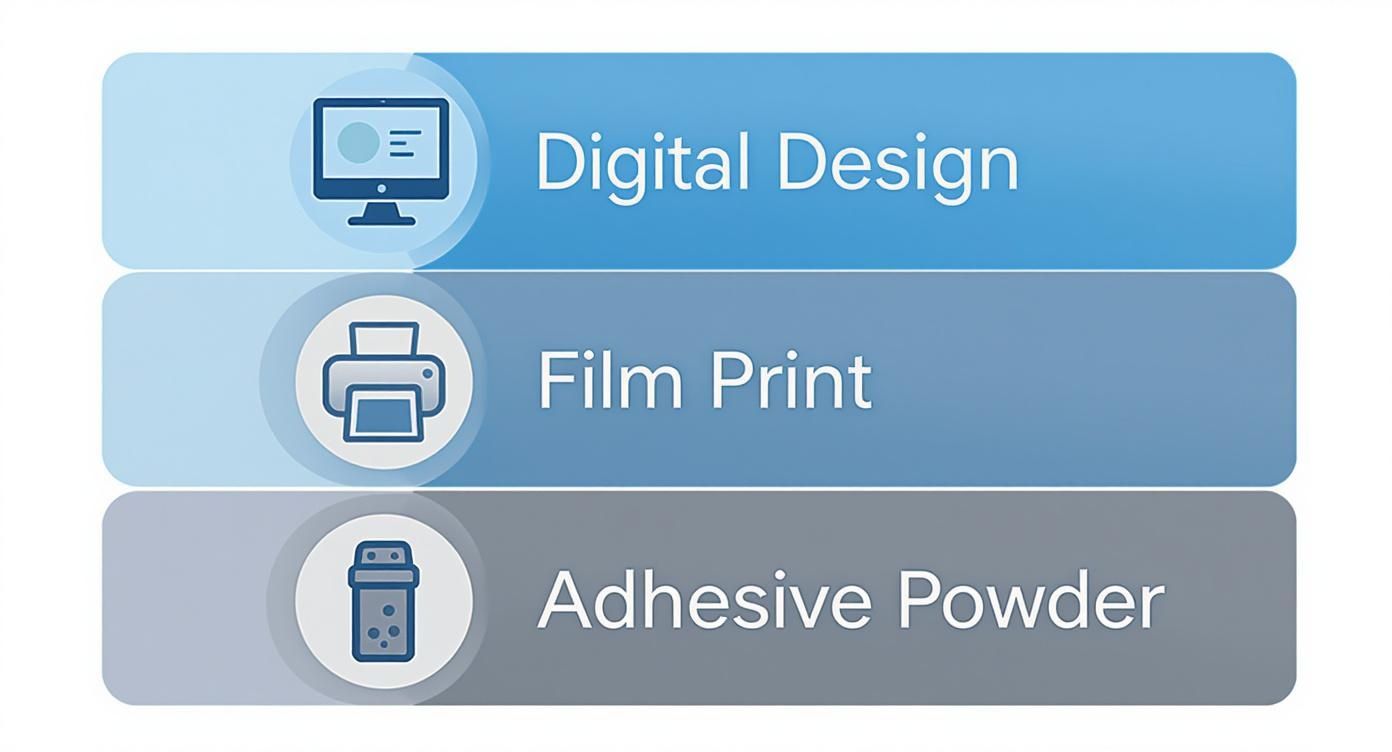
As you can see, the process flows from a digital concept to the crucial application of film and adhesive. Each stage builds upon the last to create the final, press-ready transfer.
The Film Foundation: Hot Peel vs Cold Peel
First up is the transfer film. Think of this as the temporary carrier for your design, holding everything in place until it's pressed onto the garment. These films generally come in two main flavours, and your choice can dramatically affect both your workflow and the final feel of the print.
- Hot Peel Film: Just like it sounds, you peel this film away immediately after heat pressing. It’s a real time-saver, making it brilliant for high-volume jobs. The result is often a softer, more matte finish that blends beautifully into the fabric.
- Cold Peel Film: With this type, you need to let the transfer cool down completely before removing the film. It's a slower process, but it tends to produce a glossier, more vibrant finish. It can also be a bit more forgiving for designs with very fine, intricate details.
Getting to know the properties of different DTF transfer sheets is the first step to achieving the specific look and feel you're aiming for.
The Power of High-Quality Ink
Next, we need to talk about ink. The vibrancy, sharpness, and longevity of your design depend entirely on the quality of the pigments used. You can't skimp here.
Premium DTF inks are specially formulated for maximum colour saturation, ensuring your designs pop and stay true to your original digital file. Crucially, they’re also engineered to resist fading from UV light and hold up exceptionally well to the rigours of repeated washing.
It’s no surprise the global DTF ink market is projected to hit USD 4.56 billion by 2031, growing at a rapid clip of 9.6%. This boom reflects just how critical this component is for creating durable, high-quality prints that UK businesses can rely on.
The All-Important Adhesive Powder
Finally, let's look at the unsung hero of the process: the adhesive powder. This fine, heat-activated glue is what permanently fuses the ink to the fabric fibres.
The quality of the adhesive powder is arguably the single most important factor determining the final "hand" or feel of the print. A high-quality, finely milled powder melts seamlessly into the fabric, creating a soft, stretchy finish that moves with the garment.
On the flip side, a low-grade, coarse powder results in that thick, stiff print we all hate—the kind that feels heavy and is prone to cracking the moment you stretch the fabric. The best transfers use a premium adhesive that delivers both incredible durability and that comfortable, lightweight feel your customers will absolutely love.
How to Spot High-Quality DTF Transfers Yourself
Marketing slogans can promise the moon, but the real test of a DTF transfer happens when you've actually got one in your hands. Learning how to eyeball a transfer like a pro is the single best way to know you’re getting a premium product. Before you even think about placing a big order, always get your hands on some samples and put them through their paces with a few simple, real-world tests.
This hands-on approach cuts through the sales pitch and gives you concrete proof of how the transfers will perform in the wild. It’s a small step that can save you from a mountain of wasted materials, disappointed customers, and a whole lot of headaches down the line.
Let's walk through the key checks that separate the great from the mediocre.
The Stretch Test: Durability Under Pressure
First up, the all-important stretch test. A top-notch DTF print should feel like it’s part of the garment itself, moving and stretching with the fabric without putting up a fight.
Press a sample transfer onto a scrap piece of fabric and let it cool down completely. Once it's at room temperature, give the printed area a gentle but firm stretch.
- What you want to see: The design should stretch smoothly with the fabric, with absolutely no cracking, splitting, or peeling. When you let go, it needs to snap right back to its original shape without any distortion.
- What to avoid: Any hint of cracking is a massive red flag, even if you only see tiny micro-cracks. This tells you the adhesive or ink is poor quality and too rigid, meaning it will fail fast with normal wear and washing.
The Feel Test: Softness and Integration
Next, just run your hand over the pressed design. This is the feel test, and it tells you everything about the print’s "hand"—industry-speak for how it feels against the skin.
A superior transfer should feel soft and lightweight, almost melting into the fabric's natural texture. It should never feel like a thick, heavy plastic patch just sitting on top of the shirt.
This soft finish is the signature of the best dtf transfers and is exactly what customers expect from high-quality custom clothing. If the print feels stiff, thick, or has that obvious plastic texture, it’s a good sign the supplier is cutting corners with a lower-grade adhesive powder. This doesn't just make the garment uncomfortable; it also hints that the print won't last.
Visual Inspection: A Closer Look
Finally, it’s time to play detective with the unpressed transfer sheet. Your own eyes can spot potential trouble long before the heat press is even switched on.
Look for these hallmarks of quality:
- Sharp, Clean Edges: The lines of the artwork should be crisp and perfectly defined. No fuzzy edges or bleeding colours allowed.
- Consistent Colour: The colour should look rich and even across the whole design, without any weird streaks or patchy areas.
- Clean Adhesive Backing: Flip the transfer over and look at the white adhesive layer. It should be smooth and applied evenly, stopping precisely where the ink ends.
Be suspicious of any oily-looking halos around the ink or inconsistent, clumpy adhesive. These are classic defects of low-quality transfers and often lead to a messy press and a design that peels off way too soon. For more advice on getting that perfect result, check out our guide to creating flawless custom DTF prints.
Choosing the Right UK Supplier for Your DTF Transfers
Nailing a high-quality transfer design is only half the story. The real make-or-break moment is finding a reliable UK supplier to produce it for you, time and time again. Let's be honest, the most incredible DTF transfer in the world is completely useless if it shows up late, looks different from the last batch, or comes from a company that ghosts you when there's a problem.
Your supplier isn't just another name on an invoice; they're a genuine partner in your success. So, choosing the right one means looking past the headline price and digging a little deeper. You need to understand their entire process, from the moment you upload your design to the second that perfectly printed transfer lands on your doormat. This partnership is the bedrock of your printing business, so it’s worth taking the time to get it right.
This decision is especially critical here in the UK. The global DTF printing market is already valued at around USD 2.72 billion, and Europe holds the biggest slice of the pie at roughly 36%. As a major player in that market, the UK has a competitive supplier scene, brimming with top-notch options if you know what to look for. You can dive into the full research on the direct-to-film printing market to see the trends for yourself.
Vetting Potential DTF Partners
Before you commit to anyone, it's time to do your homework. A bit of due diligence now will save you a world of headaches later on. Start by drawing up a shortlist of potential suppliers, then get ready to investigate their reputation and processes.
Here are the non-negotiables you should be asking about:
- Production Consistency: How do they guarantee quality control? Ask them about their process for ensuring colour accuracy and print quality are identical every single time, whether you're ordering one transfer or a thousand.
- Realistic Turnaround Times: Look for suppliers who are upfront and honest about their turnaround times. A reliable partner gives you a clear schedule and sticks to it, which is crucial for managing your own deadlines and keeping your customers happy.
- Customer Support: What happens when things don't go to plan? Give their support a test run. A great partner has knowledgeable, friendly staff who are easy to reach and can sort out any issues quickly and without fuss.
If you're running a local business, sourcing a nearby supplier can be a game-changer for shipping speeds and support. We've put together a handy guide on finding DTF suppliers near you with some practical tips to get you started.
The single most important step in vetting a supplier? Order a sample pack. This is your chance to do the stretch, feel, and wash tests yourself. It's tangible proof of their quality before you sink any real money into a larger order.
Reading Between the Lines
Finally, it's time to look for social proof. Don't just rely on the glowing testimonials plastered all over their website. Head over to platforms like Google or Trustpilot to find genuine, unfiltered reviews from other customers. This will give you a much clearer picture of what you can really expect.
A trustworthy supplier will be totally transparent about the technology, inks, and adhesive powders they use. If they're being cagey or evasive about the details, take that as a potential red flag. Building a strong relationship with a dependable UK supplier is your ticket to delivering brilliant results every time and growing your brand with confidence.
Your Top Questions About DTF Transfers, Answered
Even when you've got all the theory down, a few practical questions always pop up the moment you’re about to press your first transfer. Getting a straight answer can be the difference between a frustrating afternoon and a perfect finished product. So, let’s tackle some of the most common queries we get day in and day out.
Think of this as your go-to guide for getting past those common sticking points. We’ll cover the big ones, from how long your prints will last to which fabrics you can use, helping you build the confidence to press like a pro.
How Long Do DTF Transfers Last?
This is usually the first thing people ask, and it’s a great question. The durability of a print is a true measure of its quality. When applied correctly, a high-quality DTF transfer is incredibly tough—it can easily handle 50 to 100 washes, and often many more.
In terms of lifespan, it's right up there with traditional screen printing and frequently outlasts it. The secret is in the process itself. The ink and adhesive powder melt together and bond directly with the fabric’s fibres during heat pressing. This creates a permanent, flexible design that moves with the garment, so it resists cracking and fading for a long, long time.
Of course, hitting that number depends on using one of the best dtf transfers from a trusted supplier and making sure you nail the application and follow the care instructions.
Can I Use a Home Iron for DTF Transfers?
It’s tempting, I know, but using a household iron is something we strongly advise against. The simple reason? An iron just can't deliver the consistent heat and even pressure that are absolutely essential for a DTF transfer to bond properly.
A heat press is specifically designed to provide two things a home iron can’t guarantee:
- Uniform Heat: A heat press has a large, solid platen that spreads heat perfectly evenly across the entire design. Your iron has hot spots and cool spots, which will give you a patchy, weak application.
- Consistent Pressure: A proper press lets you set a precise amount of pressure and apply it consistently over the whole transfer. It’s impossible to replicate that by hand with an iron, and without that firm pressure, the adhesive just won’t fuse into the fabric correctly.
Let's be blunt: using an iron is pretty much a guarantee that your design will peel or crack after the very first wash. Investing in even an entry-level heat press is the single biggest step you can take to get professional, durable results every single time.
What Fabrics Work Best With DTF?
Here’s where DTF really shines. One of its biggest strengths is its incredible versatility. Unlike other print methods that can be picky about materials, DTF works beautifully on a huge range of fabrics.
This flexibility makes it a fantastic choice for all sorts of projects, from custom fashion pieces to hard-wearing workwear.
Works Great On:
- Cotton: DTF gives you brilliant, soft-feeling prints on 100% cotton.
- Polyester: It bonds perfectly to polyester, making it ideal for sportswear and performance gear.
- Blends (Poly/Cotton): DTF is the go-to for blended fabrics, producing consistent results where other methods might fail.
Also Good For:
- Denim
- Canvas
- Leather (just use a lower temperature)
- Nylon (be careful and always do a test press first)
The only real requirement is that the fabric can handle the heat needed for application, which is typically around 150-165°C. If you’re ever working with a new or delicate material, always do a quick test on a hidden spot first. Get these practical details right, and you’ll sidestep the common mistakes and consistently create top-quality custom garments that look fantastic and are made to last.
Ready to create stunning, durable custom apparel with prints that truly pop? Psyque - DTF Print & Press offers premium, UK-made DTF transfers that deliver vibrant colours and a soft, professional finish every time. Explore our collections or upload your own design today.