
Finding Custom DTF Transfers Near Me An Expert Guide
On the hunt for custom DTF transfers near me? You’ve come to the right place. DTF, or Direct to Film, is a brilliant printing method that lets you create bold, long-lasting designs on almost any fabric. It's quickly become the go-to for custom clothing projects, big and small.
Your Search for Custom DTF Transfers Near Me Ends Here
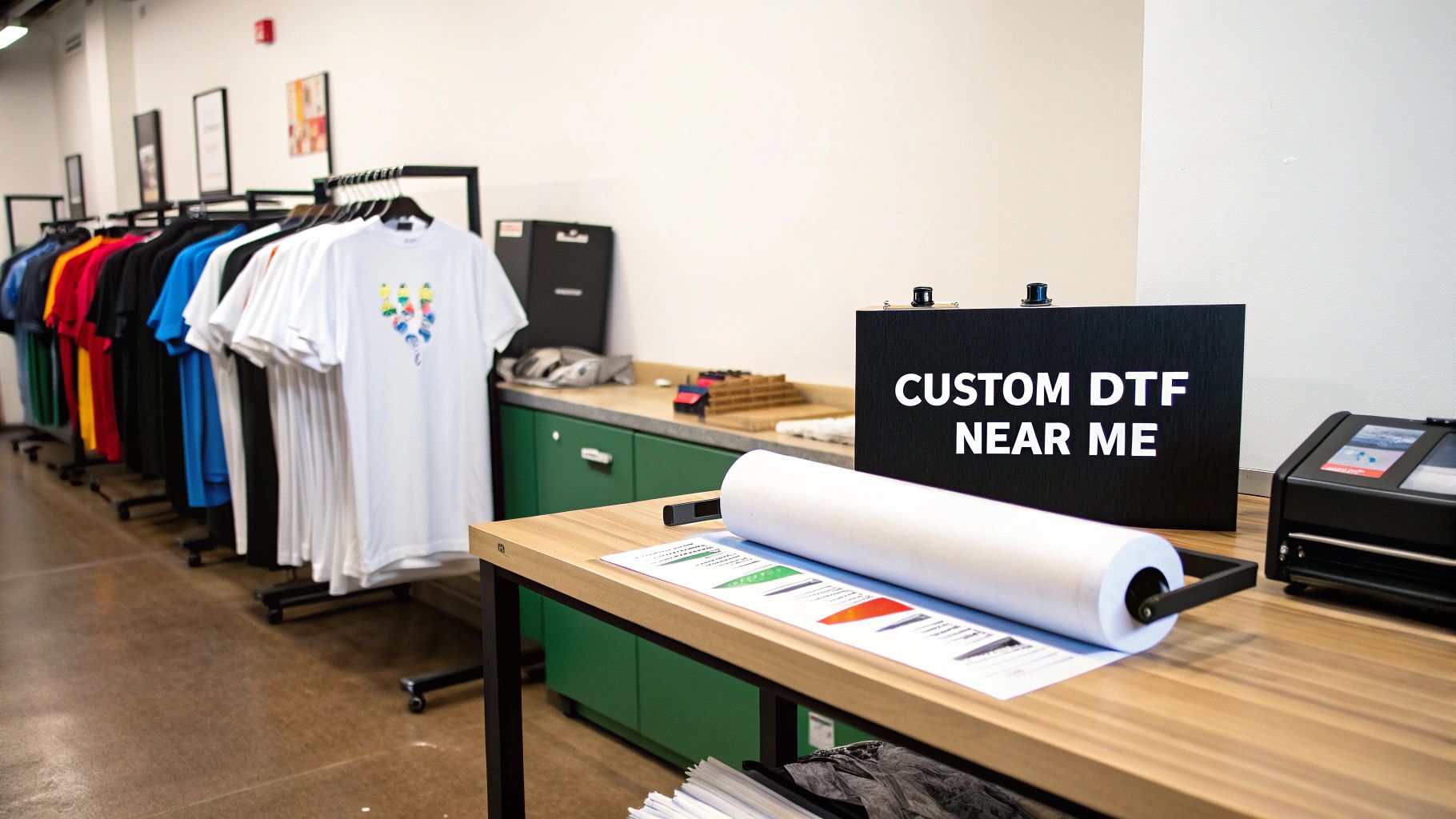
If you're looking to bring your own designs to life, getting your head around DTF technology is the first step. The easiest way to think of a DTF transfer is as a high-quality, ready-made sticker for your clothes. Your design gets printed onto a special film, and you can then press it onto a garment with a simple heat press.
This clever process puts professional-grade customisation within reach for everyone, from weekend hobbyists to established brands.
Choosing a local, UK-based provider for your transfers has some massive advantages over ordering from overseas. It’s not just about supporting local businesses; it’s a smart move that makes your entire production process smoother.
Benefits of Choosing a Local Provider
Working with a nearby printer is more than just convenient—it's a strategic decision that can make or break your project's success. The main perks really stack up:
- Faster Turnaround Times: A local supplier can often print and get your order in the post within a couple of business days. That’s a world away from the weeks you could be left waiting for an international shipment to clear customs.
- Reduced Shipping Costs: When you cut out long-distance freight and potential import fees, you can seriously bring down your overall project costs.
- Direct Communication and Support: When your printer is in the same country, sorting out any issues or just asking a quick question is so much easier. Building a relationship with a reliable local expert is genuinely invaluable.
By choosing a local supplier, you’re not just buying a product; you’re gaining a partner who’s invested in your success. They understand the UK market and can give you tailored advice to make sure your final products look fantastic.
This guide will walk you through everything you need to know to find the best service for your needs, whether you're starting a small personal project or gearing up for a big business order. We’ll cover the tech, how to pick the right provider, and what to expect from the ordering process.
Understanding DTF Transfers and Their Benefits
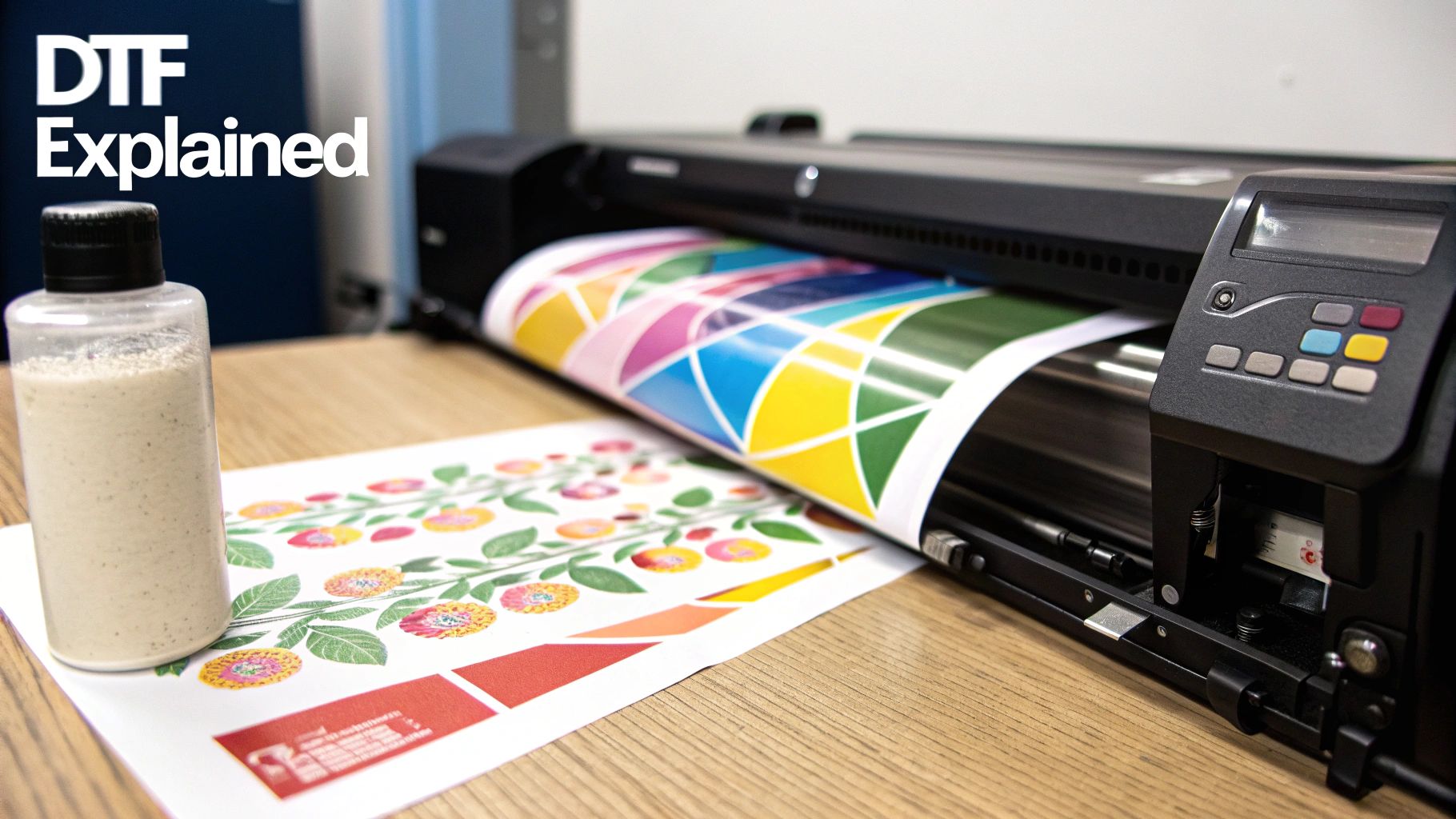
Direct to Film (DTF) might sound a bit technical, but the idea behind it is actually pretty simple. Think of it like a super-advanced, professional-grade temporary tattoo, but made specifically for your clothes. It’s a clever process that gives you a ready-to-press graphic that works brilliantly where other printing methods just can't keep up.
So, how does it work? First, a special printer lays down your design onto a clear film. While the ink is still wet, it gets a fine dusting of hot-melt adhesive powder. This film then takes a trip through a curing oven, which melts the powder and fuses it directly to the ink. The result is a single, durable transfer sheet.
This finished transfer is then sent straight to you. All you need is a heat press to apply the design to your chosen garment, and you're left with a sharp, professional finish every single time. It's this straightforward application that has made searching for custom dtf transfers near me a go-to for so many businesses and creators.
Why DTF Is a Game Changer for Custom Apparel
DTF printing isn't just another printing option; for a lot of projects, it’s flat-out the best one. It neatly solves many of the headaches you’d run into with traditional methods like screen printing or Direct to Garment (DTG). If you want to get into the nitty-gritty, you can learn more about the specifics of DTF printing in our detailed guide.
The key benefits really make this technology shine:
- Unmatched Fabric Versatility: Unlike DTG, which is happiest on 100% cotton, DTF is a true all-rounder. It sticks perfectly to cotton, polyester, nylon, leather, and tricky blends without breaking a sweat.
- No Colour Limitations: DTF can handle incredibly detailed, full-colour designs with photographic quality, including smooth gradients and tiny details. You don't have screen setup costs for each colour, which makes complex art surprisingly affordable.
- Superior Durability and Feel: When applied properly, DTF transfers are incredibly tough. They can easily handle over 50 washes without cracking, peeling, or fading. The final print feels soft and flexible too, stretching with the fabric so it’s comfortable to wear.
The real magic of DTF is its power to put vibrant, detailed, and tough prints on almost any fabric you can think of. This frees you up to create without worrying about material limitations.
Comparing DTF to Traditional Methods
To really get why DTF is such a big deal, it helps to see how it stacks up against the old-school techniques. Take screen printing—it’s great for huge runs of simple designs, but the costs and complexity shoot up as soon as you add more colours.
Then you have DTG printing, which gives you amazing detail but is mostly stuck on light-coloured cotton garments and can lack durability on some fabrics. DTF perfectly bridges that gap. It gives you the full-colour freedom of DTG but with even more material versatility and durability, especially for small to medium-sized batches. It’s simply a reliable, high-quality solution for modern custom apparel.
How to Choose the Right Local DTF Provider
Finding the right partner when you're searching for custom DTF transfers near me is the difference between a project you're proud of and one that’s a total headache. The UK market is buzzing with options right now – it was valued at around USD 272 million in 2024, largely thanks to small businesses needing quality on-demand printing. You can find more on the market's growth over at Grand View Research.
What this means for you is that you can, and should, be picky. Your goal isn’t just to find someone down the road; it's to find a supplier who delivers consistent, top-notch quality and service you can count on. The best local providers feel more like partners, helping you nail that professional finish every single time.
Assess the Print Quality Firsthand
Before you even think about placing a big order, you need to see the quality with your own eyes. Any provider worth their salt will be happy to show you what they can do.
The easiest way to do this is to ask for a sample pack. This gets the physical transfers into your hands so you can see and feel the real deal. When your samples arrive, here’s what to look for:
- Colour Vibrancy: Are the colours popping and true to life? You want rich, saturated tones, not something that looks faded before it's even been pressed.
- Print Sharpness: Get up close and check the edges of the designs. They should be crisp and clean. Blurry or fuzzy lines are a dead giveaway of low-quality work.
- Feel and Flexibility: How does the transfer feel once it's on a shirt? A great DTF transfer should be soft and flexible, stretching with the fabric without cracking.
A physical sample tells a story that no website photo ever could. It’s a small step that saves you from major disappointment down the line.
Check Reviews and Reputation
Okay, so the prints look great. What's next? It's time to do a little digging into the company's reputation. Online reviews and testimonials are your best friends here, so check out what people are saying on platforms like Google, Trustpilot, and social media.
Look for patterns in what customers are saying. Are they constantly raving about quick turnarounds, helpful service, or prints that last? On the flip side, repeated complaints about missed deadlines, bad communication, or transfers peeling after one wash are massive red flags.
A provider's track record is a strong indicator of the experience you can expect. Look for a company that not only produces great transfers but also values its customers and communicates clearly throughout the process.
Also, pay attention to how the business handles negative feedback. A professional reply that tries to solve the problem shows they actually care about keeping customers happy. If you're looking for pointers on designing your own gear, you might find our guide to custom t-shirt printing helpful.
Finally, don't be shy about asking what equipment and materials they use. A supplier who invests in high-quality printers, inks, and films is far more likely to deliver a product that looks great and lasts. That level of detail is what separates the real experts from the rest.
A Step-by-Step Guide to Ordering Your Custom Transfers
Ordering custom DTF transfers for the first time can feel a bit daunting, but once you get the hang of it, it's a surprisingly simple process. Think of it like giving a blueprint to a builder—the more precise and clear your instructions are, the better the final result will be. Nailing this part ensures your vision comes to life exactly as you imagined it on fabric.
This guide will walk you through everything, from getting your digital file ready to giving that final thumbs-up. Follow these steps, and you'll find ordering from any provider of custom dtf transfers near me is a breeze.
Preparing Your Artwork for Printing
It all starts with your design file. Submitting a print-ready file is genuinely the most critical step in getting a high-quality transfer. If the artwork isn't formatted correctly, you’re setting yourself up for disappointment with blurry, pixelated, or off-colour prints.
Here are the non-negotiables for your artwork:
- Correct File Type: Most printers work best with vector files (like .AI, .EPS, or .SVG) or high-resolution raster files (like .PNG). A PNG file is often the go-to because it supports a transparent background, which is essential for most designs.
- High Resolution: Your design absolutely must be at least 300 DPI (dots per inch) at the final size you want it printed. Anything less will look fuzzy and lose all its sharp detail.
- Transparent Background: Make sure your design file actually has a transparent background. If you see a white or coloured box around your artwork on screen, trust me, that box will get printed right onto your transfer.
Getting your file right from the beginning saves a massive amount of time and stops that sinking feeling of getting a batch of transfers that just aren't right.
This simple flowchart breaks down what really matters when you're choosing a DTF partner: quality, reviews, and support.
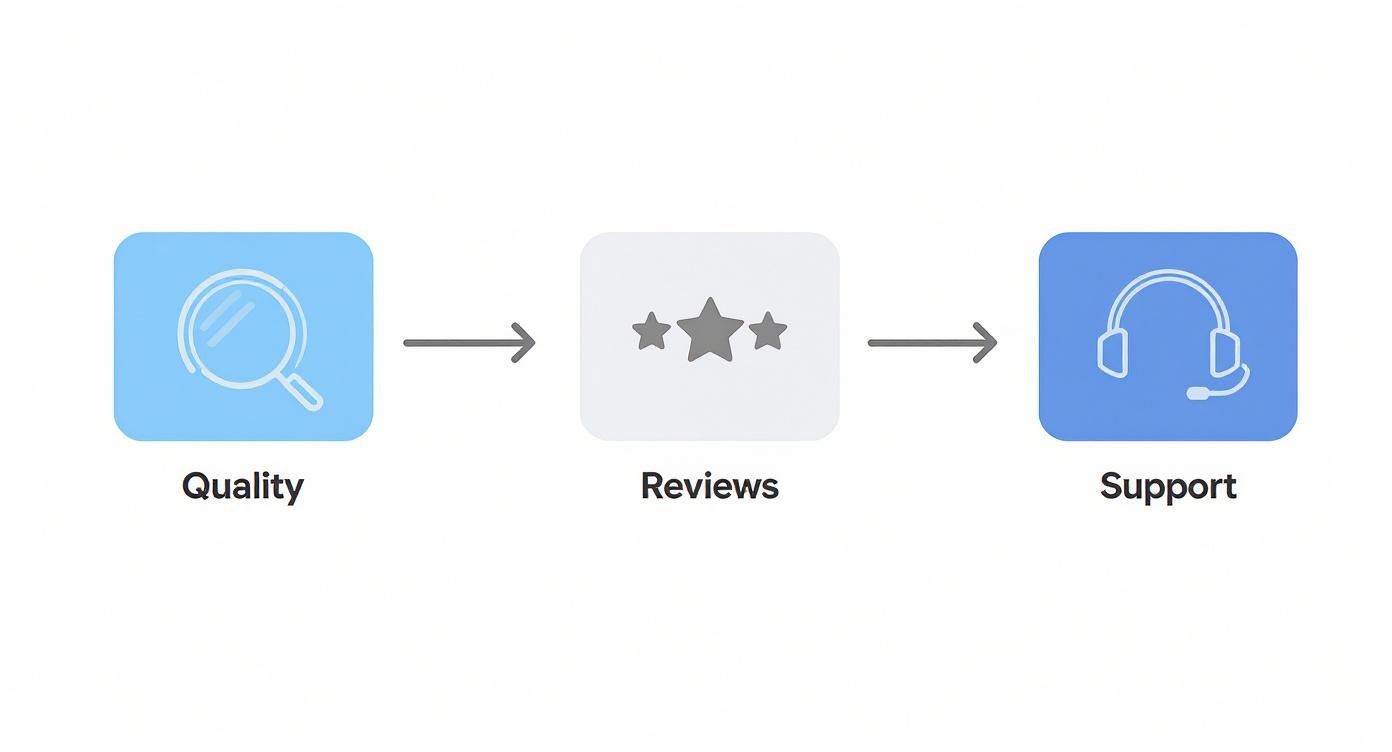
It’s a great reminder that a successful order isn't just about one of these things; you need a provider who delivers on all three.
Artwork File Preparation Checklist
To make things even clearer, here’s a quick checklist to run through before you hit that upload button. Getting these details right is the secret to a smooth, headache-free printing process.
| Requirement | Specification | Why It Matters |
|---|---|---|
| Resolution | Minimum 300 DPI | Prevents blurry or pixelated prints and ensures crisp, clean lines. |
| File Format | .PNG (preferred), .AI, .EPS, .SVG | These formats support transparent backgrounds and maintain quality when resized. |
| Background | Fully Transparent | Ensures only your design is printed, without any unwanted boxes or shapes. |
| Colour Mode | CMYK or RGB (check provider's preference) | Guarantees the colours on the final print match what you see on your screen. |
| Sizing | Artwork sized to the exact final print dimensions | Avoids distortion or unexpected resizing by the printer, which can ruin the look. |
Treat this list as your final quality check. A few minutes spent here can save you a lot of trouble later on.
Submitting Your Design and Proofing
Once your artwork is looking sharp, the next step is to upload it through your provider’s website. Many suppliers have handy online tools that let you build a gang sheet—this is a large transfer sheet where you can arrange several of your designs to get the most out of the space and bring down your cost per print.
After you've submitted your file, you'll get a digital proof back. This is your last, best chance to spot any issues.
Pay close attention to the digital proof. Check every detail: the colours, spelling, the placement of elements, and the overall size. What you see on that proof is exactly what they're going to print, so double- and triple-check everything before you approve it.
Once you’ve given your approval, you’ll sort out the payment, and your order officially joins the production queue.
If you want to dive deeper into all the different options out there, have a look at our guide to buy DTF transfers. This whole process, from file prep to final approval, is designed to be as straightforward as possible, making sure you get the exact transfers you had in mind.
Pricing and Turnaround: What to Expect
When you start looking for "custom DTF transfers near me," two big questions always pop up: "How much is this going to cost?" and "How fast can I get them?" Getting a handle on pricing and timelines is crucial for planning your project and avoiding any last-minute headaches. The good news? DTF is one of the most budget-friendly methods out there, especially for small-to-medium batches.
The final price of your order boils down to a few key factors. Unlike screen printing, the number of colours in your design doesn't impact the cost at all—a massive plus for anyone with complex, multi-coloured artwork. Instead, pricing is almost entirely based on how much film your designs use.
Breaking Down the Costs
Most suppliers price their transfers based on the sheet size you order. You'll usually see options like A4, A3, or even pricing by the metre for bigger jobs. The real trick is to fit as many designs as possible onto a single "gang sheet," as this dramatically lowers your cost per individual transfer.
Here are the main things that will shape your final quote:
- Sheet Size and Quantity: It's simple—larger sheets or longer metres cost more upfront, but buying in bulk almost always brings down the price per sheet. This is where DTF really shines; it's perfect for runs of 10 to 500 pieces, a range where other methods can get seriously expensive.
- Artwork Setup: Most reputable UK providers won't charge you a setup fee if your artwork is good to go (think a 300 DPI PNG with a transparent background). If your file needs a bit of fixing up or some design work, you might see a small fee added.
- Shipping Costs: This is where choosing a local provider really pays off. Shipping within the UK is far cheaper and quicker than ordering from overseas, where you could also get hit with surprise import duties.
The core idea is straightforward: the more efficiently you use the film space, the cheaper each transfer becomes. This makes planning your gang sheet a critical part of keeping your budget in check.
Understanding Turnaround Times
One of the biggest wins of sourcing your custom DTF transfers from a UK provider is the speed. While you could be waiting weeks for an international order to land on your doorstep, local suppliers are incredibly quick off the mark.
Most UK-based DTF printers work to a 24-48 hour production schedule. That means from the moment you give your proof the green light, your transfers are usually printed and ready to be dispatched within one to two working days. Add on Royal Mail or courier delivery times, and you can realistically have the transfers in your hands in just a few days.
And if you're really looking to keep costs down, our guide on finding cheap DTF transfers has some extra tips on how to save money without ever compromising on quality.
Applying Your DTF Transfers for Professional Results
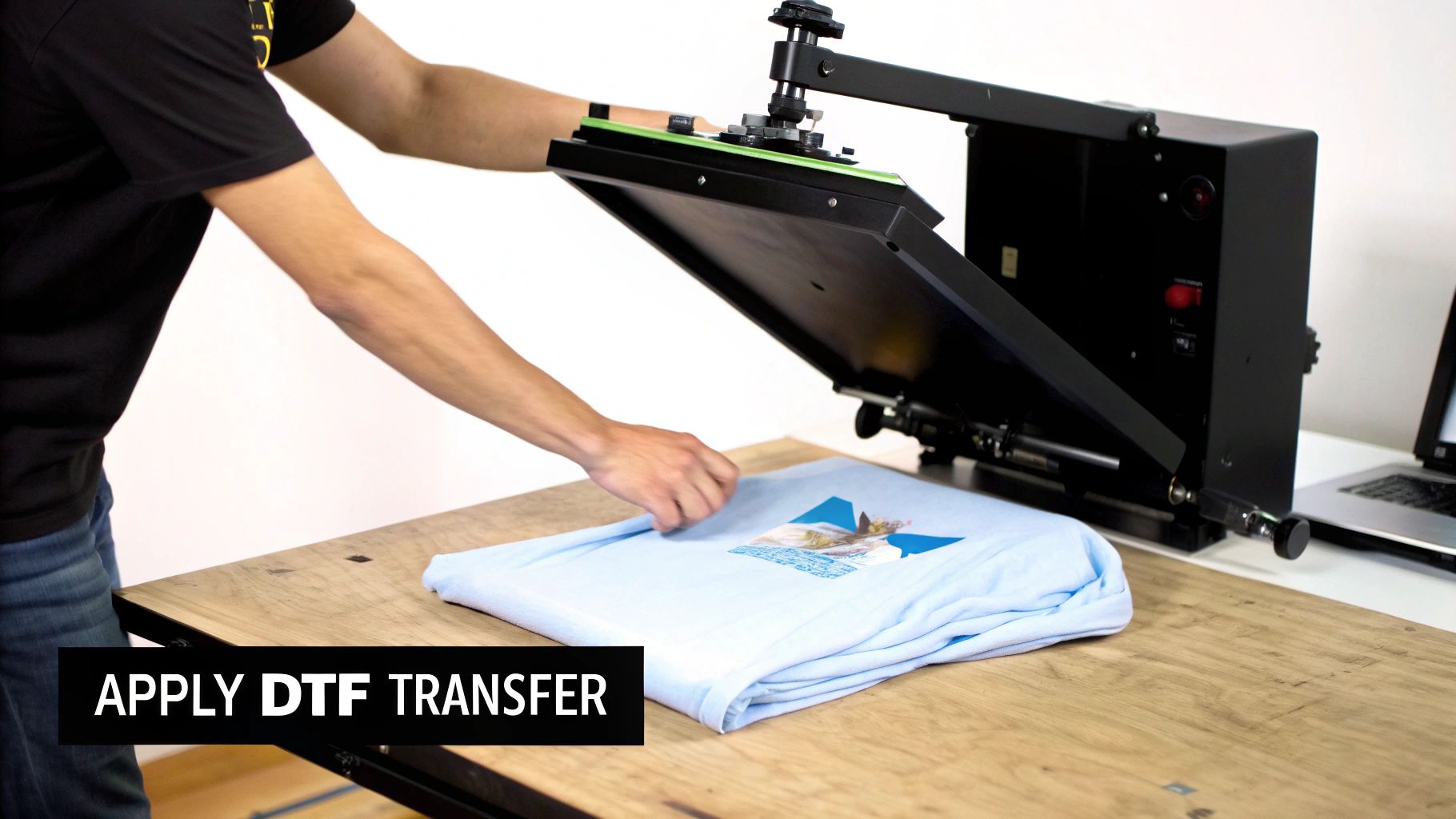
Once your custom DTF transfers have landed on your doorstep, it’s time for the fun part: bringing your garments to life. Getting that professional, durable finish is surprisingly straightforward when you know the right steps, turning a plain piece of apparel into something special. The real secret to a print that lasts is using a heat press to get perfectly even temperature and pressure.
Think of a heat press as a giant, precision-controlled iron. While you could use a standard home iron if you're in a bind, it’s a bit of a gamble. They tend to have hot spots and uneven pressure, which often leads to prints that peel or crack after just a few washes. For results that feel like they came straight from a shop, a heat press is non-negotiable.
The Heat Press Application Process
Applying your DTF transfer is a simple sequence of steps designed to perfectly bond the ink and adhesive to the fabric's fibres. Nailing this process gives you a print with a soft-hand feel that can handle dozens of washes without fading or cracking.
-
Pre-Press the Garment: First things first, place your t-shirt or hoodie on the heat press and give it a quick press for about 5-10 seconds. This is a crucial step that many people skip. It irons out any wrinkles and, more importantly, removes any hidden moisture in the fabric, giving you a perfectly flat, dry canvas for your design.
-
Position the Transfer: Lay your DTF transfer onto the garment, design facing up. Take a moment to make sure it's perfectly centred and straight.
-
The First Press: Pop a Teflon sheet or a sheet of parchment paper over the transfer to protect it. Press it according to your supplier's instructions, but a great starting point is usually 150-160°C for 10-15 seconds using medium pressure.
-
Cool and Peel: Now for the most critical part of the whole process. DTF transfers are almost always a cold peel. This means you need to take the garment off the press and let it cool down completely. Once it’s cool to the touch, start at one corner and gently peel away the clear film.
-
The Final Cure: To really lock the design in, place the parchment paper back over the graphic and press it one last time for another 5-10 seconds. This final press helps the ink settle into the fabric, improving durability and giving it that lovely soft finish. For a more detailed guide, check out our post on ready to press DTF transfers.
The cold peel is the golden rule of DTF. If you get impatient and try to peel the film while it's still warm, you risk pulling the ink right off the garment, leaving you with a patchy, ruined design. Patience is key!
Troubleshooting Common Application Issues
Even when you follow the steps, you can sometimes run into a snag. It happens. If you find your transfer just isn't sticking properly, the culprit is almost always not enough pressure or heat. Double-check your heat press settings and make sure it’s properly calibrated.
On the flip side, if your final print feels a bit thick or has a plasticky texture, your temperature is likely a touch too high. Try dialling it down by a few degrees. This small adjustment can make a world of difference, resulting in a much softer print that feels like part of the fabric itself.
Got Questions About Custom DTF Transfers? We've Got Answers
Stepping into the world of custom apparel printing can feel a bit overwhelming, especially with newer methods like DTF. To help clear things up, here are some straight-talking answers to the questions we hear most often.
How Well Do DTF Transfers Hold Up Compared to Screen Printing?
Honestly, they're incredibly tough. A well-applied DTF transfer can often outlast a traditional screen print, especially when you're working with stretchy or synthetic materials. When pressed correctly with a good heat press, you can expect a quality transfer to handle 50+ washes without any trouble—no cracking, peeling, or fading in sight.
The magic is in the combination of water-based inks and a uniquely flexible adhesive powder. Together, they create a bond that literally moves and stretches with the fabric. This avoids that classic cracking you sometimes see with thicker, less pliable layers of screen printing ink.
Can I Really Use DTF Transfers on Any Fabric?
Pretty much, yes! This is where DTF really shines. Its versatility is one of its biggest selling points, making it the perfect choice for almost any garment or project you can think of.
You can press these onto:
- Natural Fibres: Cotton, linen, canvas—the classics.
- Synthetics: Polyester, nylon, rayon, and other man-made materials.
- Blends: All those popular cotton/poly and tri-blend fabrics.
- Other Stuff: We've even seen them work on tricky surfaces like leather and wood.
Unlike Direct-to-Garment (DTG) printing, which really needs 100% cotton to look its best, DTF isn't fussy. That special adhesive layer means it can stick securely to almost any surface, whatever its colour or what it's made of. This is a game-changer if you're searching for custom dtf transfers near me to handle a mix of different apparel types.
What's a Gang Sheet, and How Does It Save Money?
Think of a gang sheet as a large canvas for all your designs. It's a big sheet of transfer film where you can arrange—or "gang up"—multiple graphics to be printed all at once. So, instead of paying for each design one by one, you're just paying for the space on that single sheet.
This is hands-down the most cost-effective way to order. You can cram as many logos, neck labels, or different graphics as you can fit onto one sheet, which massively drops your cost for each individual transfer. Most UK suppliers offer online tools to help you lay everything out and maximise your space.
Ready to get started with vibrant, durable custom apparel? At Psyque - DTF Print & Press, we supply top-quality DTF transfers with fast UK shipping. Check out our services and start your project today.