
Finding DTF Prints Near Me Your Ultimate Local Guide
If you've ever found yourself typing "DTF prints near me" into a search bar, you're probably looking for top-notch transfers without the agonising wait for shipping. Working with a local supplier isn't just about convenience; it brings real, tangible benefits to the table, like a faster turnaround, the chance to approve physical samples, and proper, face-to-face communication. All this ensures your project stays on track and hits the quality standards you expect.
Why Sourcing DTF Prints Locally Is a Game Changer
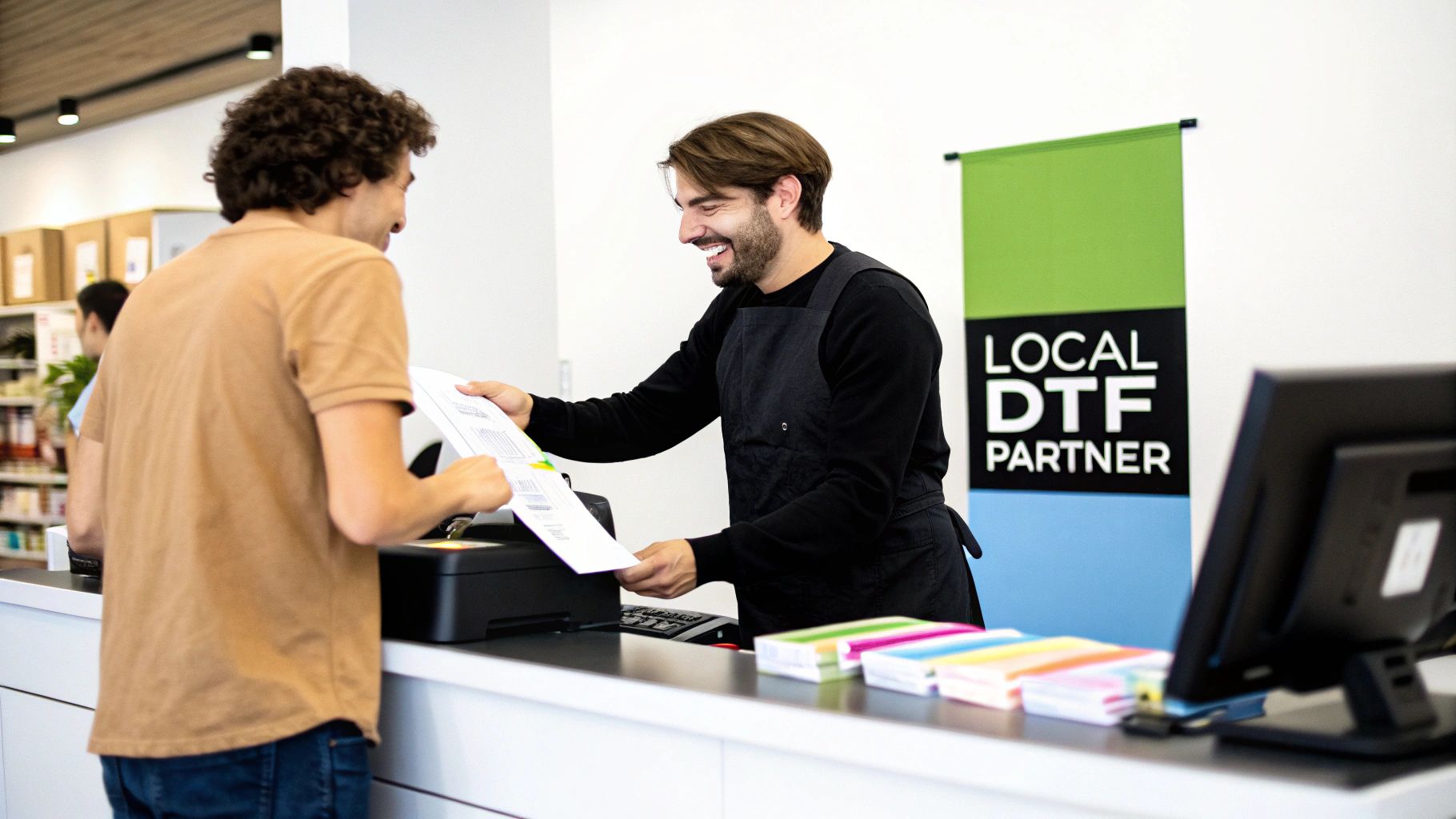
The custom apparel world is buzzing, and Direct-to-Film (DTF) printing is undeniably leading the charge. While the giant online suppliers seem to offer endless choice, there’s a compelling reason so many small businesses and creators are turning to local partners instead.
It’s a strategic move. Going local transforms the production process from an impersonal, digital transaction into a genuine, collaborative partnership. This proximity unlocks some key advantages that a remote, faceless operation just can't compete with.
The Power of Proximity and Speed
Let's be honest, the most immediate win of using a local supplier is waving goodbye to shipping delays. Instead of tapping your fingers for days waiting for a courier to cross the country, you can often pop round and collect your order within 24-48 hours.
This speed is a massive plus for any time-sensitive project, whether it's last-minute merch for an event or a rush order for a key client.
By taking the unpredictability of couriers and logistics out of the equation, you get a much firmer grip on your timeline. A local partner means you can pivot quickly, make last-minute tweaks, and hit your deadlines with confidence.
Tangible Quality Control You Can Trust
Nothing beats seeing and feeling a product with your own two hands. When you source your DTF prints locally, you get the chance to:
- Request physical samples: Before you commit to a big order, you can actually touch and test the transfers. Check the colour accuracy, the feel, the stretch. You can't do that through a screen.
- Resolve issues in person: If a colour is slightly off or a tiny detail is missed, you can have a real conversation about it. You can show them the issue directly and work out a solution together, right there and then.
- Build a real relationship: A local printer becomes more than just a supplier; they become a valuable resource. Over time, they get to know your brand, your standards, and exactly what you're looking for.
This hands-on approach drastically cuts the risk of expensive mistakes and makes sure the final product is a perfect match for your vision.
The UK's direct-to-film printing market is growing fast, valued at an estimated USD 192.2 million in 2025 and projected to climb to USD 249.0 million by 2030. This boom highlights the rising demand for the reliable, high-quality printing that local suppliers are perfectly positioned to offer. You can find more data on UK market trends over at Grand View Research.
Smart Ways To Find Your Perfect Local DTF Supplier

Finding the right local supplier for your DTF prints needs a little more savvy than just a quick online search. Of course, typing "DTF prints near me" into Google is a decent starting point, but the real gems are often discovered when you dig a bit deeper.
Think of it this way: the best partners aren't always the ones with the biggest advertising budgets. They’re often the smaller, dedicated shops focused on exceptional quality and service. Moving beyond the obvious keywords is your first real step toward finding a printer you can genuinely rely on.
Widen Your Online Search Net
You need to think like a customer who might not know the term "DTF". Many excellent print shops categorise themselves by the final product, not the specific technology they use.
So, head over to Google Maps and try broadening your search terms.
- "Custom t-shirt transfers [your city]": This is a great one, as it targets businesses set up for apparel decoration.
- "Local garment printing services": A wider term that often pulls in shops that have invested in DTF technology.
- "Heat transfer printing UK": This can sometimes uncover national suppliers who have local hubs or surprisingly fast shipping options.
It also pays to understand a little about why certain businesses show up first in your search. Getting familiar with the basics of local search ranking factors can give you an edge, helping you see past the sponsored ads to find the businesses that are genuinely well-regarded in your area.
Go Visual with Social Media
Don't sleep on this one. Social media, especially Instagram and TikTok, is an absolute goldmine for vetting suppliers. It’s where you get to see their work in the wild, not just the perfectly polished photos on their website.
Start searching with hashtags. Try things like #DTFprintingUK, #LondonDTF, or even #[yourcity]printers. You'll instantly get a feel for the quality of their prints, the vibrancy of the colours, and the types of garments they typically work on. Better yet, you’ll often find their customers tagging them in posts, giving you an unfiltered look at the final product. It’s a far more authentic way to judge a supplier's real-world capabilities.
A printer's social media feed is their living, breathing portfolio. Look at the detail in the prints and how they engage with their followers. It tells you everything about their pride in the work and their approach to customer service.
Comparing Local Supplier Discovery Methods
To give you a clearer picture, here’s a quick breakdown of the different ways you can track down a great local DTF supplier, along with the pros and cons of each approach.
| Method | Best For | Potential Pitfall |
|---|---|---|
| Google/Maps Search | Quickly finding businesses with a strong, established online presence. | Can be dominated by paid ads or larger, less personal companies. |
| Social Media Hashtags | Visually vetting print quality and seeing real-world customer examples. | Requires more time to sift through posts to find relevant suppliers. |
| Local Community Groups | Getting honest, word-of-mouth recommendations and warnings. | Recommendations can sometimes be biased or outdated. |
| Industry Directories | Locating specialised printers who focus solely on trade services. | Listings might not always be up-to-date or well-maintained. |
Each method has its place, and using a combination of all three is usually the most effective strategy for building a solid shortlist of potential partners.
Tap into Local Knowledge
Finally, never underestimate the power of a good old-fashioned recommendation, even in the digital age. Your best intel will often come from other people in the same boat as you.
Seek out local business forums, Facebook groups for crafters and small apparel brands, or even online directories for the UK printing industry. These are the places where people share genuine feedback. Posing a question in one of these groups can lead to direct referrals from happy customers, which is arguably the most reliable way to find a trustworthy partner for all your custom t-shirt printing needs.
How to Vet Local Printers and Avoid Costly Mistakes
Right, you’ve got a list of potential local suppliers. Now for the crucial part. Choosing the right partner is the difference between a project that runs smoothly and one that becomes a costly, frustrating nightmare. It’s time to separate the real pros from the hobbyists operating out of a spare room.
This isn't about pinching pennies or finding the absolute cheapest quote. It’s about finding someone reliable. A bit of due diligence now will save you a world of hurt and a whole lot of money later on, ensuring your final products actually look the way you imagined.
Start With Their Digital Footprint
Before you even dream of placing an order, have a good nosey around their online presence. A professional, slick website is a decent first impression. Does it clearly lay out what they do, how long it takes, and what they need from you in terms of artwork?
Next, get stuck into the reviews. Don't just glance at the star rating. Dig into the actual comments on places like Google, Trustpilot, or even their Facebook page. Look for recent, genuine-sounding feedback that talks about specifics – print quality, customer service, delivery speed. A pattern of comments praising the colour accuracy or durability? That's gold dust.
The Litmus Test: Ordering a Sample Pack
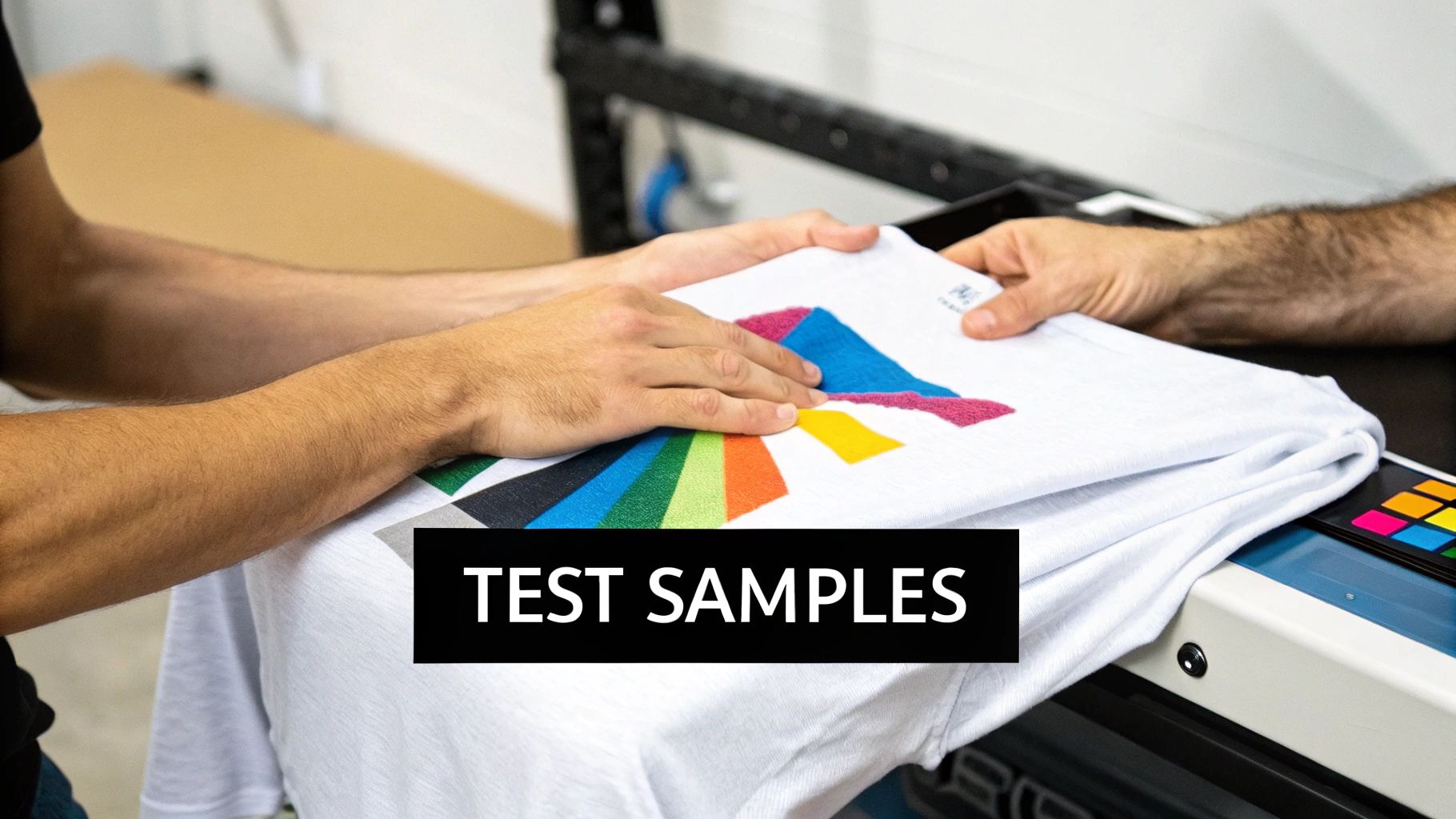
Honestly, this is the single most important thing you can do. Never, ever commit to a big order without getting your hands on a physical sample first. A digital mock-up can hide a multitude of sins, but a real transfer tells the true story.
When that sample pack lands on your doormat, don't just admire it. Put it through its paces.
- Vibrancy and Accuracy: Hold the transfer up against your original design on a properly calibrated screen. Is that red a true, vibrant red, or is it a bit orangey? Are the fine lines and tiny details sharp and crisp?
- Feel and Flexibility: Press a sample onto a spare bit of fabric. How does it feel? Is it soft and pliable, or does it feel thick and plasticky, like a cheap sticker? A quality DTF transfer should almost feel like it’s part of the garment itself.
- The Stretch Test: Give the fabric a gentle stretch where the transfer is. A good print will stretch with the material without cracking or looking stressed. If it cracks straight away, that’s a massive red flag for durability.
- The Wash Test: Here it is, the ultimate test. Wash the sample according to their instructions. Then do it again. Look for any hint of peeling, fading, or cracking. A transfer that can't survive a couple of washes is completely useless for a commercial product.
A printer who is truly confident in their product will be happy to send you samples. If a supplier gets funny about it, or wants to charge an outrageous price for a small test pack, take that as a serious warning sign about their quality or business practices.
Essential Questions to Ask Your Potential Printer
Once a supplier has passed the sample test, it's time to have a proper chat. This is your chance to get answers and to get a feel for their expertise and how they treat their customers. Remember, you're not just buying prints; you're starting a business relationship.
Your questions should cover their gear, materials, and their policies. For instance, asking what brand of printer and inks they use can tell you a lot about their investment in quality. It's also vital to understand their approach for dealing with things when they go wrong, a crucial piece of insight when you're on the hunt for reliable custom t-shirt printers.
And make sure you ask about their reprint policy. What happens if an order turns up with a clear defect? A professional outfit will have a simple, no-fuss process for sorting their mistakes out at their own expense. Their answer will tell you everything you need to know about how much they value their customers.
Getting Your Artwork Ready for Perfect DTF Prints
The final quality of your DTF prints comes down almost entirely to one thing: the quality of your artwork file. Getting this bit right is the single best way to make sure your vision translates perfectly from screen to fabric. It’s how you avoid those frustrating, and often costly, surprises when your order finally arrives.
Think of your artwork as the blueprint for your design. If the blueprint is wonky, you can't expect the final product to be perfect. A crisp, vibrant print always starts with a technically sound digital file. This isn’t about being a graphic design wizard, but it does mean following a few non-negotiable rules that professional printers live by every single day.
The Absolute Essentials for Your File
First up, let's talk resolution. Your design file must be created and saved at 300 DPI (dots per inch) at the exact size you want it printed. If you just grab a low-resolution image from the internet, it’s going to look pixelated and blurry on a T-shirt, no matter how fancy the printer’s equipment is.
Next, and this is a big one, is the background. Your artwork needs a genuinely transparent background—not just a white one that looks invisible on your screen. This is crucial because the DTF process lays down a white ink base for colours to pop on darker garments. If your file has a white background, you’ll get a solid white box printed right behind your design. It's a classic rookie mistake.
To dodge this disaster, always export your final file in a format that supports transparency.
- PNG (Portable Network Graphics): This is the go-to for most raster (pixel-based) artwork. It keeps the transparency intact and holds onto that high quality you need.
- Vector Files (AI, EPS, SVG): If your design is made of clean shapes and lines, like a logo, a vector file is even better. It can be scaled to any size without losing an ounce of quality.
Fine-Tuning Your Design Like a Pro
Beyond the basics, a couple of extra steps will make your printer's job a lot easier and all but guarantee a flawless result. One key detail is the colour mode. While you might be used to CMYK for paper printing, DTF printers are calibrated for the RGB colour space. If you design in RGB from the start, the colours you see on your screen will be much closer to the final print.
Here’s another pro tip: convert all your text to outlines or paths before you export. This essentially turns your text into a shape, meaning the printer doesn’t need to have the specific font you used installed on their system. It’s a simple click that prevents font substitution errors from wrecking an otherwise perfect design. For anyone looking to whip up some fresh designs, an AI T-Shirt Design Generator can be a fantastic source of inspiration.
A quick heads-up: pay close attention to the minimum line thickness your printer recommends. DTF can handle incredible detail, but if your lines are too thin, the adhesive powder might not have enough surface area to stick to properly, which means they could wash away after a few cycles in the machine.
The global DTF printing market is booming, set to grow from USD 2.72 billion in 2024 to USD 5.18 billion by 2035. This massive growth is driving higher standards and better tech right here in the UK, with businesses demanding more consistency and quality—all of which starts with a properly prepared file. If you're looking for more ideas, you can also check out our guide on creating amazing personalised T-shirt printing.
Navigating the Order from Proof to Print
So, you've found a great local printer and your artwork is looking sharp. What happens next? Getting your design from your screen to a physical transfer is a pretty straightforward journey, but paying close attention now will save you a world of headaches later.
Let's walk through the final steps, from handing over your files to giving that all-important final nod of approval.
Most printers you'll work with will have a simple upload portal on their website. This is where you’ll send them that high-resolution, transparent PNG or vector file you've perfected. Make sure you read their instructions carefully – some have specific requirements for naming files or might have dimension limits you need to know about.
Maximising Value with Gang Sheets
As you're getting ready to upload, you'll almost certainly come across the term "gang sheet". If you're not using them, you're leaving money on the table. It's a game-changer for getting the most out of your budget.
A gang sheet is simply a large roll of transfer film that you can fill with as many different designs as you can fit.
Instead of paying for each design as a separate order, you can arrange everything together – main logos, smaller sleeve prints, custom neck tags, even a few colour variations. The printer runs the whole sheet as one job, which drastically cuts down on their setup costs and, more importantly, your final bill. It's hands-down the smartest way to order if you've got a variety of graphics for a project.
Think of a gang sheet as a digital jigsaw puzzle. Your goal is to fit as many design pieces onto the sheet as possible to minimise waste and maximise your budget. A little time spent arranging your files can lead to big savings.
This diagram breaks down the basic file checks you need to complete before you even start building that gang sheet.
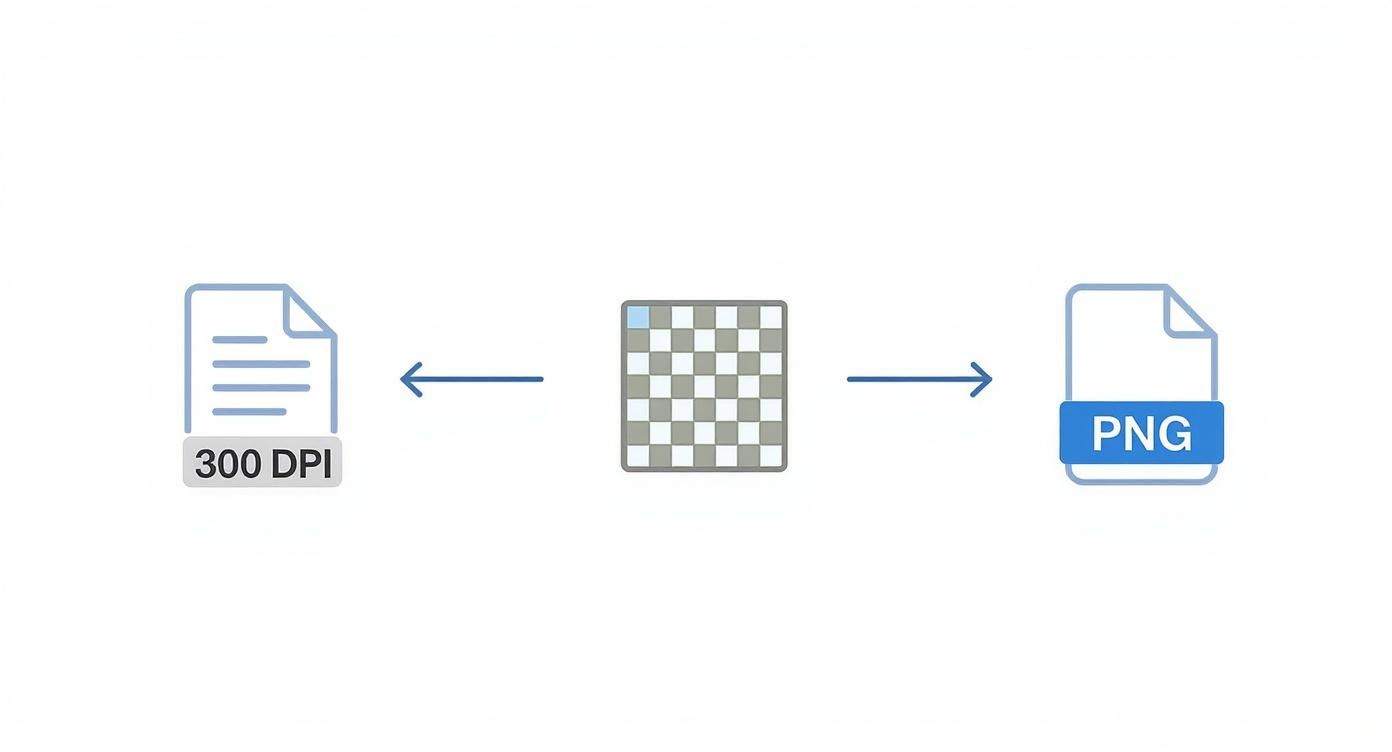
Nailing the resolution, ensuring the background is transparent, and saving in the right format are non-negotiable for getting results you’ll be proud of.
The All-Important Proofing Stage
Once your files are submitted, the printer will send back a digital proof. This is your absolute last chance to catch any mistakes. Seriously, don't just glance at it and hit 'approve'. You need to put on your detective hat and scrutinise every single detail.
- Check the text: A single typo can make an entire batch of shirts worthless. Read everything, then read it again backwards.
- Verify colours and positioning: Is that shade of blue correct? Is the logo perfectly centred? Does it look exactly how you imagined?
- Confirm the dimensions: Get a ruler out and double-check the transfer sizes against the garments you plan to press them on.
The moment you approve that proof, you're telling the printer to go ahead. Any errors discovered after that point are on you.
Finally, always ask for a clear production timeline. A good printer will be upfront about their turnaround times. Knowing when to expect your transfers helps you manage your own project deadlines and keep your customers happy, ensuring everything wraps up smoothly.
Your Top Questions About Local DTF Prints Answered
Even after you've pinpointed a few local suppliers, it's completely normal to have a few questions buzzing around. The world of custom printing is full of its own jargon and unique processes, so let's tackle some of the most common queries people have when they're searching for "DTF prints near me."
Getting solid answers on the essentials—cost, speed, and what kit you'll need—is key. It helps you budget properly and plan your projects without any last-minute surprises. Think of this as your quick-fire guide to the must-know details before you place an order.
How Much Do DTF Prints Typically Cost in the UK?
The price of DTF prints can vary quite a bit, and it usually boils down to three things: the size of the transfer, the quantity you need, and the supplier themselves. As a rough ballpark figure, you can expect to pay somewhere between £2 to £10 for a single A4 or A3 sized sheet.
Most local printers work with a tiered pricing model. In simple terms, the more you order, the cheaper each print becomes, which is a massive plus for larger runs. It's always a good idea to get a couple of quotes, but remember that the cheapest price tag doesn't always mean the best value. Paying a little extra for a print that boasts incredible durability and vibrant colours is a far smarter investment for your brand.
What Is a Realistic Turnaround Time?
This is where local suppliers really come into their own. Many UK-based DTF print shops can turn your job around in just 24 to 48 hours once you've signed off on the artwork. That's a huge leg up compared to ordering from overseas, where you could be waiting a week or more for shipping alone.
For those really tight deadlines, some printers even offer a same-day or express service for an extra fee—a real lifesaver for last-minute orders. Just be sure to confirm the production schedule directly with them before you commit, so everyone is on the same page. If you're curious about the tech itself, our guide explains in detail what DTF stands for and how the magic happens.
Do I Need Special Gear to Apply DTF Transfers?
Yes, and on this point, there's no room for compromise. To get a professional, durable finish, you absolutely must use a commercial heat press. A regular household iron just can't deliver the consistent high temperature and even pressure needed for the adhesive to bond properly with the fabric.
Trying to use an iron is a recipe for disaster. You’ll almost certainly end up with transfers that peel at the edges, crack after one wash, or just don't stick properly in the first place.
A good heat press is a non-negotiable investment if you're serious about creating high-quality custom garments. Your local supplier can even give you the exact temperature, time, and pressure settings that are optimised for their specific transfers, which helps you get a perfect press every single time.
Ready to bring your designs to life with vibrant, durable prints? Psyque offers premium DTF transfers with fast, reliable service right here in the UK. Start your custom apparel journey with us today.