
Your Guide to the UV DTF Printer UK Market
Thinking about getting a UV DTF printer in the UK? Let's cut through the jargon. At its heart, this technology lets you create incredibly tough, custom "stickers" or transfers that you can apply to almost any hard surface you can think of—glass, metal, wood, plastic, you name it. It's quickly becoming the go-to method for UK businesses wanting to put high-quality, durable graphics on all sorts of non-fabric items.
What's All The Fuss About? Understanding UV DTF Printing
So, what’s actually going on inside one of these machines? The best way to think about it is creating a super-premium, ready-to-go decal. Instead of printing directly onto an object, the magic happens on a special set of films, known as the 'A' and 'B' films. This simple difference is what sets it apart from traditional printing methods, which are often limited by an object's shape or material.
First, your design is printed onto the 'A' film using special UV-curable inks. As the ink is laid down, a powerful UV lamp inside the printer zaps it, instantly drying—or 'curing'—it. This locks in the vibrant colour and creates a slightly raised, tactile finish. It's this instant curing that gives the final print its fantastic durability and glossy look.
Once printed, the 'B' film, which is essentially a transfer sheet, is laminated over the top of the 'A' film. The final result is a pristine, ready-to-apply transfer.
The Peel-and-Stick Application
Applying the transfer couldn't be simpler. You just peel the printed design off the 'A' film backing, position it on your chosen object, press down firmly, and then peel away the clear 'B' film carrier. What's left behind is just the ink and adhesive, moulded perfectly to the surface with no background or clear edges in sight.
This straightforward "peel and stick" process is a huge plus. It completely removes the need for bulky kit like heat presses, which are a must for textile printing. This opens up a whole new world of possibilities for on-site customisation and for decorating items that used to be a real headache to print on.
Why It's a Game-Changer for UK Businesses
The appeal of a UV DTF printer in the UK comes down to two things: its incredible versatility and its efficiency. For small businesses, independent makers, and promotional companies, it offers a brilliant way to expand product lines without having to invest in a whole workshop of different machines.
Here’s why it’s catching on so fast:
- Material Freedom: It just works. You can apply these transfers to a massive range of hard, non-porous surfaces like acrylic, ceramics, metal, glass, and even treated wood.
- No Prep Needed: Forget about special coatings or primers. With UV DTF, you can apply the transfer directly to a clean surface, which is a massive time and money saver.
- Built to Last: The UV-cured ink is seriously tough. It stands up brilliantly to scratches, water, and sunlight, making it perfect for items that get a lot of use.
This technology is tapping into a market that's growing at a remarkable pace. The global UV DTF sector was valued at around USD 215 million in 2024 and is expected to nearly double to USD 442 million by 2031. It might share "DTF" in its name, but the process and what you can do with it are completely different from standard fabric printing—a topic we explore in our detailed guide on DTF printing.
How UV DTF Stacks Up Against Other Printing Methods
Choosing the right printing technology can feel a bit like navigating a maze. Each method has its own quirks, strengths, and ideal use cases. Figuring out how a UV DTF printer in the UK compares to the old hands like conventional DTF, Direct-to-Garment (DTG), and screen printing is vital for making a smart investment. It's not about finding one single "best" method, but picking the right tool for the job you need doing.
Think of it like choosing a vehicle. You wouldn't take a sports car on a removal job, and you wouldn't enter a lorry into a track day. Each is built for a specific purpose. UV DTF is the specialist for hard, non-porous surfaces, giving you a level of versatility that other methods just can't touch.
UV DTF vs Other Printing Technologies
Let's break down the main players in the customisation game. Each has a sweet spot, and understanding where UV DTF fits in makes it much easier to see its value for your business.
| Feature | UV DTF | Conventional DTF (Textile) | DTG (Direct-to-Garment) | Screen Printing |
|---|---|---|---|---|
| Ideal Surfaces | Hard, non-porous goods (glass, metal, plastic, wood) | Wide range of fabrics (cotton, poly, blends) | Primarily cotton and high-cotton blend fabrics | Textiles, but can be adapted for some hard goods |
| Heat Required? | No – peel and stick application | Yes – requires a heat press | Yes – requires a heat press to cure ink | Yes – requires a tunnel dryer to cure ink |
| Best For Volume | Small to medium batches, one-offs | Small to large batches | Small batches and one-offs | Very high volume (100+ units) |
| Setup Cost/Time | Virtually zero per design | Minimal | Minimal | High setup cost and time per colour |
| Colour Capability | Full-colour, photographic quality | Full-colour, photographic quality | Full-colour, photographic quality | Limited by the number of screens (colours) |
| Feel of Print | Slightly raised, glossy/3D effect | Soft, flexible layer on top of fabric | Very soft, breathable, ink dyes the fabric | Varies, can be a thick layer of ink |
This table gives a bird's-eye view, but the real devil is in the detail. Understanding why these differences exist is key to choosing the right path for your products.
UV DTF vs Conventional Textile DTF
At first glance, UV DTF and its fabric-loving cousin, conventional DTF, seem pretty similar. Both print onto a film first, then transfer the design. But that’s where the similarities end. The core chemistry and how you apply them are worlds apart.
Conventional DTF uses water-based textile inks and a hot-melt adhesive powder. It needs a big, hot heat press to literally melt and bond the design into fabrics like cotton or polyester.
UV DTF, on the other hand, uses UV-curable inks that are blasted with UV light to harden them instantly, and the transfer film has a pressure-sensitive adhesive. There is absolutely no heat involved in sticking it onto your product. This one difference is the secret sauce. It’s what lets you decorate heat-sensitive or totally rigid materials like glass, metal, and acrylic without any risk of damage. It’s a simple peel-and-stick job, which makes it faster and way more adaptable for hard goods.
UV DTF vs Direct to Garment (DTG)
Direct-to-Garment printing is the undisputed king of soft, natural fabrics. As the name suggests, a DTG machine works a lot like your office inkjet printer, just for t-shirts. It sprays ink directly onto a pre-treated cotton garment, resulting in a print so soft you can barely feel it. It’s breathable and brilliant for detailed, full-colour images.
But DTG's reliance on porous, natural fibres is its biggest weakness. It just doesn't work well on polyester and is completely useless for non-fabric items like mugs, phone cases, or signs. This is exactly where a UV DTF printer steps in. It absolutely smashes it on the very surfaces DTG can't even touch, creating vibrant, slightly raised designs that pop. The two aren't really competitors; they’re teammates. One owns the wardrobe, the other owns pretty much everything else.
Key Takeaway: It all comes down to the material. DTG is purpose-built for natural fabrics like cotton, giving that super-soft feel. UV DTF is your go-to for putting tough, high-res graphics onto almost any hard, non-porous surface you can think of.
This chart helps visualise where UV DTF slots into the process for customising hard-surface products.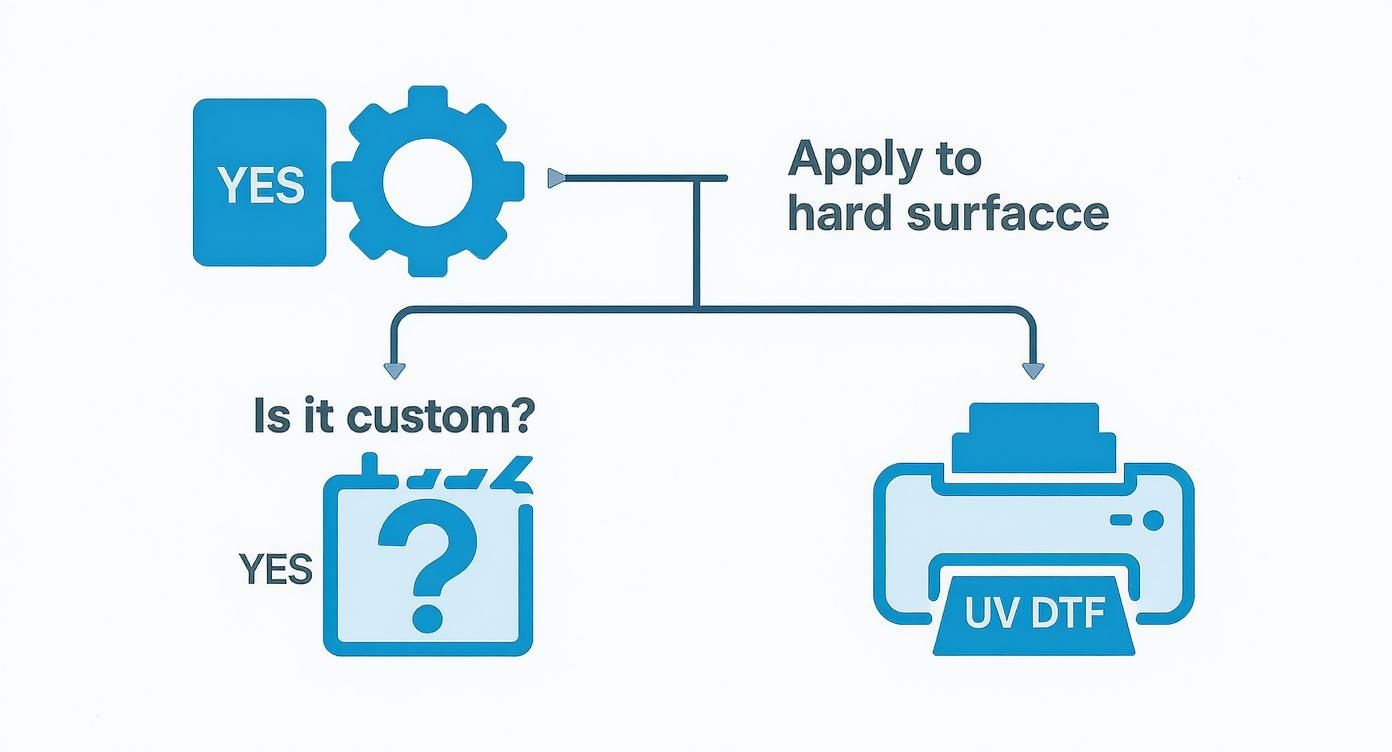
As you can see, when a custom job for a rigid item comes in, UV DTF is often the most direct and efficient route.
UV DTF vs Screen Printing
Screen printing is the heavyweight champion of high-volume production, no question. This traditional method involves pushing ink through a stencil (a screen) onto the item. For massive runs of the same design, it’s incredibly cost-effective and produces seriously durable, vibrant prints.
The catch? The setup is a beast. It’s both time-consuming and expensive. You have to create a separate screen for every single colour in a design, which makes it totally impractical for one-off jobs or full-colour photos. This is where UV DTF has a massive edge. Being a digital process, there's zero setup time for new designs. You can print a single, multi-coloured transfer just as easily as you can print a thousand.
For any business focusing on personalisation, small batches, or on-demand products, UV DTF offers an agility that screen printing just can't compete with. While the methods are very different, you can get a more detailed comparison in our article on DTF vs screen printing for graphic tees.
Key Business Benefits of Adopting UV DTF Technology
Knowing the technical details is one thing, but how does that actually translate into business growth? That’s where the real value lies. Investing in a UV DTF printer in the UK isn’t just about adding another machine to your workshop; it’s about unlocking new revenue streams, simplifying your workflow, and creating a superior product that makes you the go-to choice for customers.
The benefits ripple through your entire operation, directly impacting your bottom line and your position in the market. This technology is what allows you to start saying "yes" to all those tricky, unique jobs that were previously impossible or just not worth the hassle.
Let's break down the core advantages that make UV DTF such a smart move for any UK customisation business.
Expand Your Product Catalogue Instantly
Probably the single biggest win with UV DTF is its incredible versatility. Traditional printing methods often pigeonhole you into specific niches – think textiles for DTG or specially coated mugs for sublimation. UV DTF completely blows those doors open.
Suddenly, you can offer stunning, full-colour customisation on an almost ridiculous range of hard surfaces:
- Drinkware: Think personalised glass tumblers, metal flasks, and ceramic mugs.
- Tech Gear: Custom phone cases, laptop covers, and branded power banks are now easy wins.
- Corporate Gifting: Branded pens, keyrings, and smart acrylic awards become simple to produce.
- Signage and Decor: Small wooden signs, decorative tiles, and personalised plaques are no problem.
Being able to print on almost anything opens up whole new markets. You can stop turning customers away and start becoming a true one-stop shop for personalisation.
Boost Efficiency and Reduce Labour Costs
In any print shop, time is money. UV DTF gives you a huge advantage by getting rid of one of the biggest time-sinks of other methods: pre-treatment. There’s no need to spray on special coatings or primers before application, which slashes your material costs and, more importantly, your labour time.
The workflow is beautifully simple: print, laminate, apply. That’s it. This streamlined "peel and stick" process means one person can get through far more orders in a day, boosting your production capacity without needing to hire more staff.
This efficiency is a game-changer, especially if you're selling online. When you can produce orders this quickly, you can really capitalise on your marketing efforts. Mastering effective PPC strategies for ecommerce can drive a steady stream of customers to your newly expanded product range, and you’ll have the speed to fulfil their orders without breaking a sweat.
Deliver Superior Durability as a Selling Point
In a crowded market, quality is what sets you apart. UV DTF transfers are famous for being incredibly tough. The UV-cured ink creates a resilient, almost plastic-like layer that’s highly resistant to scratches, water, and fading from sunlight. The finished product doesn't just look amazing—it’s built to last.
This durability becomes a powerful selling point. You can confidently charge a premium for your products and build a reputation for quality that keeps customers coming back. This is a key factor for staying competitive in the UK market, where customers expect and appreciate products that last.
Whether you're just starting out or you've been in the game for years, getting to grips with the equipment is vital. To learn more about the hardware itself, our guide on choosing a DTF printing machine is a great place to start. By combining a super-efficient workflow with a premium, long-lasting product, a UV DTF printer gives UK businesses a clear path to growth and diversification.
How to Invest in a UV DTF Printer in the UK
Deciding to bring a UV DTF printer into your UK business is a big move. It's not just another piece of equipment; it's a serious investment in what your company can produce. The first thing most people get stuck on is the cost, which is a lot more than just the initial price tag on the machine.
The market is flooded with options, from small desktop units to massive industrial workhorses, each built for a different scale of production. To make sense of it all, you need to be crystal clear on your budget and where you want your business to go.
Understanding the Initial Investment
The cost of a UV DTF printer in the UK varies wildly depending on its size, speed, and fancy features. The easiest way to get your head around it is to think in tiers.
Here’s a rough guide to what you can expect to pay:
- Entry-Level / Desktop Models: These are your A3 or A4-sized printers, perfect for startups, small craft businesses, or anyone just dipping their toes in the water. Expect to see prices from £2,000 to £5,000. They produce great quality for smaller items but aren't built for speed.
- Mid-Range / Commercial Printers: If you've got a steady stream of orders, a mid-range printer hits that sweet spot between cost and capability. These are typically around 60cm wide and will set you back anywhere from £6,000 to £15,000. You get faster output and a machine that’s built to run all day, every day.
- Industrial-Grade Systems: These are the absolute beasts of the UV DTF world, designed for non-stop, high-volume production. With all the bells and whistles and bulletproof construction, they're a major investment, often starting at £20,000 and climbing fast.
Don't forget the extras. Beyond the printer, you'll need to budget for a powerful PC, specialised RIP (Raster Image Processor) software (which often comes with the printer), and a well-ventilated workspace.
Factoring in Ongoing Operational Costs
That initial purchase price is just the beginning. To figure out if this investment will actually make you money, you have to get real about the ongoing costs of consumables. These are the things you'll be buying over and over again to keep the machine printing.
Your main recurring expenses will be:
- UV Curable Inks: This is a major one. The specialised inks aren't cheap, and a full set can be a significant outlay.
- A and B Films: This is your core printing media. You’ll need a constant supply of both the printable 'A' film and the 'B' transfer film to create your transfers.
- Maintenance Supplies: Think cleaning fluids, swabs, and spare parts like dampers or wipers to keep your printhead happy and healthy.
These consumable costs directly affect how you price your final products and, ultimately, how profitable you are. Finding a reliable UK supplier is absolutely key to keeping these costs under control and avoiding frustrating delays.
Choosing the Right UK Supplier
Buying a complex machine like this isn't like ordering something off Amazon. The relationship you have with your supplier is one of the most important parts of the whole deal. A good UK-based supplier becomes a partner, someone who’s there to help long after they've taken your money.
When you invest in a printer, you're also investing in the support network behind it. UK-based technical support is non-negotiable, as troubleshooting with a team in a different time zone can lead to costly downtime and immense frustration.
Use this checklist when you're sizing up potential suppliers for your UV DTF printer in the UK:
- UK-Based Technical Support: Is their support team actually in the UK? Can you get a real person on the phone during your business hours?
- Warranty and Service Terms: What, exactly, does the warranty cover, and for how long? Read the small print, especially when it comes to critical parts like the printhead.
- On-Site Training: Do they offer proper, hands-on training when they deliver the machine? Good training from the start will save you from making costly mistakes down the line.
- Spare Parts Availability: How quickly can you get spare parts? Waiting weeks for something to be shipped from the other side of the world can bring your entire operation to a grinding halt.
- Showroom or Demos: Can you see the printer running before you commit? A live demo is the best way to judge the real-world quality, speed, and how easy it is to use.
This is just one piece of the puzzle; for a wider look at picking the right kit, our guide on choosing the right t-shirt print machine has some great tips that apply to any print technology.
Getting Your UV DTF Printer Setup and Maintained Like a Pro
Bringing a UV DTF printer into your workspace is a brilliant move, but getting fantastic results over the long haul comes down to more than just the machine itself. Your setup and a rock-solid maintenance routine are what will keep it humming along, preventing expensive downtime and making sure every single print is up to scratch.
Think of your printer less like a one-off purchase and more like a key member of your production team. The time you spend getting it settled in properly will pay you back tenfold.
Creating the Perfect Printing Environment
Before the delivery van even pulls up, you should have a space ready for your new machine. A UV DTF printer is a precision bit of kit, and it really does care about its surroundings. Get this right, and you've already dodged a whole host of common printing headaches.
Here’s what you need to focus on:
- A Dust-Free Zone: Dust is the absolute nemesis of a perfect print. It can get trapped in your transfers, create tiny imperfections, and, worst of all, clog the incredibly delicate nozzles on your printhead. Find a clean room, away from open windows and busy walkways.
- Stable Temperature and Humidity: UV inks and the films they're printed on aren't big fans of sudden changes. You'll want to aim for a consistent room temperature and keep humidity in check. Wild swings can mess with how the ink cures and how well the film adheres.
- Good Ventilation: Let's be honest, the UV curing process can create some fumes and ozone. To keep your workspace safe and comfortable, make sure you've got decent ventilation sorted, whether that's an extractor or a dedicated air filtration system.
A clean, stable, and well-ventilated space isn't just a 'nice-to-have'—it's non-negotiable if you're serious about professional-quality results. Treat your print room like a clean room, and it'll save you a world of pain later.
Staying on top of your printer's health is also smart business. Good maintenance is one of the most direct ways to reduce operational costs and get the best possible return on your investment. It’s the bedrock of a profitable print operation.
Nailing Down a Solid Maintenance Schedule
A little daily care goes an incredibly long way. The quickest route to expensive repairs—especially to the printhead, the very heart of the machine—is neglect. A simple, structured routine is all it takes to keep your printer in peak condition.
Let's break it down into daily, weekly, and monthly jobs.
Daily Checks (Before You Start and After You Finish)
- Nozzle Check: Always run a nozzle check pattern before your first job of the day. It’s a quick way to see if all channels are firing cleanly.
- Wiper and Capping Station Clean: Grab a lint-free swab and some cleaning fluid to gently wipe the rubber wiper blade and the seal on the capping station. This stops ink from drying and causing clogs.
Weekly Tasks
- Manual Head Clean: Give the underside of the printhead and the area around it a more thorough manual clean. Just be sure to follow your manufacturer’s instructions to the letter.
- Ink System Check: Have a quick look at your ink lines for any air bubbles and make sure your cartridges or tanks are topped up.
Monthly Responsibilities
- Software and Firmware Updates: Pop onto your UK supplier’s website and check for any updates for your printer's firmware or RIP software. These often contain crucial bug fixes and performance boosts.
- Grease and Lubrication: As per your printer's manual, apply a little grease or lubricant to any guide rails or moving parts to keep everything running smoothly.
The UK's direct-to-film market is buzzing, and dedicated DTF printers are leading the charge. In 2024, they claimed a huge 45.01% revenue share, showing just how vital this tech is for UK businesses. Keeping this valuable asset in prime condition is simply smart business.
Proper care extends to all your gear, of course. That's why we've also put together a guide on maintaining your heat press machine, as many of the same principles of regular upkeep apply.
Your Top UV DTF Questions Answered
As you start looking into the world of UV DTF, a few questions are bound to pop up. It’s a straightforward process once you get the hang of it, but the technology has its own quirks and capabilities. Here are the answers to some of the most common queries we hear from UK businesses, designed to clear things up and help you decide if it’s the right move for you.
Can I Use My Regular DTF Printer for UV DTF Transfers?
This is probably the number one question we get, and the answer is a firm no. A standard DTF printer for textiles and a UV DTF printer are completely different beasts, built for entirely different jobs, even though they share a name. Think of it like trying to run a diesel car on petrol – they’re both engines, but the mechanics just aren’t compatible.
A regular DTF printer is all about water-based textile inks and a hot-melt adhesive powder. The entire system is built around heat; you need a heat press to cure the ink and stick the transfer onto fabric. There's no UV light involved whatsoever.
A UV DTF printer, on the other hand, is a specialised bit of kit.
- UV-Curable Inks: It uses very specific inks that are chemically designed to harden, or "cure," the instant they're hit with ultraviolet light.
- Built-in UV Lamp: This is the key difference. A powerful UV lamp is built right into the print head. As the ink is printed onto the film, the lamp zaps it immediately, solidifying it on the spot.
- Different Chemistry: The films and glues are also totally different, made for a cold-peel application onto hard, non-porous surfaces.
Trying to put UV DTF films or inks into a standard DTF machine would be a disaster. Without that crucial UV lamp, the ink would never dry, leaving you with a wet, sticky, and completely unusable mess.
What Is the Average Lifespan of a UV DTF Print?
The durability of UV DTF prints is one of their biggest selling points. When you apply them correctly to a clean, properly prepped hard surface, these transfers are incredibly tough. They’re designed to handle the knocks and scrapes of everyday life, making them perfect for items that get a lot of use.
A properly applied UV DTF transfer is highly resistant to:
- Scratches and Abrasion: The cured ink creates a hard, almost plastic-like layer that stands up well to minor scuffs and scrapes.
- Water and Moisture: The prints are completely waterproof, which is why they’re so popular for mugs, tumblers, water bottles, and anything else that needs washing.
- UV Fading: The curing process itself locks the colour pigments in, giving them fantastic resistance to fading from sunlight.
So, how long do they really last? For most things, you can expect a print to stay looking sharp for several years. Obviously, the exact lifespan depends on what the item is and how it’s treated. A logo on a decorative award on a shelf will last longer than one on a phone case that’s in and out of a pocket all day. But for promotional goods, personalised gifts, and branded merch, their longevity is a massive plus.
Are the Materials and Inks Expensive in the UK?
When you’re thinking about getting a UV DTF printer in the UK, you have to look at the whole picture, not just the price tag on the machine. The ongoing cost of consumables like ink and film is what will really shape your profit margins. While the initial investment for a good UV DTF setup can feel steep compared to other methods, the cost per print is often surprisingly competitive.
The true value of UV DTF printing isn’t just about the cost of ink per millilitre. It’s about total operational efficiency. You’re cutting out pre-treatment chemicals and slashing labour time, which saves you real money on every single item you make.
The main costs you’ll need to budget for are the UV-curable inks and the A/B film sets. Finding a reliable UK supplier is absolutely crucial here. A good local partner means you get consistent quality, fair pricing, and you won’t have your production line grinding to a halt waiting for a shipment from overseas. While a litre of UV ink might seem expensive at first glance, its efficient use combined with the premium price you can charge for the finished product usually leads to a very healthy return on investment.
Do I Need Special Software for a UV DTF Printer?
Yes, you definitely do. A UV DTF printer isn’t like your office printer that you can just plug in and start using. It needs a specialised piece of software called a Raster Image Processor (RIP) to work properly. The RIP software is basically the brain of the whole operation, translating your digital design into the precise instructions the printer needs to follow.
This software is vital for a few key reasons:
- Colour Management: It makes sure the colours on your screen are what actually come out in the final print.
- Ink Channel Control: UV DTF printing isn’t just one layer. You often have a colour layer, a white ink base, and sometimes a varnish for a glossy or textured finish. The RIP software manages how all these layers are printed.
- Print Quality Settings: It gives you control over things like resolution (DPI), ink droplet size, and print speed, so you can fine-tune the output for different jobs.
The good news is that almost any UV DTF printer UK suppliers sell will come with a compatible RIP software package. What’s more, a decent supplier will include training on how to use it, so you can hit the ground running and get the most out of your machine from day one.
Ready to bring your unique designs to life on any surface? While owning a printer is a big step, you can start today by outsourcing your printing needs to experts. Psyque offers premium DTF printing services for both textiles and hard goods, ensuring your vision is produced with professional quality every time. Explore our services and see how we can help your brand grow.