
A Guide to Bulk DTF Transfers for UK Businesses
When you hear the term bulk DTF transfers, what should come to mind? In simple terms, it's about buying large quantities of ready-made designs, printed onto a special film, that are all set to be heat-pressed onto just about any fabric you can think of.
For UK businesses that customise textiles, this method is a real game-changer. It delivers vibrant, incredibly durable designs without the hefty costs of other printing methods. Imagine them as professional-grade, super-soft 'stickers' for fabric that actually last.
So, What Exactly Are Bulk DTF Transfers?
Direct to Film (DTF) is a modern printing technique that has taken the UK's custom apparel scene by storm. It's a clever process that sidesteps the limitations of older methods. Instead of printing directly onto a garment or dealing with the painstaking process of weeding vinyl, DTF prints your design onto a specialised film first.
Once printed, this film gets a dusting of a powdered adhesive which is then melted and cured. The result? A perfect, ready-to-apply transfer.
Ordering in bulk simply means you're buying these finished transfers in large volumes, often arriving as big sheets or long rolls packed with your designs. The logic is straightforward: the more you order, the less you pay for each individual print. This economy of scale makes bulk dtf transfers the perfect solution for businesses wanting to ramp up production without investing thousands in their own DTF printing setup.
The Power of Ready-to-Press Designs
The real magic of bulk DTF transfers lies in their sheer efficiency. Forget juggling inks, powders, and curing machines. You receive a roll of transfers that are prepped and ready to go. All you need is a good heat press. This completely streamlines your workflow, saving you a massive amount of time and effort.
Here’s why so many businesses are making the switch:
- Unmatched Versatility: DTF transfers stick beautifully to a massive range of fabrics. We're talking cotton, polyester, blends, and even tricky materials like leather and nylon that other methods struggle with.
- Stunning Print Quality: The process produces full-colour, high-resolution prints with razor-sharp details and brilliant, punchy colours. A white ink layer is printed first, which makes your designs pop, even on the darkest of garments.
- Serious Cost-Efficiency: Buying at scale drastically cuts the cost per transfer. This makes it a highly profitable option for commercial runs of T-shirts, hoodies, workwear, and more. You can learn more about the different kinds of DTF prints in our detailed guide.
This technology gives businesses the power to produce professional-quality apparel with incredible consistency and speed. It effectively removes the steep learning curve and technical headaches of traditional printing, letting you focus on what matters most: your designs and your customers.
The UK market has embraced DTF with open arms. The global DTF printing market was valued at an impressive USD 2.72 billion in 2024, and Europe holds the largest slice of that pie with a 36% market share. This growth is being fuelled by small and medium-sized businesses across the UK looking for a better, more efficient way to create high-quality custom products.
Ready to see how DTF stacks up against the old guard? Let's take a look.
DTF Transfers vs Traditional Methods At a Glance
To really get a feel for why DTF has become so popular, it helps to see how it compares to traditional methods like screen printing and Direct-to-Garment (DTG). Each has its place, but for bulk orders needing versatility and vibrant colour, DTF often comes out on top.
| Feature | Bulk DTF Transfers | Screen Printing | DTG (Direct-to-Garment) |
|---|---|---|---|
| Best For | Full-colour, complex designs on any fabric type. Small to large runs. | Simple designs (1-4 colours) on very large runs (100+ items). | Detailed, full-colour designs on cotton or cotton-blend fabrics. |
| Fabric Versatility | Excellent. Works on cotton, polyester, blends, leather, nylon, and more. | Limited. Best on cotton and poly-blends. Dark fabrics require an underbase. | Limited. Works best on 100% cotton. Polyester requires pre-treatment. |
| Colour & Detail | Unlimited colours and gradients with photographic quality. | Limited colours per design. Each colour adds cost and complexity. | Excellent, full-colour photographic quality. |
| Feel on Garment | Soft, flexible, and lightweight. Sits on top of the fabric. | Can be thicker, especially with multiple colours. Ink soaks into the fabric. | Very soft, as the ink is absorbed directly into the fabric fibres. |
| Setup Cost | None for you. The transfers arrive ready to press. | High. Requires creating a separate screen for each colour in the design. | Low. No screens required, similar to a desktop printer. |
| Cost Per Print | Very low at bulk quantities, making it highly scalable. | Extremely low on very large runs, but expensive for small orders. | Higher than DTF/Screen Printing for bulk, best for one-offs or small runs. |
| Durability | Excellent. Rated for 50+ washes without cracking, peeling, or fading. | Very good. Can last the lifetime of the garment if cured properly. | Good, but can fade over time, especially without proper washing care. |
This table makes it clear: while screen printing is the king of massive, simple-colour runs and DTG is great for one-off cotton prints, bulk DTF offers a unique blend of quality, versatility, and cost-effectiveness that is hard to beat.
How The DTF Printing Process Works
To really get why DTF transfers are such a game-changer for bulk orders, it helps to pull back the curtain on the clever tech that makes them. The journey from a digital file on your screen to a vibrant, ready-to-wear design isn't just one simple step. It's a precise process that blends digital printing with some smart material science.
Think of it less like old-school printing and more like creating a professional-grade, high-tech sticker engineered specifically for fabric. This is exactly how suppliers can churn out thousands of identical, top-quality images for you to press.
Let's walk through the five key stages that make bulk DTF transfers possible.
Stage 1: The Digital Blueprint
It all starts with your design file. Before a single drop of ink is used, your artwork needs to be prepped and ready. This means making sure the file is a high-resolution format—usually a PNG with a transparent background—to get those crisp, clean edges everyone loves. The design is then fed into specialised software that tells the DTF printer exactly where to place every dot of ink.
Stage 2: Printing Onto The Film
This is where the magic begins. A specialised DTF printer doesn't print directly onto your t-shirt. Instead, it prints onto a special PET (polyethylene terephthalate) film. First, it lays down all the colours of your design using cyan, magenta, yellow, and black (CMYK) inks.
Then, straight away, it prints a crucial layer of bright white ink directly over the colours. This white underbase is the secret sauce behind DTF's incredible vibrancy. It acts like a primer on a wall, making sure that your design’s colours pop, whether the final garment is black, white, or bright pink. Without it, colours would just sink into dark fabrics and look dull.
Stage 3: The Adhesive Powder Application
With the ink still wet, the printed film moves on to the next step. Here, it gets a dusting of a fine, granular thermoplastic polyurethane (TPU) adhesive powder. You can think of this powder as a heat-activated glue. It only sticks to the wet ink of your design, and any extra powder is shaken off, leaving a perfect adhesive layer that matches your artwork exactly.
This is the stuff that will eventually fuse the design to the fabric fibres when you apply heat and pressure. It’s a different approach to other customisation methods like iron on clothing decals, which often rely on different types of bonding materials.
Stage 4: Curing And Finishing
Next, the powdered film is sent through a curing oven. This bit of heat does two things: it melts the adhesive powder into a smooth, even sheet that fuses with the ink, and it also cures the ink itself.
What comes out the other side isn't a wet print anymore. It's a solid, flexible, and surprisingly durable transfer, ready to be applied. The finished film is then rolled up, ready to be shipped out as part of a bulk order. If you want to dive deeper into the specific equipment and inks involved, we have more in-depth information on DTF printing in our dedicated guide.
This simple infographic really nails the core journey of a DTF transfer, from the moment you order to the moment it's worn.
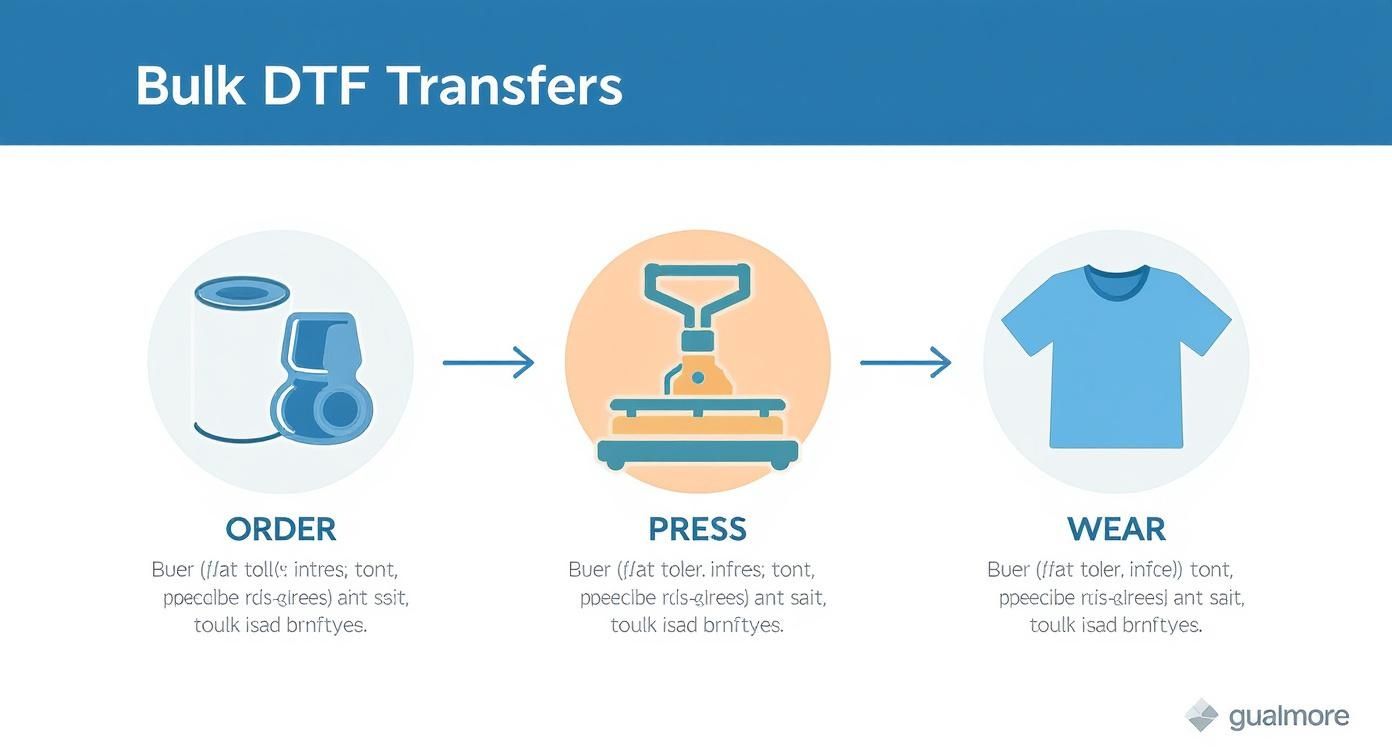
As you can see, the whole point is that all the technical printing work is done before the transfers even land on your doorstep, making your life much easier.
Stage 5: Heat Press Application
The final step is all you. In your own workshop or studio, you simply place the transfer onto the garment, position it just right, and use a heat press. Set to a specific temperature and pressure, the heat reactivates that cured adhesive, letting it melt deep into the fabric's weave for a permanent bond.
After just a few seconds, you peel away the film, and what's left behind is just the ink—vibrant, perfectly bonded, and ready to go.
The Core Benefits of Using Bulk DTF Transfers
Choosing the right way to decorate your apparel is a massive decision for any business. When you invest in bulk DTF transfers, you're not just buying prints; you're adopting a smarter, more flexible, and seriously profitable way of working. The advantages ripple out and touch everything from your product range to your bottom line.
Let’s get into the nitty-gritty of why this technology is such a strategic move for growing UK businesses.
Unmatched Fabric Versatility
One of the real game-changers with DTF is its incredible ability to stick to almost any fabric you can throw at it. This is a huge leg up on methods like DTG, which really prefers 100% cotton, or sublimation, which is strictly for polyester.
With DTF, the creative doors are wide open. You can confidently print on:
- Cotton and Ringspun Cotton: The bread and butter for t-shirts and casual wear.
- Polyester: Perfect for sportswear, team kits, and performance gear.
- Poly-Cotton Blends: The go-to for hoodies, sweatshirts, and trendy fashion pieces.
- Tricky Materials: It even handles fabrics like nylon, leather, and denim that other methods just can't touch.
This versatility means you can say "yes" to more jobs and expand what you offer without needing a workshop full of different machines and inks. A single roll of bulk DTF transfers can decorate an entire collection of diverse apparel.
Superior Durability and Feel
Let's be honest, customers want designs that last. DTF transfers deliver on that promise, often rated for 50+ washes without cracking, peeling, or fading. The ink and adhesive create a bond that’s both strong and flexible, moving with the fabric—a must-have for activewear and clothes that get a lot of wear.
And unlike some old-school transfers that feel thick and plasticky, a well-pressed DTF transfer has a remarkably soft, lightweight feel. It sits smoothly on the garment, so the fabric still feels like it should. This premium finish is something customers really notice and appreciate, which means better reviews and more repeat business for you.
Exceptional Colour Vibrancy on Any Garment
Ever printed a stunning design on a black t-shirt, only for the colours to look dull and washed out? DTF completely solves this with its brilliant white ink underbase. This opaque white layer is printed first, sitting underneath the coloured inks and acting as a perfect primer.
This underbase makes sure your colours—whether they're bright neons or subtle pastels—pop exactly as intended, no matter what colour the garment is. The result is consistently vibrant, high-impact graphics that truly stand out from the crowd.
The Power of Cost-Effective Scaling
This is where ordering in bulk really starts to make sense. The cost per transfer drops significantly when you order larger quantities. This economy of scale gets a massive boost when you use gang sheets—large sheets of film where you arrange multiple designs to use every last square inch of space.
Instead of paying for each logo separately, you’re just paying for the total printed area. By packing your designs efficiently onto one sheet, you can slash your production costs. We've got a full guide on mastering this technique in our article on DTF gang sheets. This approach is absolutely key to boosting your profits on big orders for events, staff uniforms, or your retail stock.
Streamlined Operational Efficiency
Finally, one of the biggest wins is just how simple it makes your operations. When you order bulk DTF transfers, you get a product that is 100% ready to press. All the complicated, messy, and time-consuming stuff—mixing inks, applying powder, curing—is already handled by your supplier.
Your workflow becomes beautifully simple:
- Receive your roll of transfers.
- Cut out the design you need.
- Press it onto the garment with a heat press.
This model saves you a huge amount of time, labour, and the need to invest in expensive printing equipment. It's a much more efficient way to work, which is why so many businesses are seeing the benefits. Understanding how this efficiency feeds into business growth often involves looking at wider strategies to improve profit margins.
How to Prepare Your Artwork for Printing
The journey to a flawless, vibrant finished garment begins long before the heat press is even switched on. It starts right there on your screen, with your digital artwork file. Truth be told, submitting a poorly prepared design is the single biggest reason for printing errors, delays, and just plain disappointing results.
To get the sharp, professional quality you expect from bulk DTF transfers, you have to give the printer a perfect blueprint. Think of it like baking a cake; if you use the wrong ingredients or mess up the measurements, you can't blame the oven when it doesn't turn out right.
This section is your definitive checklist to get your artwork print-ready every single time. Follow these steps, and you'll sidestep the common pitfalls and get the absolute best out of your order.
File Format: The PNG Advantage
When it comes to DTF printing, one file format is king: PNG (Portable Network Graphics). This isn't just a casual preference; it's the industry standard for a crucial reason.
Unlike a JPEG, which always has a solid background, a PNG file supports transparency. This is non-negotiable for DTF. It's what allows your design to have clean, crisp edges without any unwanted white or coloured boxes printed around it. So, rule number one: always save and send your final artwork as a PNG.
Mastering Resolution for Sharp Prints
Resolution is the next critical piece of the puzzle. It’s measured in DPI (Dots Per Inch), which literally means how many tiny dots of ink the printer will lay down in a one-inch line. For a print that looks crisp and professional—not blurry or pixelated—your artwork must be created and saved at 300 DPI.
You can't cheat the system on this one. Taking a low-resolution file (like a 72 DPI image you grabbed from a website) and just stretching it bigger won't work. The result will be a soft, fuzzy print. You must start your design in a 300 DPI canvas to guarantee sharp, high-quality results.
This high resolution ensures every line, curve, and tiny detail in your design is captured with precision, giving you that truly professional finish on the garment.
Understanding Colour Modes
Here's something that trips a lot of people up. Your screen displays colours using an RGB (Red, Green, Blue) model, but DTF printers work with CMYK (Cyan, Magenta, Yellow, Key/Black). Because of this technical difference, some of those super-bright, almost neon colours you see in RGB can look a little different when printed in CMYK.
If your design software allows it, it's always best to design in CMYK from the get-go. This gives you a much more accurate preview of how the final printed colours will actually look. If you want to get into the nitty-gritty, you can learn more about the differences between CMYK vs RGB for print in our detailed guide.
The Secret Weapon: Gang Sheets
Now, let's talk about the single most powerful money-saving tactic for ordering bulk DTF transfers: the gang sheet. A gang sheet is simply a large sheet of transfer film where you arrange, or 'gang up', multiple designs. Instead of paying for each design one by one, you just pay for the total area of the film you use.
This is the key to unlocking serious value. By smartly packing all the designs you need—front logos, sleeve prints, neck tags, and full-size graphics—onto a single sheet, you slash your cost per individual transfer.
Here are a few pro tips for building an effective gang sheet:
- Fill the Space: Think of it like a game of Tetris. Rotate and nest your designs as close together as you can to minimise wasted, empty space on the film.
- Plan Your Quantities: If you need ten small chest logos for every two large back prints, arrange them on the sheet in that exact ratio. This way, you avoid printing transfers you don't actually need.
- Leave a Cutting Margin: While you want to be efficient, make sure you leave a small gap between each design. This makes it easy to cut them apart with scissors before pressing.
Mastering the art of the gang sheet turns a simple prep step into a powerful tool for profitability. It's how you ensure you get the absolute most from every single bulk DTF transfer order.
Finding a UK Supplier and Placing Your Order
You’ve perfected your artwork, and now it’s time for the next big step: choosing the right UK supplier to actually produce your transfers. This isn't a decision to take lightly. A reliable partner is just as critical as your design itself, as their quality, service, and efficiency directly shape your final products and, ultimately, your business’s reputation.
It can feel a bit like navigating a maze at first, but knowing what to look for makes everything much clearer. A trustworthy supplier will be upfront and transparent, giving you all the information you need to make a smart decision without any guesswork.
Vetting Potential UK Suppliers
When you land on a supplier’s website, think of it as a first impression. The best partners make it incredibly easy to find what you need. A clean, professional website is often a good indicator of a well-run operation.
Here are the key things to look for:
- Clear Artwork Guidelines: A reputable supplier will have a dedicated page explaining their exact file requirements. Look for specifics on DPI, file types, and how to build your gang sheets.
- Transparent Pricing: You should find a straightforward pricing structure, usually based on the length of the film you’re ordering (e.g., price per metre). There should be no hidden fees or nasty surprises at checkout.
- Realistic Turnaround Times: They ought to clearly state their production times and shipping options. This is vital for managing your own deadlines and keeping your customers happy.
- Contact Information and Support: Easy-to-find contact details and responsive customer service are a must. You'll be glad you have them if you ever run into a problem or have a quick question.
Once you’ve found a few suppliers that tick all these boxes, you can move forward with confidence.
The Typical Ordering Process
Placing an order for bulk DTF transfers is almost always a smooth digital process. While the exact interface might differ slightly from one supplier to the next, the core steps are pretty consistent across the board.
A good ordering system should feel seamless. The goal is to remove any friction, making it as easy as possible to get from uploading your art to receiving your finished transfers. It should empower you to order with confidence, knowing exactly what you're getting.
Here’s a typical step-by-step breakdown:
- Select Your Product: You’ll usually start by choosing an option like "DTF Gang Sheet" or "Transfers by the Metre".
- Upload Your Artwork: Next, you'll use their online tool to upload your print-ready PNG file. Many suppliers even have a live gang sheet builder that lets you arrange, resize, and duplicate your designs visually.
- Specify the Quantity: Simply enter the total length of film you need, usually in metres. The price will update automatically as you adjust the quantity.
- Review and Confirm: This is your final chance to double-check everything—your artwork layout, the quantity, and the total cost—before adding it to your basket.
- Checkout and Payment: Complete the purchase using your preferred payment method, and you're all set.
If you’re new to this, we’ve got you covered. We offer a complete walkthrough in our guide on how to order DTF prints, which breaks down every single detail.
The UK market has some brilliant suppliers who specialise in professional-grade bulk DTF transfers. Companies like TransferGang and DTF Transfers & Printing Services offer robust online ordering systems where you can upload your custom designs and receive high-quality, ready-to-press sheets. For instance, some suppliers provide next-day shipping for orders placed before noon on a weekday—an absolute lifeline for businesses working to tight deadlines. You can find out more about ordering custom DTF transfers on TransferGang.co.uk.
Still Got Questions About Bulk DTF?
Even after getting the hang of the process, it's completely normal to have a few questions rattling around before you place your first big DTF order. We get it. So, let's clear up some of the most common queries we hear to give you the confidence to dive in.
Here are the straight answers to what people usually ask.
How Do Bulk DTF Transfers Hold Up Against Screen Prints?
This is the big one, and the news is great. Properly applied DTF transfers are incredibly tough, often rated for 50+ washes without cracking, peeling, or fading. In terms of sheer longevity, they're right up there with traditional screen printing, and sometimes they can even outperform it.
The secret is the unique combination of flexible ink and a powerful adhesive that literally bonds with the fabric. It stretches and moves with the garment, which prevents the cracking you sometimes see with older, thicker types of transfers. For the best results, just tell your customers to wash their gear inside-out on a cool cycle and skip the high-heat tumble dryer.
Can I Just Use My Home Iron to Press These?
It might be tempting, but honestly, using a home iron for professional DTF transfers is a recipe for disaster. Getting a perfect, lasting application boils down to three things: consistent temperature, even pressure, and precise timing. A proper heat press is built to nail all three across the entire design, every single time.
A home iron, on the other hand, has hot spots, an uneven surface, and delivers patchy pressure. You’ll almost certainly end up with a print that starts peeling off after its first trip through the wash. Investing in even a basic heat press is non-negotiable if you want to produce professional, sellable products that last.
A quality heat press isn't just a suggestion—it's the crucial final step. It’s what forces the adhesive to fully melt into the fabric’s fibres, creating that permanent, durable finish that makes DTF so good.
What's a Gang Sheet and How Does It Save Me Money?
Think of a 'gang sheet' as your ultimate money-saving tool for bulk DTF transfers. It’s simply a large sheet of the DTF film where you arrange—or 'gang up'—as many different designs as you can fit. Instead of being charged for each individual logo or graphic, you just pay for the total film area you use, usually by the metre.
By cleverly packing everything onto one sheet—your main graphics, smaller sleeve logos, neck tags, you name it—you use every last square inch of film. This approach massively drops your cost per transfer, making it by far the most economical way to get your designs printed in volume. Most UK suppliers have online builders that make creating an efficient gang sheet dead simple.
Do I Really Need a White Ink Layer for White T-Shirts?
Technically, no, you can print on white garments without a white underbase. But if you're aiming for top-tier, professional results, we'd always recommend using one.
Think of the white ink layer as a primer. It lays down a solid, opaque foundation that makes the coloured inks on top appear as bright and vibrant as they do on your screen. Without it, the colours can sink into the fabric fibres a little, looking slightly muted. For prints that truly pop, a white underbase is the way to go, no matter what colour the garment is.
Ready to see your designs come to life with prints that truly stand out? At Psyque - DTF Print & Press, we're experts in producing vivid, durable, and press-ready bulk DTF transfers for businesses all over the UK. Check out what we offer and get your order started today.